Fragile Fascists: How Active Clubs Try to Recruit Insecure Men into Organized Violence
Active Clubs present themselves increasingly as quasi-self-help networks for anxious, frustrated, and socially adrift white men. Their recruitment offer combines fitness, friendship, community, status, and purpose with an ideology of racial hierarchy that rewards aggression. Robert Rundo, the network’s co-founder and main strategist, adds a distinctive element. He presents his own past powerlessness and later transformation through physical strength, violence, and leadership as proof that the Active Club model works. His story connects personal vulnerability with political grievance, status through violence, and militia-like organization.
Key findings
- CEP’s assessment that Active Clubs use sports as a cover for building a militia network is predominantly based on the cumulative messaging of the network’s leadership.
- Rundo personalizes the standard extremist grievance narrative. He presents his younger self as powerless, isolated, and unable to protect his friends. He then portrays violence, prison discipline, physical strength, and white nationalism as the path that transformed him from victim to warrior.
- Active Clubs combine a genuine fitness and community offer with white supremacy, violence as a driver of status, and preparation for organized targeted violence.
- The network uses different messages for two audiences: self-improvement and community for mainstream recruitment, and openly fascist, violence-oriented messaging for right-wing extremists.
- The recruitment strategy, which targets fragile men by promising recognition and belonging through violence, raises the threat profile of Active Clubs.
- Prevention and deradicalization efforts should strongly consider offering credible alternatives that foster a sense of belonging, physical competence, purpose, and male peer support.
| Key terms and scope. In this article, ‘fragility’ refers to perceived humiliation, insecurity, social isolation, status anxiety, and unstable masculine worth. It describes vulnerabilities invoked in recruitment, not a psychiatric diagnosis. Vulnerability alone is not a violence indicator. The concern is how Active Clubs combine it with an extremist ideology, status rewards through violence, and training for organized violence. ‘Powerlessness’ refers to a perceived lack of control, protection, and status. ‘Militant masculinity’ describes the movement’s ideal of physical discipline, racial purity, endurance, obedience, and capacity for targeted violence. |
Rundo as the wounded warrior
Many extremist narratives begin with collective victimhood: the group is threatened, an enemy is responsible, and supporters must join the struggle. Rundo personalizes this familiar extremist sequence of grievance, blame, and restoration. He presents himself as a relatable prototype: a fragile, directionless young man who supposedly achieved status, discipline, brotherhood, and purpose through white-nationalist militancy.
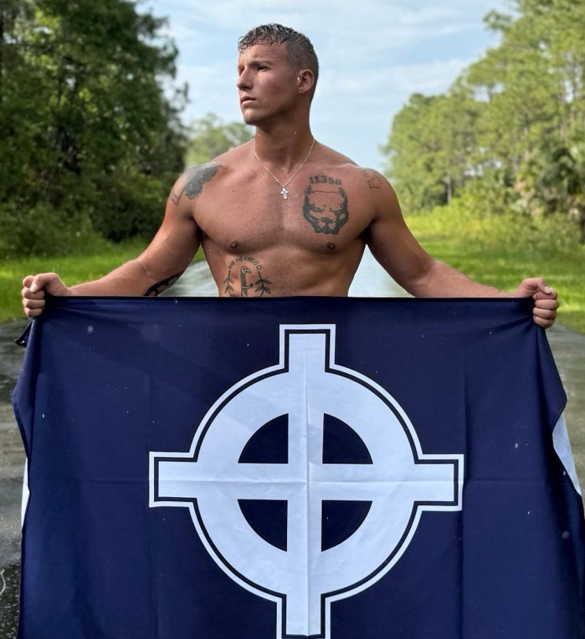
Rundo posing with a version of the Celtic cross, a symbol used by right-wing extremist actors. Substack, April 2026.
In an April 2026 interview, he explicitly said that he created a style directed at a younger version of himself.
“I created a style that, in my mind, always addressed a younger version of myself: a lost self in drugs, trying to find my way as a white boy surrounded by strangers.”
The potential recruit is invited to identify with an individual before fully adopting the movement’s racial and political ideology. The implied message is: I experienced the condition you recognize; the movement remade me; it can remake you. Research on radicalization and significance restoration, narrative persuasion, and identity leadership provides several reasons why this presentation may increase identification, engagement, and perceived authenticity. These studies do not measure Active Club recruitment outcomes.
The same pattern predates his recent podcasts. CEP documented how Rundo and Denis Kapustin, a mentor of Rundo, used stories about fist fights, knife fights, street gangs, and football hooliganism to present the necessity, glory, and fun of brutal violence as a route to manhood and brotherhood. Violence is therefore more than an abstract future risk in the movement's culture. It is narrated as a desirable experience, masculine proof, and a qualification to lead. Rundo´s curated life story appears to be designed to justify and promote violence as a form of self-therapy and empowerment.
Violence as authenticity and authority
The transformation Rundo advertises does not end with emotional stability or physical fitness. In a July 2026 Active Club podcast, he presented adolescent knife violence as evidence that he was a legitimate leader:
“When I was 17, I held down a guy from MS-13. I held him down to the ground, and I [expletive censored in the original] stabbed the [expletive censored in the original] out of him. Who else has done that? Who else evaded the FBI for years?” Rundo, Substack, July 2026
In the same podcast, Rundo dismissed young activists interested mainly in podcasts and online content. He contrasted them by presenting real-world violence and personal risk as sources of authenticity and authority.
Rundo applies the same interpretation to political street violence. In an August 2026 recording, he described the 2017 violent confrontations in Berkeley, California, as “epic,” celebrated another group member stomping an opponent, and called it a great day. Rundo was sentenced to two years in federal prison for his participation.
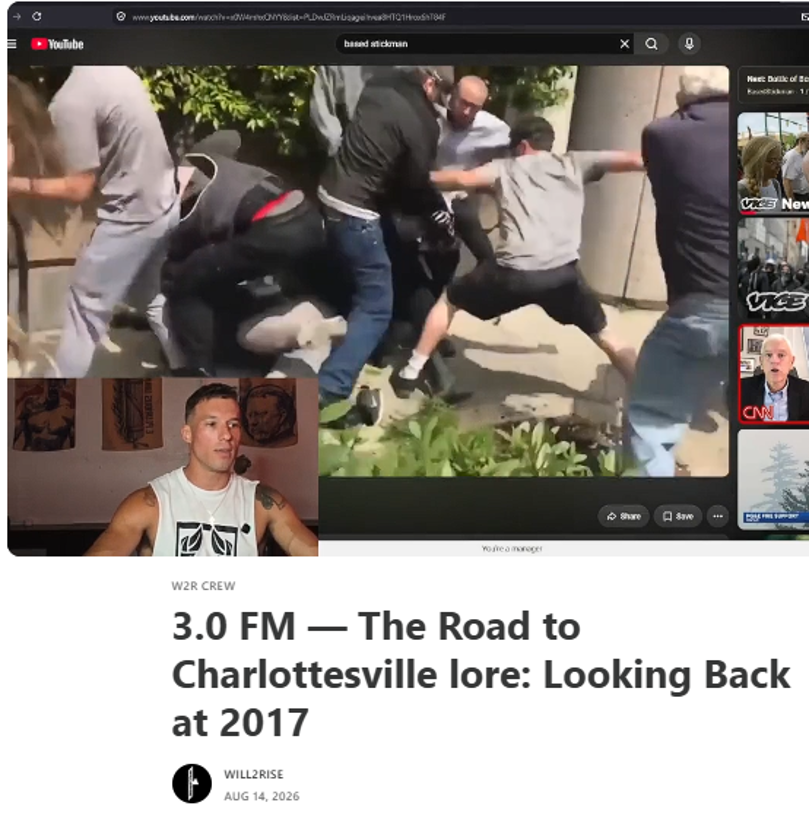
Rundo glorifying the 2017 Berkeley violence. Substack, August 14, 2026.
A safe space for white men
The network generalizes Rundo’s personal story into a status-upgrade offer. An August 2026 post from the main Active Club profile claims that young white men are being destroyed by drugs, suicide, and broken families. Active Clubs supposedly prevent them from becoming broken, isolated, or lone shooters by helping them stop drinking and using drugs, train, develop friendships and community, start businesses, and meet partners. The claimed outcomes remain unverified movement self-reporting. The message is nevertheless clear: the movement sees the recruit’s weakness as an asset, claims it can repair him, and will make the repaired man useful in a larger racial struggle.
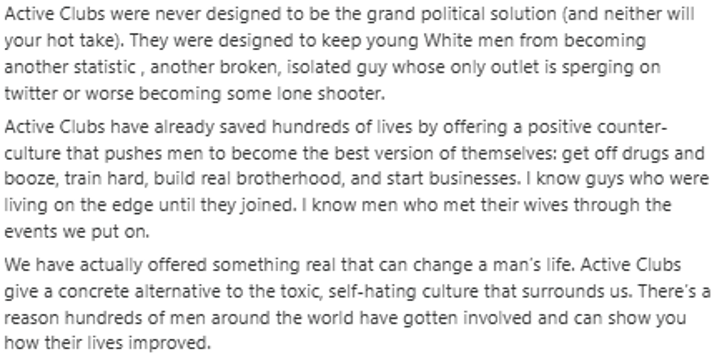
Will2Rise/Active Club profile. Substack, August 6, 2026.
In 2023, the founder of the French Active Clubs described targeting men who are alone and want to belong as a priority. In a podcast from 2021, the Russian violent right-wing extremist Dennis Kapustin (Nikitin), whom Rundo calls a mentor, tells Rundo that nationalist youth in Russia lacked their own MMA clubs and tournaments, while combat-sports tournaments were “completely dominated by Muslims.” He presents his White Rex strategy as a response: an alternative martial arts network built around strength, unity, brotherhood, and racial nationalism. In other words: a safe space for white men. This continuity suggests a deliberate recruitment model.
From personal grievance to violent mobilization
Active Club recruitment appears to combine three mechanisms: first, the (self-)selection of men already attracted to aggression or risk; second, the redirection of diffuse personal grievance towards political enemies; and third, the reinforcement of violent attitudes through peer recognition, discipline, and status upgrades.
Research on radicalization supports distinguishing personal grievance, ideological narratives, and group networks as related but separate components. These factors can reinforce one another. The evidence shows that Active Clubs try to combine them. More research is needed to understand how they affect individual recruits.
The muscular body as a promise of security and status
Fitness also offers visible and predictable progress. Training can produce greater strength, skill, and confidence at a time when work, housing, and social status may feel harder to control. This makes physical training a credible entry point for men who feel powerless in other areas of their lives.
Active Club channels repeatedly display photos and videos of posing, flexing, sparring, and muscular bodies as an aspirational future self. A recruit is invited to imagine becoming disciplined, respected, protected, and capable. The images also establish a hierarchy: strength, mobility, and self-control are elevated above bodies portrayed as soft, passive, old, or ordinary. Young, fit bodies symbolize movement renewal; gym and mixed martial arts training produce a body that is visually attractive and functionally prepared for violence.
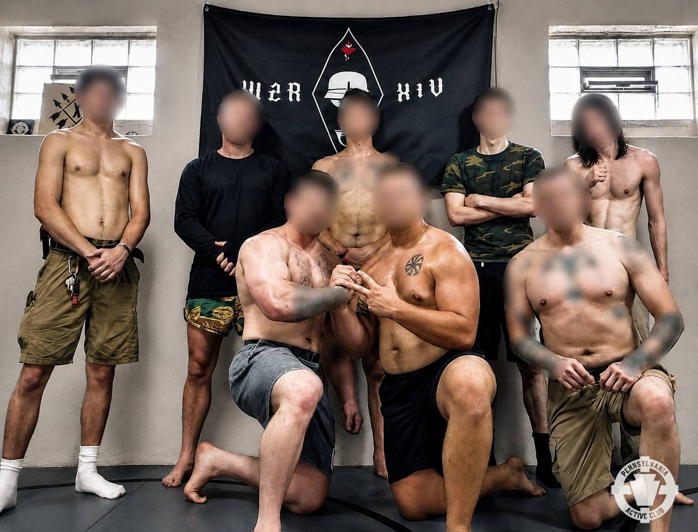
Active Club Pennsylvania, Telegram, July 2026.
| The dual-audience messaging strategy. The Active Club network uses mainstream aesthetics, sports, brotherhood, heritage, and community-building to attract members and to reduce scrutiny by law enforcement. At the same time, in communications directed towards violent extreme-right milieus, the network repeatedly invokes Nazi Germany´s SA, the SS, and the Italian Fascist Blackshirts, and places itself in the tradition of these militant formations. Active Clubs should therefore not be understood as a mere extreme-right combat-sports network. |
From ‘isolated rage’ to a cohesive legion
A February 2026 Active Club article described the nationalist scene as ‘forged in iron and sweat’ and its path as ‘body, mind, tribe.’ It celebrated pulling men out of online isolation and ‘turning isolated rage into a cohesive legion.’ The same text was moved directly to the Italian fascist Blackshirts as a vanguard, calling for men to forge the legion and answer with thunder.
“Organizing in the shadows: meetups that turn into crews, active clubs drilling discipline, educating each other on the 3.0 path—body, mind, tribe. No more doom-scrolling in the glow of screens, no more petty keyboard wars over who’s the purer fascist. Activist culture bridged that gap. It yanked guys out of the digital sewer, slapped them awake, got them shaping up, lifting, reading, sparring, building. Turning isolated rage into a cohesive legion.
This is the turning. The nationalists aren’t asking permission anymore. They’re taking the field. From the cathedrals of old Europe to the concrete jungles of American cities, the black shirts rise again, not as cosplay, but as the vanguard. Quentin’s name echoes in every chant, every march. Honor him by becoming what he fought for: men who train, who act, who forge the legion. The streets are calling. Answer with thunder.” Active Club/Will2Rise, Substack, February 15, 2026.
The network also contrasts Active Clubs with accelerationist SIEGE culture, Terrorgram, and Atomwaffen-linked milieus associated with nihilism, isolation, and lone-actor violence. Its proposed alternative concerns social form and strategy. The white-supremacist objective, fascist aesthetics, and preparation of capable activists remain central. Active Club members are portrayed as fit guys at the gym (who can fly under the radar if needed), compared to what is portrayed as deviant, overweight, or scrawny SIEGE culture adherents with firearms in the woods. The objective is to replace the accelerationist online death cult with a white militant male community based on durable loyalty, discipline, and collective capacity.
Extending the model to teenagers
United Youth, a transnational white-supremacist youth network associated with Active Clubs and Patriot Front, moves the pitch toward teenagers. It describes a pro-social fraternal fitness network for young white men while telling them that the surrounding world does not care about them. Youth propaganda has also placed the imagined fate of white people on their shoulders. Adult and youth channels repost one another, and joint offline training has been documented. Direct adult control remains unclear, but the shared vulnerability-to-duty script and practical overlap make teenagers a priority audience for prevention.
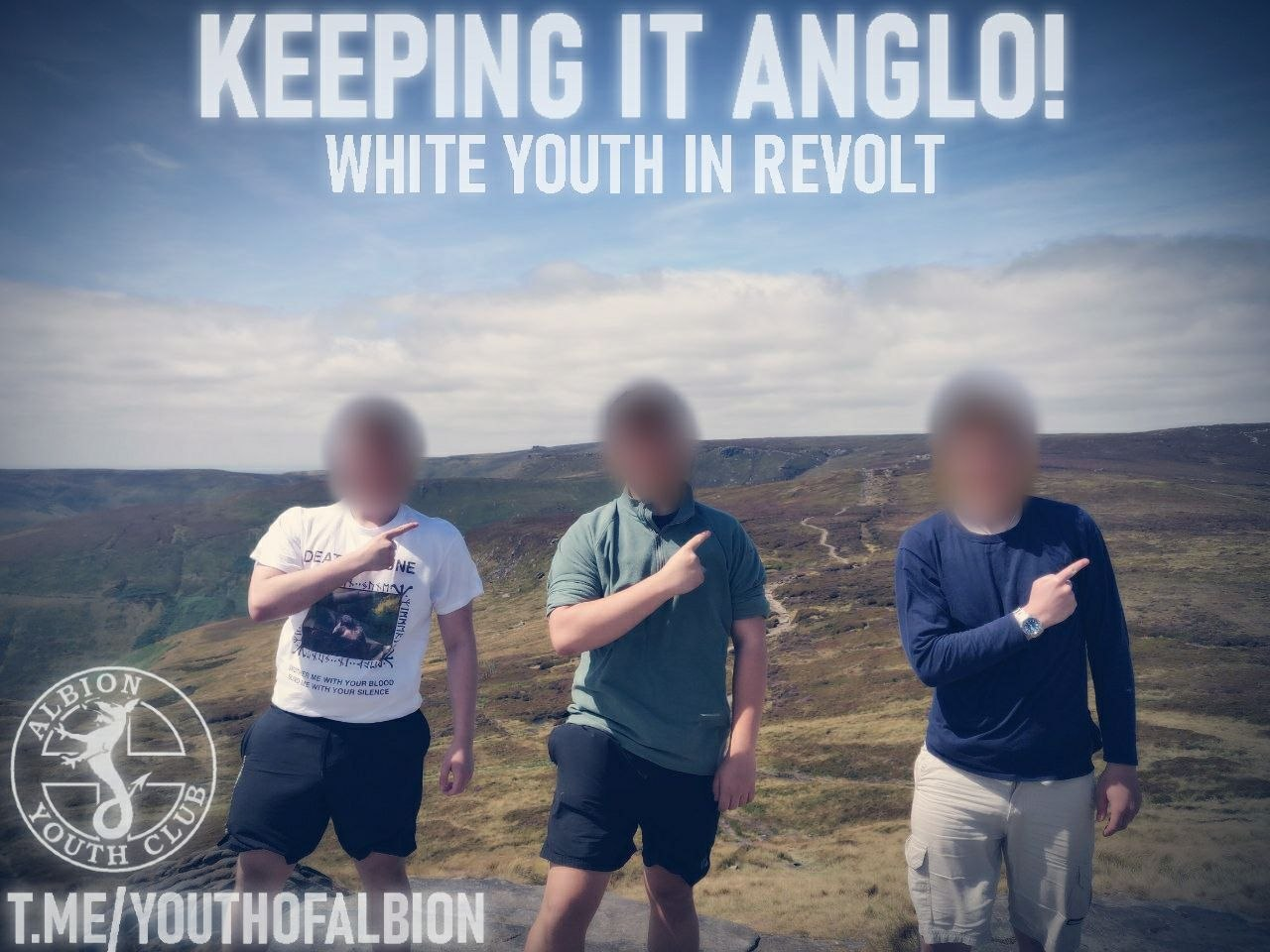 | 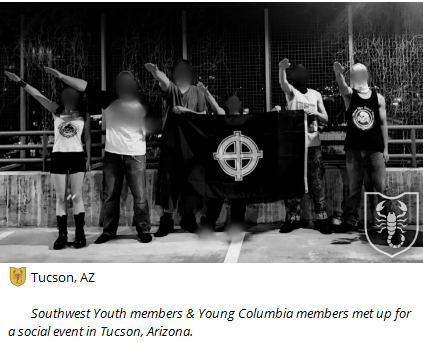 |
Albion Youth Club, Telegram, June 2026. | Southwest Youth and Young Columbia members, Telegram, August 2026. |
Building a militia on male vulnerabilities
CEP's assessment that Active Clubs use sports as a cover for building a militia network is predominantly based on the cumulative messaging of the network’s leadership. Rundo compared autonomous local Active Clubs to the Minutemen militia: separate bands in different states acting in conjunction as a form of “leaderless resistance.” He said local activism like illegal banner drops and graffiti teaches coordination, planning, leadership, following rules and directions, and moving men safely in and out of places. When a future mass white movement or leader arrives, he argued, Active Clubs will provide an experienced nationwide militant support.
Another recent Active Club post states that the Active Club model is based on European football hooligan firms and CasaPound, and defines real power as the ability to summon capable men within 30 minutes. These are not interchangeable organizations, but the admired functions are consistent: local loyalty, disciplined men, rapid assembly, street control, and a cadre prepared to act.
Rundo has also compared Active Clubs to the Arditi, Italian stormtrooper units of World War I, whose military mythology contributed to the identity of Mussolini’s Blackshirts.
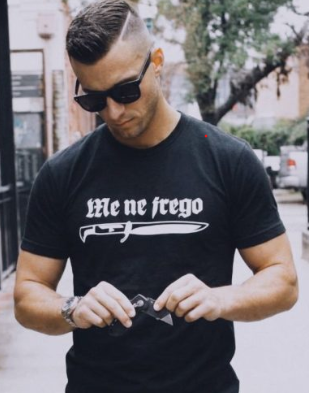
Active Club merchandise invoking the Arditi and Blackshirt slogan “Me ne frego” (“I don´t give a damn”) and a stylized Hitler Youth knife. Will2Rise, 2026.
CEP also documented Heartland Active Club members at tactical firearms training and an Arizona chapter conducting tactical-casualty training. Active Club material has instructed readers on operational security in the context of the Belfast riots in June 2026, advising on how to avoid identification by law enforcement while carrying out targeted violence.
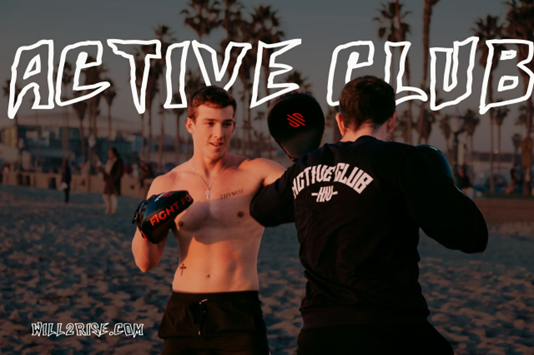 | 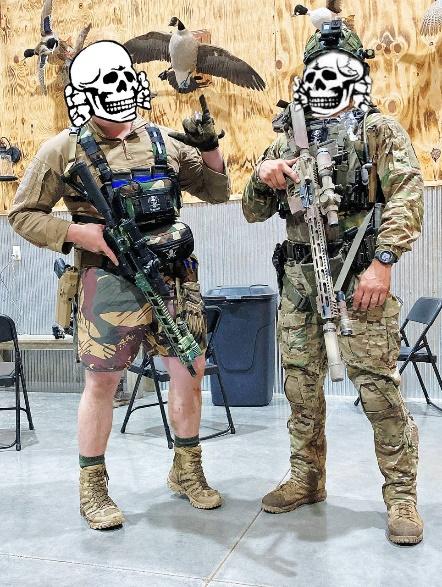 |
Active Club mainstream propaganda, Telegram, 2022. | Heartland Active Club during tactical firearms training, Telegram, May 2023, showing SS skulls. |
Preparing for violence while denying intent. On March 15, 2026, the Active Club official Substack profile claimed that they are not training for violent confrontation: “Effective self-defense and proficiency in hand-to-hand fighting is not the aim of Active Clubs, but it’s a useful side-effect that develops naturally within individuals and clubs’ sans intention; therefore, not premeditative and not engineered toward the initiation of racial or religious violence regardless of what some individuals post.” |
Analysis and recommendations
The evidence shows a common approach. Active Clubs target men who feel powerless, isolated, or without direction. They offer fitness, belonging, purpose, and status, then direct personal grievances toward racial and political enemies. Physical strength and action are presented as proof of personal change. Violence becomes a source of authenticity and status. The network also promotes discipline and seeks to build groups that can be mobilized for targeted violence. Local chapters differ in their commitment, capabilities, and readiness to act.
Rundo adds a distinctive element: recruitment through his own life story. He presents his former weakness as something potential recruits can recognize. His physical transformation, violent history, and leadership role then serve as proof that the movement’s approach works. In his story, powerlessness becomes racial grievance, self-improvement becomes ideological commitment, and violence proves that he has regained strength, status, and the right to lead. Each new club and follower can be presented as further evidence that his personal transformation has become a model for the wider network.
Prevention and deradicalization efforts should strongly consider offering credible alternatives that foster a sense of belonging, physical competence, purpose, and male peer support. Comparative research should assess the effectiveness of previous or existing deradicalization programs with a strong (combat) sports angle. Interviews with former members could help inform the project design.
Further recommendations for preventing and disrupting the Active Club network are available in CEP’s March 2026 policy brief: Return of the Leader.
CEP Sources and further reading
- CEP, From Fight Clubs to Fascist Towns: The Blueprint for an Active Club Counter-Society, August 2, 2026
- CEP, The Girls Will Follow? The Active Club’s Answer to the ‘Woman Question,’ June 28, 2026
- CEP, Extreme-Right Active Clubs Are Treating the Riots in Belfast as a Case Study in Effective Violent Mobilization, June 13, 2026
- CEP, Return of the Leader: Robert Rundo’s Impact on the Violent Extreme-Right Active Club Network, March 2026
- CEP, Don’t Get Fooled: The Extreme-Right Active Club Network Is Not About Combat Sports, 2024
- CEP, Hiding in Plain Sight: The Transnational Right-Wing Extremist Active Club Network, September 22, 2023
- CEP podcast, Riots and Women: How the Active Club Strategy Is Evolving
- CEP podcast, Return of the Leader: Robert Rundo’s Impact on the Violent Extreme-Right Active Club Network
Stay up to date on our latest news.
Get the latest news on extremism and counter-extremism delivered to your inbox.