The Girls Will Follow? The Active Club's Answer to the “Woman Question”
The emergence of the first all-female white nationalist youth club in early May 2026 within the wider Active Club network in the U.S. coincides with Robert Rundo’s recent remarks on the “woman question.” Rundo is a co-founder and chief propagandist of the transnational violent extreme-right Active Club network. The network uses a deceptive mainstreaming strategy: Publicly, they present themselves as being only about sports and white nationalism. Communications towards violent extreme-right milieus, however, have a clear fascist militia framing. Active Clubs often reference historical paramilitary formations such as the Italian Fascist Blackshirts or German National Socialist Brownshirts / SA. In June 2026, the network also elaborated on how to effectively conduct organized street violence while mitigating the risk of criminal prosecution.
On 27 June 2026, one of the networks` main propaganda channels celebrated Young Columbia as the first all-female Youth Club in the Active Club affiliated United Youth network. The post says the all-female Youth Club emerged from Active Club aesthetics, culture, and real-world examples, but that the Active Club leadership was not aware of Young Columbia’s existence until it was brought to their attention. The central claim is that “if you build it, make it clean, attractive and unapologetic, they (women) will come.” It also states that the Active Club Network has “always been a strictly male-focused network and will continue to be so,” but that female clubs are “necessary” for the parallel society objective. Women should not be “relegated only to nurturing tasks. We expect to see Young Columbia and future female Youth Clubs training together; putting up stickers, posters, and banners; and using graffiti to lay claim to territory.”
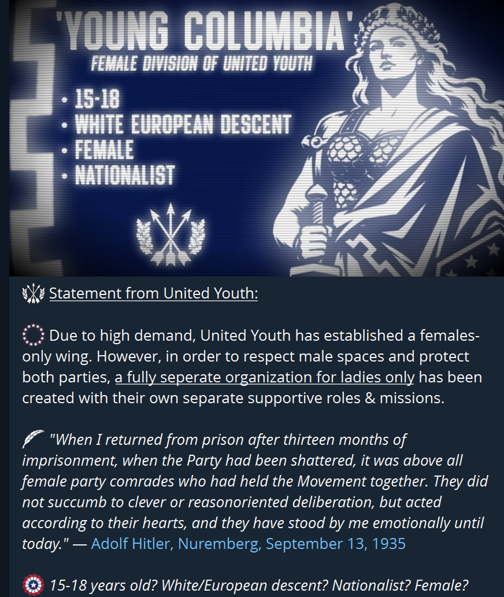
Telegram, Young Columbia channel, May 10, 2026
This message is a continuation of the Active Club strategy identified in CEP’s 2023 “Hiding in Plain Sight” report, which found that women played no visible role in U.S. Active Clubs. They were absent from most public photos, videos, statements, and discussions. CEP also showed that this absence was not universal. In 2023, Active Club Canada had a separate women’s group focused on spouses, girlfriends, children, outdoor activities, and community building. In France and Germany, Active Clubs publicly describe their objective as training young men and women and include women in their propaganda imagery.
The recent Young Columbia female-only channel appears to consolidate those earlier exceptions into an explicit argument: the movement remains male-focused, but a durable “parallel society” needs women. This is consistent with the Active Club's strategic messaging on moving from spectacle to infrastructure.
Rundo: Extreme-Right Groups Alienate Women
In a June 2026 podcast, Rundo gives the clearest account of the “women question”. His central premise is that attracting women is “absolutely” desirable because the movement needs “the other half.” He rejects softening the ideological message. Instead, he argues for changing presentation, aesthetics, social environment, and male conduct.
Rundo’s first point is a critical self-description of the milieu. He describes his earlier environment as shaped by neo-Nazi skinhead culture with openly violent messaging such as “kill them all,” “shoot them,” and “hang them.” He says that when he tried to persuade a girlfriend by showing videos of white people being attacked and reacting with rage, it “disturbed her” but “changed zero opinion.” In his account, violent shock material, racialized crime imagery, conspiracy talk, and heavy ideological lectures do not attract women. They alienate them.
This criticism is tactical, not ethical. Rundo is not rejecting racism, violence, or extremist ideology. He is arguing that crude hatred, antisocial presentation, and graphic violence are bad recruitment methods. He also says women who join extreme-right groups do not want to be harassed, filmed, attacked, or placed in confrontational street settings. In his words, the movement is “not there yet” in offering women safety.

"Young Columbia member enjoying nature during a meet-up", Substack, June 27, 2026
“Girls Just Wanna' Have Fun In Fascism”
His alternative is an inward-focused message. He points to European examples such as Generation Identity, CasaPound, and White Rex. What mattered to him was a shift from hatred of enemies to “this is about us” and “bettering us.” He emphasizes beauty, culture, physical improvement, unity, music, events, and visual normality. He claims that women are “aesthetic-based” and that “everything is aesthetic for them.”
Essentially, Rundo urges right-wing extremists to stop alienating and scaring white women. This reflects a broader strategic aspect already described by Rundo: the movement should appear normal, attractive, social, and fun, while minimizing overtly threatening behavior to avoid attracting attention from law enforcement.
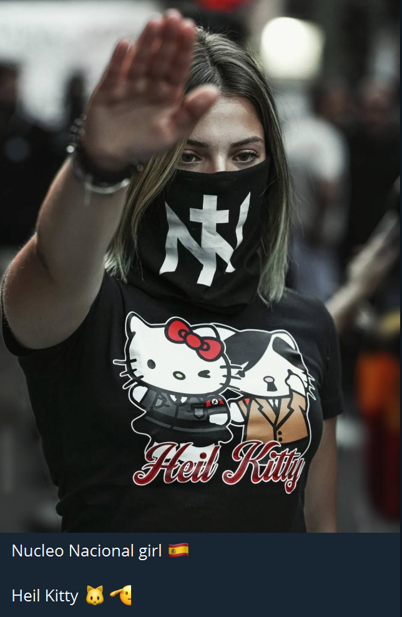
Image shared by Columbia Youth Telegram channel, June 2, 2026
Protect, Provide, and Play
Rundo reduces his strategy for recruiting women to three elements: “protect, provide, and play.” Protection means women should feel safe around men in the extreme-right movement and within movement spaces. Provision means the movement should look materially viable: women should see jobs, work, and social infrastructure rather than marginality or dependence on donations. Play means fun. He argues that men in the scene are often too serious and that women “just want to have fun.” The Italian neo-fascist CasaPound group is his model because it offers “concerts, beer pong, dining nights, and events”. In his formula, if the movement can “protect, provide, and play,” then “the girls will follow.”
Specifically for Active Clubs, this logic connects to lifestyle recruitment. Rundo claims that Active Clubs did not spread because of a manifesto or formal rules. They spread because they offered a lifestyle: aesthetic pictures, hype videos, branded clothing, music, training, and a broader countercultural concept. In Rundo’s view, the strategy for recruiting women should use the same approach.
Analysis and Recommendations
Women’s groups within extremist milieus are not new. Historically, male-dominated movements have often built parallel women’s structures to support recruitment, ideology, family formation, welfare, propaganda, and social control. The Women of the Ku Klux Klan, the National Socialist Women’s League, and the League of German Girls show that rigidly patriarchal or paramilitary movements can exclude women from the militant core while still relying on them for movement-building, indoctrination, and community expansion. Contemporary research on women in extremism reaches a similar conclusion: women may function as organizers, recruiters, influencers, propagandists, partners, mothers, activists, or auxiliary-network builders. In this context, Young Columbia is less a novelty than a contemporary adaptation of a familiar pattern: a male-centered militant milieu experimenting with female-facing structures to increase legitimacy, continuity, and social reach.
The new all-female youth group within the Active Club-affiliated network does not indicate a broad change in strategy or direction. CEP’s 2026 “Return of the Leader” policy brief found that Rundo’s post-prison-release messaging treats youth clubs as strategically important. Rundo framed youth clubs as vehicles for recruiting younger men, building a counterculture, and adapting propaganda to youth-facing platforms. He also mentioned a quote by Adolf Hitler: “whoever captures the youth, captures the future”. Female youth clubs, therefore, should not be treated as a marginal add-on. They are part of a broader effort to build continuity across age cohorts and social roles.
For preventing and countering violent extremism (P/CVE), the most relevant question is a functional one: what role does female visibility play in recruitment, normalization, social infrastructure, youth outreach, and long-term resilience within the wider Active Club network? Young Columbia, the French and German mixed-gender messaging, and Rundo’s own “three Ps” strategy all point in the same direction. Active Clubs are attempting to create an extremist parallel counter-society, without compromising the male-only militia strategy.
In addition to investigations into criminal acts associated with extremist (youth) groups, P/CVE policymakers should consider creating specialized cross-agency youth-safeguarding task forces because extremist youth recruitment often presents first as a safeguarding problem rather than a violent extremism or terrorism case. Minors may be drawn in through sports, hiking, youth clubs, online aesthetics, music, identity content, or peer belonging before they are exposed to violence-oriented ideology, adult organizers, illegal activism, or weapons-related environments. A child-protection approach allows authorities to act on concrete risk factors: adult contact with minors, unsupervised closed-group activity, coercive relationships, grooming, exploitation, harassment, and exposure to violence. Such a cross-agency task force can apply targeted administrative measures or initiate criminal proceedings if risks for youth have been identified.
 | 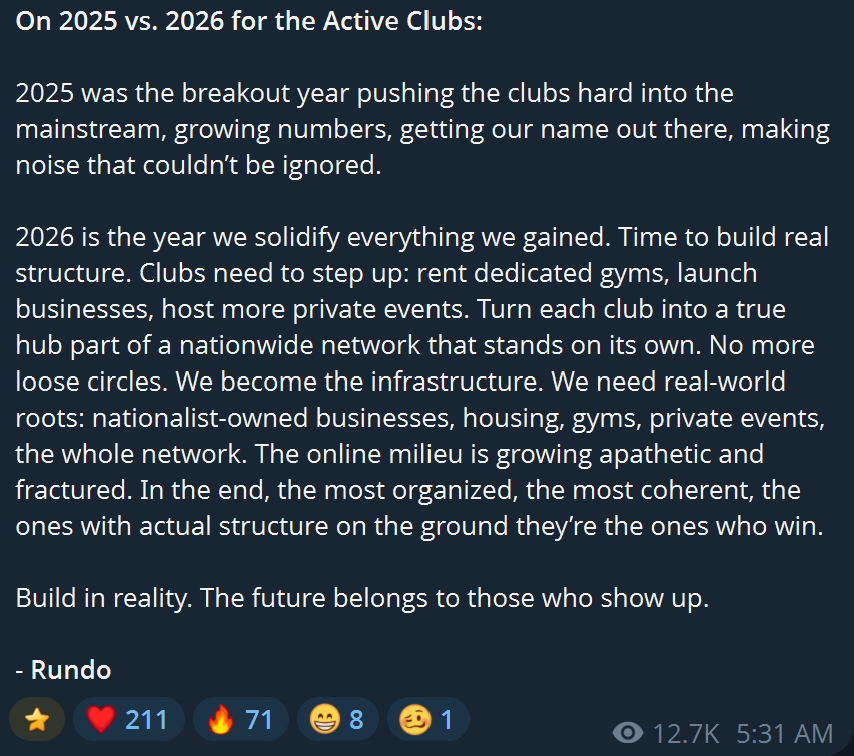 |
Telegram, January 1, 2026
Stay up to date on our latest news.
Get the latest news on extremism and counter-extremism delivered to your inbox.