Extreme-Right Active Clubs are Treating the Riots in Belfast as a Case Study in Effective Violent Mobilization
Knife attacks conducted by refugees or citizens with a recent immigration background in England and Northern Ireland have been followed by anti-immigration and extreme-right street violence. Two recent articles by the violent extreme-right Active Club´s main propaganda channel use the Belfast riots and the Southampton unrest as case studies for extreme-right street violence.
The first article draws operational lessons from Belfast, Northern Ireland, praising tighter group discipline, operational security (OPSEC), and reduced exposure to prosecution; the second provides the ideological justification, framing violent disorder as a necessary response to immigration, policing, and the political system. Taken together, the texts show how the Active Club-adjacent ecosystem turns knife attacks and subsequent riots into propaganda, tactical learning, and arguments for building parallel local structures.
Resources on Active Clubs: CEP policy paper / Active Club Network profile
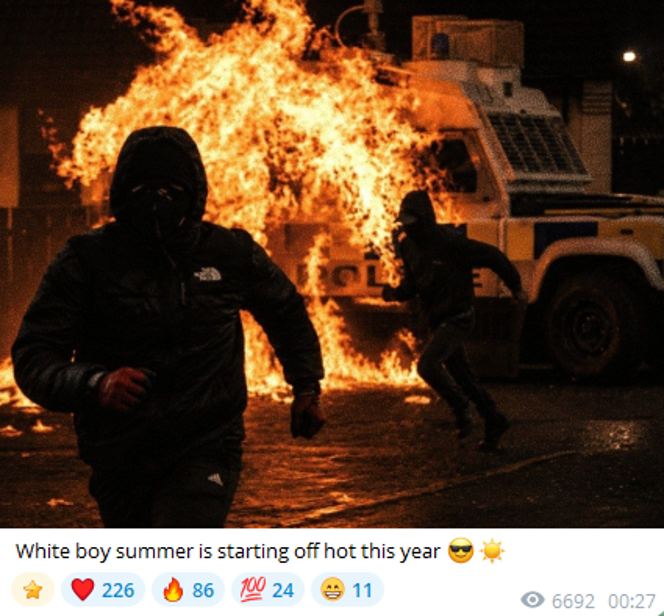
Telegram, June 10, 2026
On June 10, 2026, the violent extreme-right Active Club´s main propaganda channel published a Substack article on OPSEC, using the Belfast riots as a case study in extreme-right violent street mobilization. In the article, they contrast violent Irish Loyalists in Belfast with a high level of OPSEC with what they portray as weaker and more exposed protests in England, where several protesters got arrested and sentenced to prison. The piece argues that disciplined groups can exploit public disorder to control the street environment and reduce the risk of subsequent identification and prosecution.
The two-faced propaganda strategy
This article is best understood as advice on how the Active Club network can eat its cake and have it, too: Simultaneously training members for street violence while preserving the public-facing claim that Active Clubs are merely about white nationalism and sports. The piece shows how the Active Club ecosystem approaches public disorder and violence: not as problems to avoid but as opportunities to build capability while preserving deniability. Its core message is not about protest safety but about how to participate in violent street action while reducing the risk of being identified, arrested, or prosecuted.
This two-faced approach closely fits the Active Club strategy, which uses a dual-track approach. Publicly, Active Clubs present themselves as harmless nationalist sports and self-improvement groups. Communication towards violent extreme-right milieus, however, is a clear militia framing. Active Clubs frequently, explicitly, and prominently reference Nazi Germany’s Hitler Youth, SA, and SS, as well as Italian Fascist Blackshirts, as historical role models.
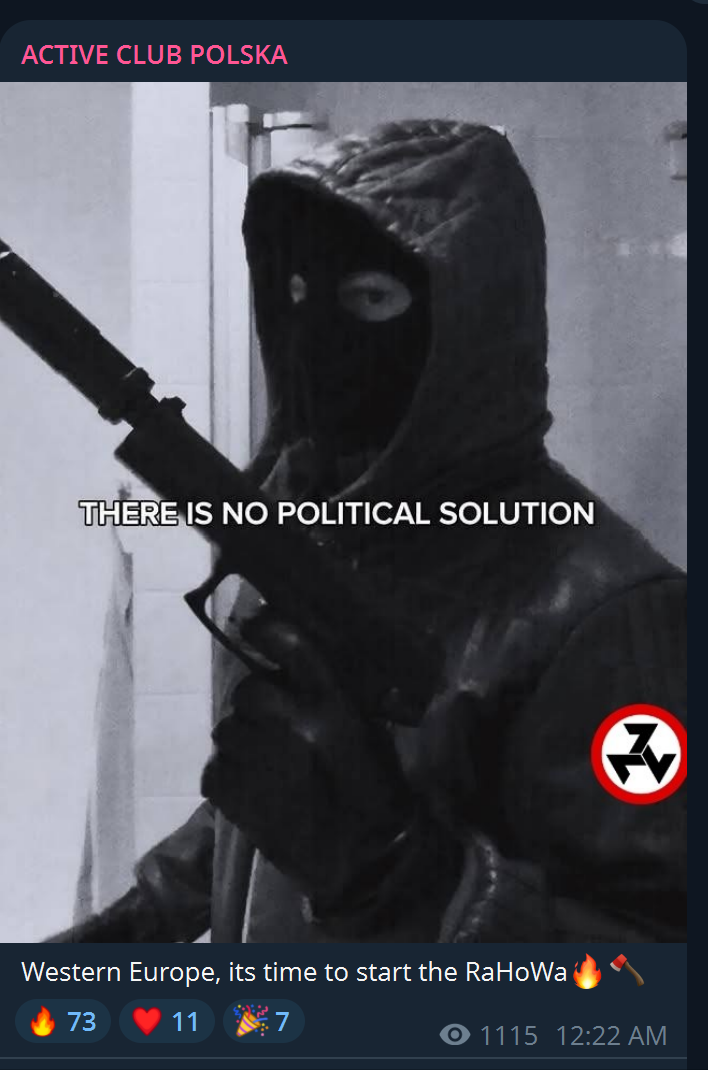
Telegram, June 3, 2026 (RaHoWa-Racial Holy War)
How to build a capable militia in plain sight
The central question for the network is how to build a militia while pretending to be just about heritage and sports. MMA training and closed tournaments alone do not create the capabilities of a militia. A militia needs to train how groups move under pressure, how they behave during rioting, how they contest control of a street environment, and how they avoid accountability by the authorities. Riots and violent demonstrations can function as real-world training grounds for exactly those capabilities.
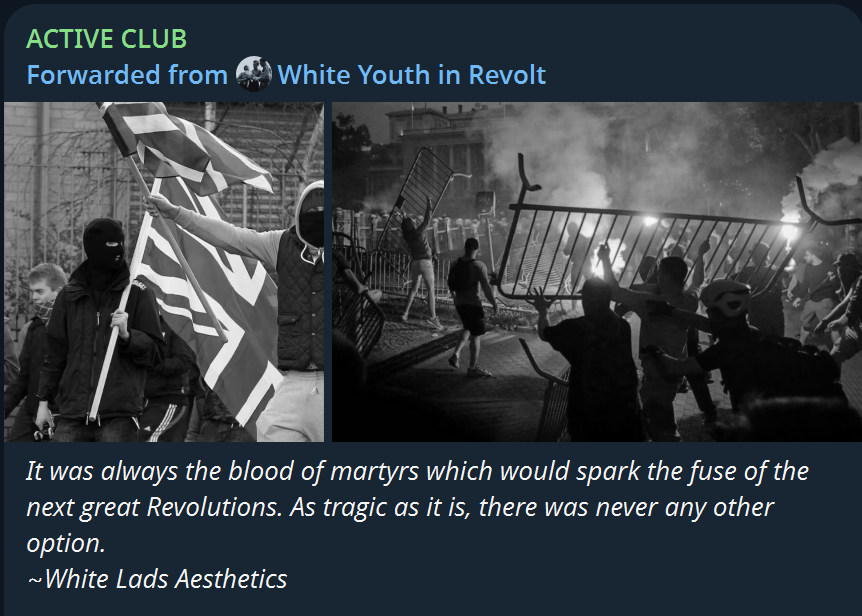
Telegram, June 10, 2026
The article praises practices that make violent street mobilization harder to document, police, and prosecute. This is why the piece’s disclaimer that it is merely “educational” is unpersuasive.
“Prison is a small price to pay for effective resistance.”
A second article, published on June 11, 2026, adds the justificatory layer to the OPSEC article and frames violent attacks and rioting as necessary, legitimate, and politically useful. It therefore strengthens the assessment that the Active Clubs' main propaganda channel is not merely commenting on Belfast and Southampton, but converting these events into movement doctrine. It moves from tactics to political justification. The second text explains how the network believes such confrontation is justified: the state, police, mainstream politicians, journalists, migrants, and even victims’ families are all framed as part of an “anti-white” system.
1. It legitimizes the Belfast riots as a defensive action.
The article does not treat attacks on migrant housing or street disorder as criminal violence. He reframes them as community protection or forced self-help after the alleged failure of the state. This is central: violence is not denied, but morally reclassified.
2. It attacks de-escalation by victims’ families.
The article explicitly questions the calls for calm from the families of stabbing victims. This is important because it seeks to remove one of the main restraints on escalation: the moral authority of victims’ relatives asking people not to use the case for violence.
3. It casts legal consequences as acceptable or even useful.
The OPSEC article was about avoiding arrest and prosecution. This article adds a different layer: some activists, it argues, may be willing to go to prison if this is seen as the cost of “effective resistance.” That shifts the message from pure OPSEC to a martyrdom/risk-acceptance frame.
4. It links riots to the Active Club infrastructure strategy.
The final section is the most relevant for the Active Club issue. It argues that political victory is unlikely and that the movement must build a “Plan B”: local roots, community protection, material assistance to selected families, support for the elderly, and parallel education. This matches CEP’s assessment that the post-2025 Active Club strategy increasingly emphasizes infrastructure, community embedding, and “lay low, build quietly, harden your community.”
5. It reinforces the “shadow militia” logic.
CEP’s previous assessment is that Active Clubs use mainstream fitness and self-defense aesthetics to hide in plain sight while building violence-ready local networks. This article adds the political-social ecosystem around that strategy: not only training men, but building communities that distrust police, reject official narratives, and create parallel structures.
6. It creates a bridge between street violence and a parallel society.
The article’s message is not only “riot better.” It is: use riots to reveal the alleged failure of multiculturalism, then build local extreme-right alternatives that can provide protection, social support, and ideological education.
Recommendations on how to counter the Active Club Strategy: CEP policy paper
Stay up to date on our latest news.
Get the latest news on extremism and counter-extremism delivered to your inbox.