From Fight Clubs to Fascist Towns: The Blueprint for an Active Club Counter-Society
A new strategy for fascist Aryan towns goes beyond living separately in a whites-only community. Within the wider Active Club doctrine, such towns or enclaves would provide the social and logistical base for a network that portrays whites as under attack and prepares white men for targeted violence.
The transnational violent extreme-right Active Club network has recently issued strategic guidance in several formats. In June 2026, they treated the Belfast riots as a case study in disciplined violent mobilization: tighter groups, stronger operational security, reduced exposure to identification, and acceptance that prison can be the cost of “effective resistance.” The same messaging linked street violence to a longer-term “Plan B” of local protection, material assistance, and parallel education.
Later that month, Robert Rundo, their co-founder and main propagandist, addressed the “woman question.” White women were presented as necessary for a durable parallel society, even while the Active Club’s militant core remained male. His strategy to attract women is “protect, provide, and play”: make movement spaces safer and more attractive to women, show jobs and functioning social infrastructure, and offer music, events, and fun.
Rundo’s new podcast from July 28, 2026, “Build a Parallel Society by Your Bootstraps,” brings these strands together. It is his most detailed explanation so far of how an Active Club should grow from a small training group into a local economic, residential, cultural, and political power base.
“We gotta beat around the bush. You gotta make it, oh no, it's just a heritage American community. It's not a super giga-chad, esoteric, Aryan Hyperborean community where we all get together and Sieg Heil and read (Julius) Evola and things like this and wear SS uniforms. No, that's not what it is. It is just for heritage Americans that want to be around other heritage Americans. That's all it is.” - Robert Rundo, “Episode 3—Build a Parallel Society by Your Bootstraps,” Will2Rise, July 28, 2026, 00:08:27, edited for clarity.
The Active Club network follows a dual-audience deception strategy. It uses mainstream aesthetics, sports, brotherhood, heritage, and community-building to attract members and to reduce scrutiny by law enforcement. At the same time, in communications directed towards violent extreme-right milieus, the network repeatedly invokes Nazi Germany´s SA, the SS, and the Italian Fascist Blackshirts, and places itself in the tradition of these militant formations. The two messages serve different audiences: mainstream cover for outsiders, fascist militant messaging for insiders. Active Clubs should therefore not be understood as merely an extreme-right combat-sports network.
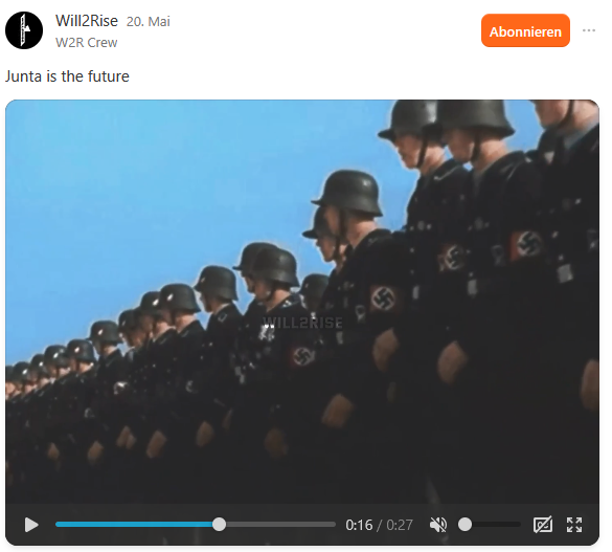
Active Club (Will2Rise) propaganda and recruitment video featuring Nazi Germany’s SS, SA, and Hitler Youth, as well as Adolf Hitler, Benito Mussolini, and the Italian Fascist Blackshirts, May 20, 2026.
“Heritage community” outside, Aryan community inside
Rundo praises “heritage communities” and “heritage American” as smart movement language, referencing recent reporting about whites-only settlements in the United States. He says that many men in his milieu would prefer to describe the project openly as an Aryan community where members salute Hitler, read Julius Evola, and wear SS uniforms. He does not reject that imagined community. He says it would be strategically ineffective to describe it openly.
His instruction is direct: “choose your words carefully” and “beat around the bush.” Publicly, it should be described as a place where heritage Americans live among other heritage Americans.
Previous Active Club communication explicitly links its recent call to “Build a Parallel Society by Your Bootstraps” to a “fascist cultural revolution”. Read alongside Rundo’s instruction to code the message, “parallel society” likely functions as a deceptive public label for a counter-society intended to entrench the network and challenge the existing democratic order.
From spectacle to structure
CEP’s March 2026 policy brief “Return of the Leader” identified a shift in Rundo’s messaging from short-lived propaganda to permanent infrastructure. His formula can be summarized as “lay low, build quietly, harden your community”. He urged clubs to rent dedicated gyms, launch businesses, create housing, and hold private events.
The new podcast adds a practical sequence. Rundo explains how he thinks a counter-society could be built, one local club at a time. He also identifies social and organizational models he wants the network to copy by pointing to Williamsburg in Brooklyn, New York City, and Austin, Texas.
“You got to realize that the left got to where they are today by not saying the obvious. They got to where they are today by coding everything. … We gotta do the same thing. You gotta choose your words carefully. We gotta beat around the bush.” - Rundo, 00:08:14
In his account, culturally aligned left-wing newcomers opened coffee shops, bookstores, barber shops, and bars, found one another without explicit signs, formed dense social networks, and eventually acquired political influence. The Active Club equivalent, he says, should begin with a gym or pool hall.
He then cites Korean immigrant networks as a model for mutual assistance: newcomers receive housing and work, live together, pool income, buy property, and bring in others. The lesson he draws is clear: employment, housing, and ownership bind people to a movement more effectively than podcasts or occasional activism.
He also points to ideologically marked spaces in Europe: CasaPound and associated venues in Rome; Greek villages that he associates with Golden Dawn; and parts of Athens’ Exarchia district as an anarchist or militant-left counterexample. He is interested in places where a dominant political subculture becomes embedded in venues, walls, symbols, businesses, and everyday social life.
The fascist town blueprint
Rundo’s sequence begins with approximately ten reliable Active Club members. They meet in parks, train together, and rent a cheap industrial unit with a roll-up door. The private gym becomes the headquarters for combat-sports training, socialization, planning, and business development.
The club then starts a low-entry service business. His examples include moving companies, vehicle detailing, trades, and repair work. The aim extends beyond fundraising. Members work together daily, earn their livelihood through the network, and become less likely to leave.
Next, members move closer to the headquarters. They share apartments, reduce personal expenses, sleep on floors if necessary, and pool money. Rundo presents comfort and individual privacy as obstacles to collective power.
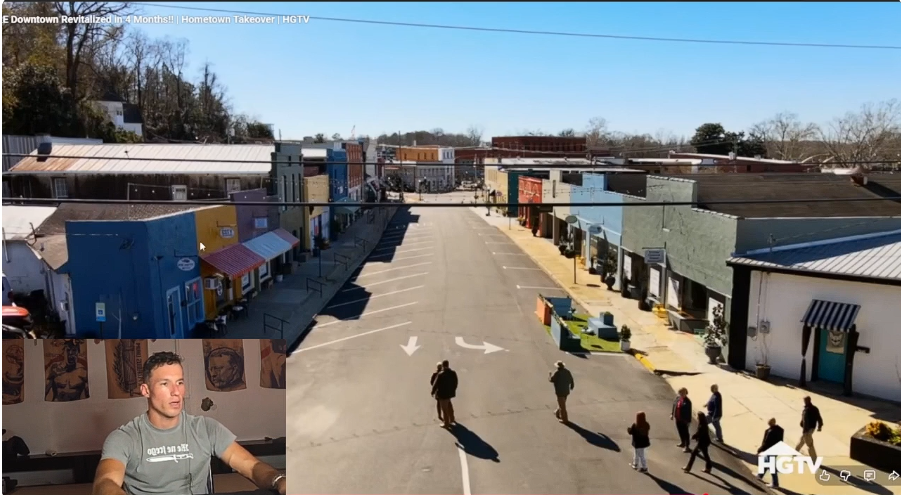
Rundo uses a “Home Town Takeover” TV show as a template for fascist towns. 1:02:43
The pooled income is used to buy property. Housing allows more members to relocate into the area. Ownership reduces dependence on landlords and gives the group a permanent local stake.
After establishing the labor-intensive “breadwinner” business, the network opens a public-facing venue: a bar, barber shop, restaurant, or public gym. It should carry no obvious extremist sign. It remains open to outsiders, while people “who know” recognize it as a movement space. It can also be closed for private gatherings.
“Now you look around, you got 10 guys with you. Well, these aren't just 10 guys to train with. These are 10 guys you can employ. You can start a business. Now I know multiple guys that have done this. The guys in California have done this. They started a moving company off this. He hires only guys from the club. They have a full moving company. They even expanded. They got like 3 trucks now, right? You start with that.” - Rundo, 00:39:51
Rundo rejects an isolated rural compound. He recommends a declining small town close enough to a city for customers, employment, transport, and recruitment. Members can earn money in the city and invest it in cheaper local property.
The next stage is public legitimacy. Members clean streets, renovate buildings, open attractive businesses, and present themselves as disciplined community builders. Rundo’s stated goal is to embed the network so deeply that removing it would damage the wider town.
He advises against immediately displaying polarizing symbols. The town should look “heritage American” before outsiders understand the ideological project.
Finally, concentration should become political influence. Rundo imagines organized members attending school-board meetings and becoming a decisive local bloc. Multiple towns and club headquarters would then form a national network offering work, training, accommodation, business knowledge, and mutual assistance.
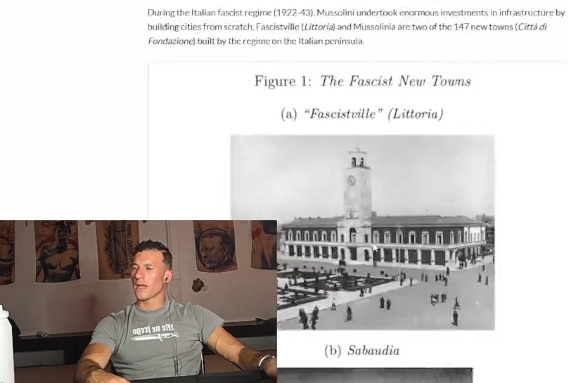
“God, I love this stuff.” Rundo expresses admiration for architecture from Fascist Italy (1922–1943), including “Fascistville”. He is wearing a T-shirt bearing Me ne frego (“I don’t give a damn”), a slogan closely associated with Italian Fascism, and a stylized depiction of the Hitler Youth knife. 1:10:04
Analysis
The strategy for fascist Aryan towns goes beyond living separately in a whites-only community. Within the wider Active Club doctrine, such towns or enclaves would provide the social and logistical base for a network that portrays whites as under attack and prepares white men for violence. CEP’s 2023 Hiding in Plain Sight report assessed the Active Club strategy as an effort to build decentralized stand-by militias that could be mobilized for coordinated violence on a larger scale in a future “Day X” scenario.
Rundo’s deceptive “heritage” town framing is designed to create a respectable public-facing cover for a fascist counter-society. A gym, business, shared house, pub, and school-board presence are meant to reinforce one another. They would create recruits, money, loyalty, space, legitimacy, and local power. The new fascist Aryan towns would combine the Active Club strategy, racial exclusion, coded public messaging, movement employment and housing, and territorial control, for a network that openly invokes fascist militias and violence-readiness.
“Young guys join the scene. What do you want to do? I don't know, podcast, make content, Christ almighty. We can't all just be content makers. I do it because my content is unique and special. Also, when I was 17, I held down a guy from MS-13. I held him down to the ground, and I [expletive censored in the original] stabbed the [expletive censored in the original] out of him. Who else has done that? Who else evaded the FBI for years?” Rundo, 01:08:02
Rundo’s new podcast does not establish that every Active Club is or will be implementing this model. It does show, however, why the threat should be assessed through an accumulated capacity framework. Durable venues, income, housing, recruitment networks, and local influence could make Active Clubs more resilient to disruption, broaden the pool of violence-ready members, and reduce the practical barriers to coordinated action when the network believes the time is right.
For policymakers and law enforcement, the practical implication is to look beyond social-media propaganda and isolated sports activities. Further recommendations for preventing and disrupting the Active Club strategy are available in CEP’s March 2026 policy brief, Return of the Leader.
Sources and further reading
- Active Club (Will2Rise), Robert Rundo, Episode 3 - Build a parallel society by your bootstraps (Substack)
- Russell Contreras, “The Rise of Whites-Only ‘Heritage Communities,’” Axios, July 21, 2026.
- CEP, Return of the Leader – Robert Rundo’s Impact on the Violent Extreme-Right Active Club Network, March 2026.
- CEP, Extreme-Right Active Clubs are Treating the Riots in Belfast as a Case Study in Effective Violent Mobilization, June 13, 2026.
- CEP, The Girls Will Follow? The Active Club’s Answer to the “Woman Question”, June 28, 2026.
- CEP, Don´t get fooled - The extreme-right Active Club network is not about combat sports, 2024.
- CEP, Hiding in Plain Sight – The Transnational Right-Wing Extremist Active Club Network, September 22, 2023.
CEP podcast episodes on Active Clubs
Riots and Women: How the Active Club Strategy is Evolving | Counter Extremism Project
Stay up to date on our latest news.
Get the latest news on extremism and counter-extremism delivered to your inbox.