Europe’s Violent Extreme Left — Part 2: Germany’s Current Violent Extreme-Left Threat Landscape
This article is part 2 in a series examining the contemporary state of left-wing political violence in Europe. Part 1 discussed the 42.7% increase in police-recorded violent left-wing offenses in Germany in 2025. This article uses a different lens. It looks at how the Federal Office for the Protection of the Constitution (BfV), Germany’s domestic intelligence service, defines the threat landscape and how it could develop through 2026. The upcoming part 3 will focus on the transnational dimension of Europe’s violent extreme left.
Key Findings
German domestic intelligence assessments describe a heterogeneous threat environment rather than a centrally directed movement. The most consequential elements are small networks and clandestine cells capable of converting broad political mobilization into targeted assaults or disruptive sabotage. Decentralized organization complicates attribution and disruption, while common causes and transnational contacts can otherwise separate extremist milieus.
Upcoming state elections in Germany in September 2026 increase the risk of attacks against political parties, candidates, campaign events, and public representatives, particularly those associated with the right-wing populist/extremist party Alternative für Deutschland (AfD).
- The BfV estimated that Germany had 42,200 left-wing extremists in 2025, including 11,600 classified as violence-oriented. This category includes actors who commit or prepare violence as well as those who support, endorse, or encourage it.
- The disruption of the transnational, violent Antifa Ost network reduced the threat posed by this specific network. Its operational model remains reproducible. Small, trusted groups can conduct reconnaissance, train for attacks, allocate roles, store equipment, and coordinate violence without establishing a formal organization.
- Infrastructure sabotage offers the clearest opportunity for small clandestine groups to produce consequences far beyond the immediate target. Electricity, railways, telecommunications, logistics, construction, defense-related companies, and industrial infrastructure remain plausible targets.
- Antifascism, anti-capitalism, climate activism, antimilitarism, and pro-Palestinian extremism create overlapping mobilization environments. Official reporting documents cooperation among parts of the violence-oriented extreme left, secular pro-Palestinian extremists, and Islamist or foreign left-wing extremist organizations.
Four threat scenarios emerge from the available evidence. These are election-related intimidation and confrontation, the formation of targeted-violence networks, high-impact infrastructure sabotage, and cross-issue or transnational capability convergence. The final pathway involves foreign conflicts, militant networks, and possible skills transfer.
Relevant concepts and definitions Germany´s militant democracy Germany’s Constitution was written after the failure of the Weimar Republic and the crimes of National Socialism. Its designers concluded that a democracy must be able to defend its essential rules before its opponents destroy them. This is the idea of a militant or defiant democracy. The state may protect the core constitutional order, but it remains bound by law, judicial review, and fundamental rights. This is the basis of Germany’s constitutional-protection system, including the domestic intelligence agencies (Verfassungsschutzämter). What the Verfassungsschutz can and cannot do Germany has one federal and 16 state constitutional-protection authorities (one in each federal state). The BfV is the federal domestic intelligence service. It collects information, analyzes threats, and informs the government and the public. It is not a police force or a prosecution service. It cannot arrest people, bring charges, or direct police operations. The legal separation between police and intelligence services is a central postwar safeguard. In August 2026, the Federal Cabinet approved a BfV reform that combines constitutionally required safeguards with proposed expansions of its technical and operational powers, though parliamentary debate may still amend the bill. Left-wing extremism The BfV defines left-wing extremists as actors who seek to abolish Germany’s existing constitutional order and want to replace it with a communist or an anarchist system. What “violence-oriented” means This Verfassungsschutz category is broader than “violent.” It covers people or groups assessed as violent, prepared to use violence, supportive of violence, or approving of violence. The term is used across all forms of extremism. The category is not a count of convicted offenders or suspected attackers but rather a risk indicator.
Criticism of classification and reporting Some academic and civil-society publications have repeatedly questioned the transparency, consistency, and breadth of the underlying Verfassungsschutz classification practices. Since 2020, one final court judgment has overturned the inclusion of an organization as a left-wing extremist in a state Verfassungsschutz report. No successful judgments overturning a designation of a left-wing extremist organization as “violence-oriented” have been identified. |
The status quo of left-wing extremism in Germany in 2025
The BfV estimated that there were 42,200 left-wing extremists in Germany in 2025. Within that total, 11,600 were violence-oriented. Violence-oriented left-wing extremists view criminal acts and violence as a legitimate part of their “antifascist struggle.” All figures are rounded intelligence estimates.
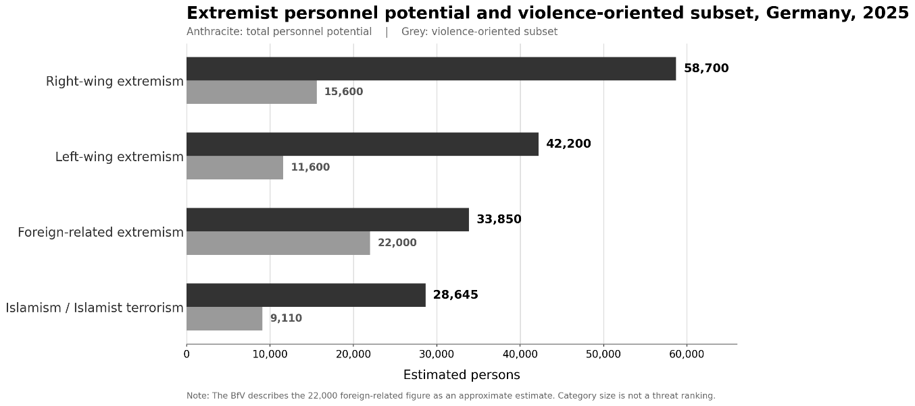
Figure 1. Estimated extremist personnel potential in Germany, 2025. These are rounded intelligence estimates, not counts of identified offenders.
A note on statistics Police statistics record suspected crimes, while intelligence reports additionally assess extremist intent, networks, mobilization, and capabilities. Germany therefore publishes two related but different figures for left-wing violence. Police statistics count all violent offenses classified as Politically Motivated Crime–left (PMK-left), regardless of whether the underlying motivation is assessed as extremist. The BfV applies a narrower threshold and reports only cases assessed as having a left-wing extremist background. Thus, in 2025 police recorded 1,087 violent PMK-left offenses, while the BfV classified 856 of these as left-wing extremist violent offenses. The two figures therefore describe overlapping populations of offenses, with the BfV figure representing the narrower extremist subset. According to the BfV, the number of crimes motivated by left-wing extremism rose by 38.9% in 2025 to 8,133 offenses. The increase is even more pronounced among violent crimes, which went up 60.9% to 856 offenses. In particular, violence against actual or perceived right-wing extremists and against the police increased significantly. |
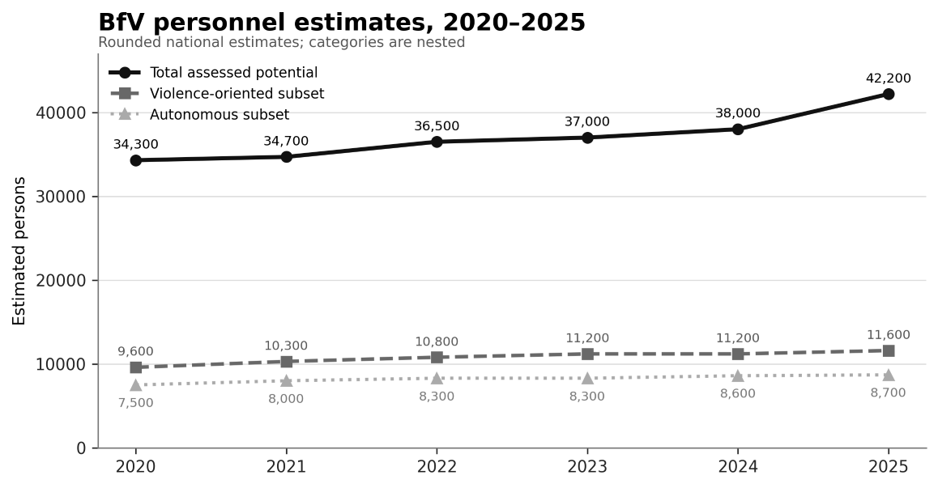
Figure 2. BfV annual extremist personnel estimates. The figures are rounded and describe assessed extremist potential, not offenders. The categories must be read as nested. The 8,700 autonomous activists are part of the 11,600 violence-oriented estimate. That estimate is part of the 42,200 total.
Antifa Ost The Antifa Ost complex refers to a transnational violent left-wing network that courts have found to constitute a criminal organization. The network organized planned attacks against people whom it classified as part of the right-wing scene. Its methods included target reconnaissance, defined roles, prepared weapons, and coordinated ambushes. Court decisions have imposed prison sentences from two years and five months to five years and three months. A further five-year sentence linked to the Budapest attacks has been issued but was not final at the time of the decision. Proceedings against further alleged members and supporters in Germany and Hungary remain ongoing. |
The 2025 BfV report identifies several qualitative changes. It considers Antifa Ost dismantled and describes the resulting reduction in the network’s threat potential as a significant turning point in militant antifascism. Yet the BfV expects militant antifascism to remain important. It links continuing perceived pressure to act against the right-wing populist/extremist party Alternative für Deutschland (AfD), their electoral gains, high polling figures, and a perceived societal shift to the right. The report also highlights infrastructure attacks that can cause widespread disruption.
How violence serves strategy
For the most militant actors, violence serves a political purpose. The BfV reports that violence-oriented left-wing extremists regard criminal acts and violence as legitimate components of their “antifascist struggle.” Their understanding of fascism extends beyond organized neo-Nazism. It can include people and institutions associated with the democratic state and market economy, which they interpret as structures of capitalist exploitation and oppression.
This worldview broadens the range of potential targets. The BfV documents attacks and threats directed against party officials, individual AfD members, police officers, companies, landlords, tenants, and other private individuals. Responsibility is assigned according to the perpetrators’ political interpretation.
“Experience in directly confronting Nazis is often lacking. We need to manage to pass on this experience across generations. In theory and practice. This way, we can succeed in becoming a movement again that upholds basic antifascist principles together and makes it crystal clear again: You don’t debate with fascists; you fight fascists. On all levels and with all means necessary.” (Internet platform “antifa-info.net,” April 28, 2025, quoted by the BfV; Translated by the author)
Public “outings” (also called “doxxing”) can form part of the targeting process. The BfV describes these publications as a possible precursor to physical violence. Personal information is circulated to stigmatize and intimidate the target and to enable other actors to proceed independently. According to the report, arson, property damage, and violent assaults have repeatedly followed such publications.
Targeted assaults by networks like Antifa Ost seek effects beyond the immediate injury. The BfV assesses that repeated violence and threats are intended to create persistent fear within the wider right-wing and far-right milieu. They can deter people from expressing political views or participating in public life. Particularly violence-oriented groups have inflicted serious and sometimes life-threatening injuries. The BfV concludes that the absence of a fatality has partly been a matter of chance.
Violence at demonstrations follows a different operational pattern. The 2025 report records coordinated formations, masks, standardized clothing, blockades, pyrotechnics, and attacks using stones, bottles, or direct physical force. Such collective action can disrupt events, confront police or political opponents, and demonstrate the scene’s capacity for mobilization. It may also strengthen cohesion among participants, although that effect is an analytical inference rather than an explicit BfV finding.
Sabotage offers another way to transform limited manpower into wider effects. The BfV highlights attacks against electricity, telecommunications, rail, construction, logistics, and industrial targets. Some attacks caused large financial losses or significant disruption to transport and public services. Claims of responsibility connect the physical act to anti-capitalist, environmental, or antimilitarist narratives. Online platforms also circulate technical instructions intended to facilitate further attacks. The Vulkangruppen illustrate this decentralized model.
The BfV assumes that different structures use “Vulkangruppe” as a shared label, while possible connections between them remain unresolved. The international “Switch Off” campaign provides a related framework. Its website identifies companies as targets and calls for attacks on what it describes as the “infrastructure of capitalism.” The BfV has connected more than 100 offenses in Germany alone to the campaign and notes additional offenses abroad. The strategic significance lies in the potential asymmetry between effort and effect. A small group can attack an exposed infrastructure node and produce disruption far beyond the immediate site. Public claims, ideological framing, and technical instructions then communicate the attack to a wider audience and may encourage replication.
Networking among violence-oriented left-wing extremists, pro-Palestinian extremists, and Islamists
Official sources describe a cross-ideological mobilization environment. Within it, secular pro-Palestinian extremists classified as violence-oriented connect Palestinian Islamist organizations with parts of the German and Turkish extreme left. According to the assessment of the BfV, cooperation intensified and became more sustained after October 7, 2023. It includes jointly organized demonstrations and events, reciprocal participation in each other’s mobilizations, and a shared social-media space for anti-Israel propaganda and agitation. Left-wing extremists have regularly participated in Nakba Day and October 7 anniversary demonstrations, while actors from the pro-Palestinian spectrum have joined Berlin’s Revolutionary May Day demonstrations in a “Palestine bloc.” Police reports from 2024 and 2025 document repeated episodes of violence at or around several of these demonstrations, including attacks on police officers, stone and bottle throwing, pyrotechnics, barricade-building, and forcible resistance to arrests.
The authorities characterize secular pro-Palestinian extremists as a “hinge” because anti-imperialist and anticolonial narratives allow them to connect left-wing extremist ideas with Islamist concepts of “resistance.” Hostility toward Israel and, in some cases, openly expressed antisemitism provide the principal bridging narratives.
The strongest documented organizational chain runs from the Popular Front for the Liberation of Palestine (PFLP), through the Palestinian Prisoner Solidarity Network (Samidoun), to the Palestinian Alternative Revolutionary Path Movement (Masar Badil). The PFLP is a secular, historically Marxist-Leninist terrorist organization included on the EU terrorist list. German intelligence reporting states that people from its environment organize anti-Israel demonstrations in Berlin and that PFLP supporters have shown no reluctance to mobilize alongside supporters of the Islamic Resistance Movement (Hamas). Samidoun was founded by PFLP members abroad and is described by the Berlin Verfassungsschutz as closely intertwined with the PFLP and violence-oriented. It propagated support for the PFLP, Hamas, and the Turkish left-wing terrorist organization Revolutionary People’s Liberation Party–Front (DHKP-C), endorsed violence as a political instrument, and mobilized through demonstrations and online campaigns. Germany prohibited Samidoun and dissolved its German structures on November 2, 2023, although the BfV states that former members remain active. The Berlin Verfassungsschutz documented an especially direct interface with Germany’s violence-oriented left.
Masar Badil was founded in 2021 by a Samidoun functionary and is officially described as closely intertwined with Samidoun and as an international umbrella for pro-Palestinian activist groups. It glorified Hamas after October 7, endorses armed struggle, rejects Israel’s existence, and called on diaspora communities to support the attack through campaigns and demonstrations. Additional research identifies overlapping leading personnel and online events connecting Masar Badil to Hamas and Houthi representatives.
Antifa and the logic of decentralized organization
Antifa, short for antifascism, is a broad political concept and label used across left-wing milieus and beyond to describe opposition to real or perceived fascists. The term covers diverse antifascist groups and networks, many nonviolent, and some violence-oriented. Large parts of the violence-oriented extreme-left antifa milieu today reject hierarchy, formal membership, fixed organizational structures, and permanent leadership because these arrangements conflict with their objective of a “hierarchy-free” society.
This ideological position also serves a strategic function. Operating through informal groups, temporary networks, and autonomous cells follows a form of leaderless resistance intended to reduce vulnerability to infiltration and allow individuals or small groups to conduct attacks without central authorization. The resulting decentralized guerrilla logic limits the information available to investigators, protects the wider milieu when one cell is identified, and makes violent networks harder to track and disrupt. The BfV consequently describes an emerging threat from small, clandestine groups capable of increasingly professional and targeted violence.
Yet a decentralized guerrilla logic does not mean an absence of organization. The Antifa Ost proceedings established the opposite: a transnational violence-oriented left-wing extremist criminal network that had operated for several years (see above).
A strategic lesson here is that a small, trusted network can remain embedded in a wider political milieu while building a separate operational layer. It can combine local knowledge, target research, physical training, transport, lookouts, and short-notice recruitment. It does not need a public name, office, bank account, or membership list.
In a 2024 investigative journalistic podcast, an anonymous self-described former member of the militant scene argued that Antifa Ost was less capable than other current decentralized violent left-wing extremist groups. According to him, these other groups also conduct violent attacks against “fascist” targets, but with better operational security (e.g., no use of mobile phones/chat messages and aborting attacks if circumstances change). He has allegedly participated in such attacks. These claims cannot be independently verified.
Public sources do not establish the existence of additional militant networks comparable to Antifa Ost. The BfV nevertheless repeatedly reports attacks carried out by small groups whose composition changes over time. These actors differ in their degree of public visibility: the Vulkangruppen, which focus primarily on infrastructure sabotage, have publicly claimed attacks and published manifestos. By contrast, Antifa Ost and comparable groups targeting individuals perceived as “fascists” did not publicly identify themselves; their strategies, structures, and activities became known mainly through police investigations and subsequent court proceedings.
The threat landscape today – four scenarios
Germany’s violence-oriented extreme left comprises autonomous groups, militant antifascist networks, clandestine sabotage cells, communist cadre structures, and issue-based coalitions. This preliminary threat assessment synthesizes official Verfassungsschutz reporting and parliamentary data, supplemented where necessary by third-party research. It identifies four partly connected pathways. The scenarios are the authors’ analytical synthesis of official reporting and other cited research. They are not formal BfV threat categories.
The greatest harm could arise from small groups combining extremist intent, operational preparation, and clandestine methods. These scenarios will be reassessed as later articles in this series examine individual threat areas in greater depth.
Scenario 1: Election-related intimidation and confrontation
Election campaigns provide predictable targets and repeated opportunities for confrontation. Three major elections are imminent. Saxony-Anhalt votes on September 6, 2026. Berlin and Mecklenburg-Western Pomerania vote on September 20, 2026. In early August 2026, Reuters reported AfD polling at 41 percent in Saxony-Anhalt and 36 percent in Mecklenburg-Western Pomerania. This potentially reinforces the BfV’s assessment that electoral gains create pressure to act among violence-oriented opponents. Likely actions include doxxing, threats, vandalism, destruction of campaign material, attacks on party offices, and violence surrounding rallies and counterprotests. The AfD will remain the principal target, although other parties, police, journalists, venue operators, and private companies may also be affected. Police recorded 103 politically motivated left-wing violent offenses against AfD representatives or members in 2025, compared with 33 in 2022.
Indicators: Public “outings” followed by surveillance, repeated threats, travel by known militants, attack instructions, or efforts to reach targets away from protected events.
Scenario 2: Formation of targeted-violence networks
The disruption of Antifa Ost reduced the immediate threat associated with that network. Its operational model remains reproducible: a small trusted circle can conduct target research, combat training, surveillance, equipment storage, and coordinated assaults without a formal organization. The Budapest proceedings also demonstrate how German networks may select targets and conduct attacks across borders. The principal risk is the emergence or discovery of similarly compartmentalized groups targeting people classified as “fascists.”
Indicators: Repeated reconnaissance, covert training, equipment depots, burner telephones, role allocation, cross-border travel, and recurring personnel across separate attacks.
Scenario 3: High-impact infrastructure sabotage
Clandestine sabotage offers small groups effects far beyond the immediate target. Electricity, railways, telecommunications, logistics, construction sites, defense companies, military facilities, and industrial infrastructure remain plausible targets. The BfV assesses that perpetrators increasingly accept disruption to the public and potential danger to human life as collateral consequences. Antimilitarism, climate politics, and anti-capitalism can provide mutually reinforcing justifications.
Indicators: Publication of technical guidance, target lists, reconnaissance of exposed infrastructure, procurement of incendiary materials, coordinated attacks, and claims encouraging replication.
Scenario 4: Cross-issue and transnational capability convergence
Antifascism, antimilitarism, pro-Palestinian extremism, Kurdish militancy, and foreign conflicts create opportunities for networking and skills transfer. The BfV reports that approximately 80 people from Germany’s left-wing extremist spectrum have travelled to southeastern Turkey, northern Syria, or northern Iraq since 2013. Most joined the Kurdistan Workers’ Party or affiliated organizations; some participated in combat. The BfV considers returnees with weapons or explosives experience a particular security risk. In Ukraine, research suggests that 100–150 European anti-authoritarian leftists joined Ukrainian formations. The ecosystem includes combatants and support networks. No comparable estimate has been found for the pro-Russian extreme left.
Indicators: Combat returnees reconnecting with domestic militants, weapons or drone expertise, fundraising linked to armed structures, foreign training contacts, and foreign-acquired capabilities combined with domestic reconnaissance or attack planning.
In summary, the evidence points to a broader transformation within parts of Germany’s violence-oriented extreme left. Attacks on perceived right-wing opponents have become more systematic. Some clandestine networks have demonstrated the capacity to operate across borders, while infrastructure sabotage can produce wider consequences. Decentralized structures also complicate detection and disruption. Foreign conflicts and cross-issue mobilization may create further opportunities for capability transfer.
Read more about CEP´s work on Violent Left-Wing Extremism and Terrorism here: Violent Left-Wing Extremism and Terrorism | Counter Extremism Project
Stay up to date on our latest news.
Get the latest news on extremism and counter-extremism delivered to your inbox.