Europe’s Violent Extreme Left—Part 5: The Case of Spain—Fragmented, Connected, and Underestimated
This article is part five of CEP’s series on the violent extreme left in Europe. It focuses on Spain’s landscape of anarchist, antifascist, radical-left, independentist, and issue-based actors and milieus. It examines documented violence since 2020, transnational networks and foreign-conflict participation, gaps in available data, and Spain’s institutional response. It concludes by identifying indicators that could signal a shift from episodic violence and dispersed capabilities towards sustained organisation, operational cooperation, or capability transfer.
Key Findings
Fragmentation shapes how violent mobilisation occurs, rather than simply indicating organisational weakness. Spain’s contemporary violent extreme-left landscape lacks a single organisational centre. However, overlapping anarchist, antifascist, radical-left, independentist and issue-based milieus can converge episodically around political events, conflicts, prisoner campaigns, or confrontations with ideological opponents. Mobilisation capacity, therefore, does not necessarily depend on durable organisational consolidation.
Individual and small-cell capabilities exceeds demonstrated collective capability. Most documented violent extreme-left activity since 2020 has relied on tactics such as sabotage, arson, property damage, and street confrontation. Individual cases nevertheless reveal surveillance, role differentiation, use of progressively more powerful explosive devices, and foreign-acquired military experience. Available evidence does not show these capabilities being systematically aggregated or transferred into sustained domestic violent infrastructure.
Transnational connectivity is stronger than demonstrated transnational operational integration. Spanish actors and milieus participate in European propaganda networks, prisoner-solidarity campaigns, parallel cross-border mobilisation and foreign conflicts. Evidence becomes substantially thinner, however, for shared financing, logistics, training or sustained operational coordination. The principal documented transnational connections are therefore ideological and mobilisational rather than operational.
The convergence of currently dispersed capabilities would be an important indicator of changing operational capacity. Developments to monitor include insurrectionary-anarchist networks rebuilding operational capacity; episodic violent mobilisation developing into persistent networks; evidence of transnational financing, logistics, training, or operational cooperation; and the transfer of skills or contacts acquired in foreign conflicts to domestic violent activity.
Measurement remains a major analytical limitation. Spain’s distinction between ideological classification, violent extremism, and terrorism, combined with distributed institutional responsibilities and dispersed public reporting, means there is no single public dataset capturing the scale and evolution of the broader violent far-left milieu across 2020–2026.
Defining the Violent Far Left in Spain
Spain’s contemporary approach to political extremism is rooted in the democratic settlement that followed the Franco dictatorship. The 1978 Constitution (articles 1 and 16) placed political pluralism and ideological freedom at the centre of the new political order, thereby providing the basis for a system in which radical political objectives are not, in themselves, criminalised.
Consequently, Spain has no discrete criminal offence of “left-wing extremism” or “left-wing political violence.” Authorities use ideological categories to describe and monitor different milieus, while criminal liability depends on the applicable statutory offences rather than ideological classification alone. Prosecutorial and national-security reporting has referred to extrema izquierda (extreme left), anarquismo insurreccionalista (insurrectionist anarchism), anarcoterrorismo(anarchoterrorism), and violent extremism, while the Ministry of the Interior uses “violent far-left and anarchist groups” as an operational policing category. These categories overlap, but not one in itself amounts to terrorism.
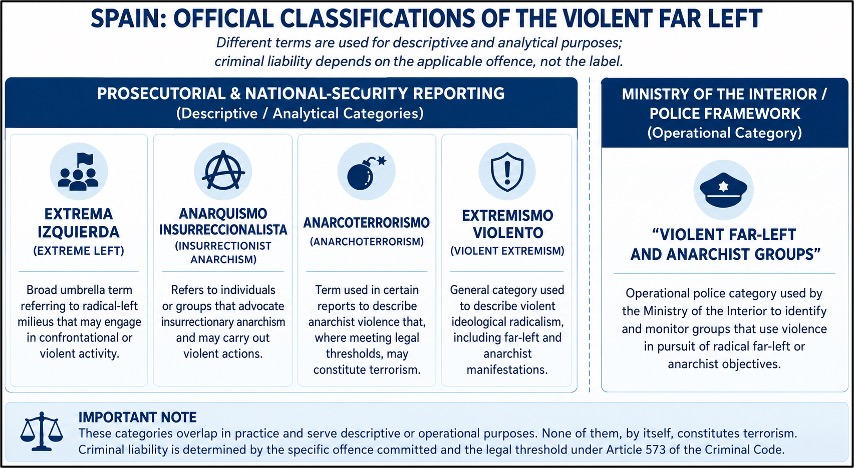
Figure 1: Spain's Official Classification of the Violent Far Left. Source: Author's synthesis based on the Spanish Criminal Code, Fiscalía reporting, and the Ministry of the Interior's 2022 youth-group framework.
Terrorism has a separate legal threshold. Under Article 573 of the Criminal Code, specified serious offences constitute terrorism when committed for purposes including subverting the constitutional order, seriously destabilising political institutions, seriously disturbing public peace, destabilising an international organisation, or provoking terror among the population. Therefore, an act may not necessarily constitute terrorism even if it is politically motivated, violent, and associated with the violent far left.
Ideology nevertheless remains operationally relevant. In 2022, the Ministry of the Interior revised its framework for violent youth groups, introducing classifications based on ideology or motivation and organisational relationships. One category, “violent far-left and anarchist groups,” expressly includes radical antifascist and okupa (squatter) movements. The framework primarily concerns violent youth groups aged 14–30 and is therefore not an exhaustive taxonomy of Spain’s violent far left.
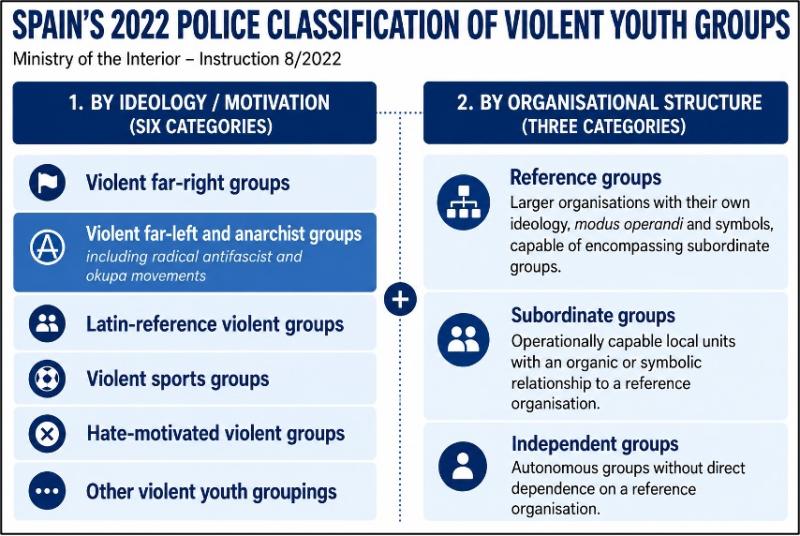
Figure 2: Spain's 2022 Police Classification of Violent Youth Groups. Source: Ministry of the Interior, 2022. The category is age-bounded and not a general taxonomy of the radical left.
Quantifying the broader milieu is harder. The Fiscalía de la Audiencia Nacional (Public Prosecutor’s Office at the National High Court) recorded 32 activities under anarquismo insurreccionalista in 2020, but changing categories and less detailed subsequent reporting prevent consistent longitudinal comparison. Interior Ministry hate crime statisticsprovide only a partial proxy: offences recorded under “ideology” do not distinguish between left- and right-wing perpetrators and exclude much of the sabotage, public disorder, and violence against police relevant to this study.
The Informes Anuales de Seguridad Nacional (Annual National Security Reports, or IASN) primarily assess relevant national-security threats rather than provide a consistent quantitative series for violent far-left activity.. Europol’s TE-SAToffers greater continuity, but only for the narrower category of terrorism, and it is compiled from information provided and verified by Member States. Spain’s distinction between violent far-left activity and terrorism therefore also shapes how the phenomenon appears in European-level statistics: activity recorded domestically under broader ideological or security categories will not necessarily appear in TE-SAT.
There is consequently no comparable public dataset tracking the full scale or evolution of Spain’s violent far-left milieu across 2020–2026. Nevertheless, Fiscalía reporting somewhat indicates the scale of activity in individual years. In 2021, prosecutors recorded 77 activities under extrema izquierda and 39 arrests, 36 of which arose from protests over the imprisonment of Catalan rapper Pablo Hasél, who had been convicted of glorifying terrorism and insulting the Crown and state institutions. The following year, the Fiscalía recorded 31 activities and 20 arrests under anarquismo insurreccionalista. The change in categories and reporting practice means these figures are useful as snapshots, but do not provide straightforward year-on-year trends.
Within Europol’s narrower terrorism framework, TE-SAT groups left-wing and anarchist cases together under the analytical category “left-wing and anarchist terrorism.” TE-SAT 2023 records one completed terrorist attack in Spain in 2022, resulting in one injury, and separately refers to an explosives attack on a real-estate agency in L’Hospitalet de Llobregat (Catalonia). The public report does not clarify whether these two mentions concern the same incident. TE-SAT 2026 subsequently records one arrest in Spain for a left-wing or anarchist terrorist offence in 2023, one in 2024 and two in 2025. These figures concern terrorism as classified and reported by Spain; they therefore capture a narrower set of cases than the broader categories of extrema izquierda, anarquismo insurreccionalista, and violent extremism used in Spanish domestic reporting.
The classificatory boundaries are not merely semantic. Actors operating within overlapping radical-left and independentist milieus may fall under different analytical or legal categories depending on the conduct involved and their primary organisational and political context. Spanish prosecutorial reporting places Amnistia Ta Askatasuna (ATA) within the ETA-related and radical Basque separatist framework, rather than under the categories used for anarchist or broader far-left violence. This is consistent with Europol’s wider taxonomy, which treats ETA and Basque separatist violence as “ethno-nationalist and separatist terrorism” instead of “left-wing and anarchist terrorism.” The distinction illustrates why ideological proximity alone does not determine how violent activity is classified.
This fragmentation of classification is analytically consequential. The same broad ideological environment can become visible to the state through different institutional lenses depending on conduct: as public-order violence, violent radicalism, insurrectionary anarchism, separatist violence, or terrorism. Low terrorism figures therefore cannot be treated as a proxy for the prevalence of politically contextualised violence, while broader domestic categories cannot simply be aggregated into a single measure of violent far-left activity. The measurement problem reflects not only incomplete public data but differences in the conduct being measured and the institutional purposes for which it is classified.
That difference is visible in the prosecution of three ATA members for a May 2020 incendiary attack on a Kutxabank branch in Ea (Bizkaia, Basque Country), carried out in support of ETA prisoners. Prosecutors charged the conduct as terrorist arson, and the defendants admitted their involvement before the Audiencia Nacional in 2024.
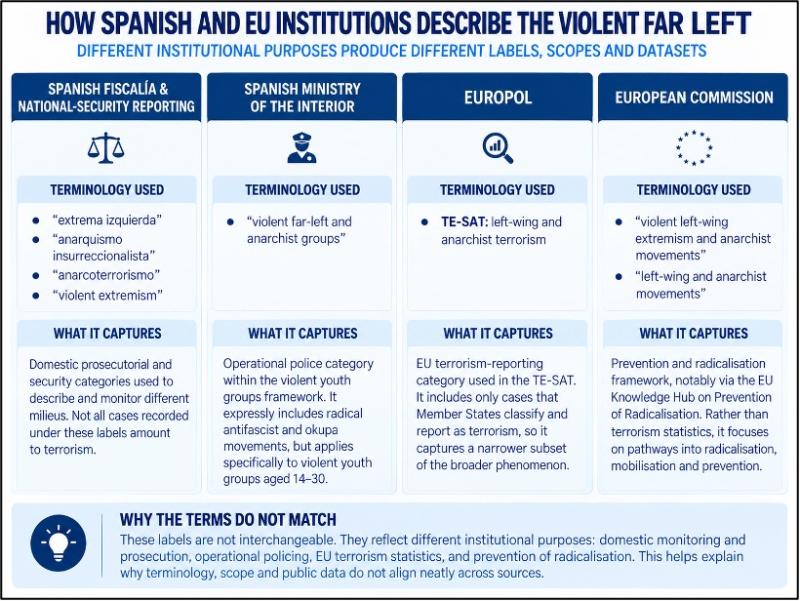
Figure 3: How Spanish and EU Institutions Describe the Violent Far Left. Source: Author’s synthesis based on Spanish Fiscalía and national-security reporting, the Ministry of the Interior, Europol TE-SAT, and the European Commission’s prevention framework. The labels capture different legal, operational, and prevention contexts, helping explain why terminology and data do not align neatly across sources.
Fragmentation and Episodic Convergence
Official reporting nevertheless provides a reasonably clear picture of the composition and capabilities of Spain’s violent far-left milieu.. Rather than describing large hierarchical organisations, the reporting depicts a fragmented environment in which insurrectionary anarchism remains the clearest identifiable violent strand. In 2020, the Fiscalía identified Informal Anarchist Federation / International Revolutionary Front (FAI/FRI)-linked individuals and groups as the principal anarchist threat, targeting banks, businesses, political offices, and churches, principally in Madrid and Barcelona. Limited economic, logistical, and operational resources constrained their capacity, and by 2021–22 prosecutors described anarchist violence as low and residual, centred largely on small-scale sabotage following years of police and judicial pressure.
Fragmentation should not, however, be understood simply as the absence of organisational capacity. It also shapes the way mobilisation occurs. In a milieu without a dominant organisational centre, particular events and causes can temporarily bring otherwise distinct actors and networks into the same mobilising environment without producing a durable organisation. The relevant analytical distinction is therefore between organisational consolidation and episodic convergence. The latter can generate violence around a common trigger, even where participating milieus remain organisationally separate before and after the event.
Operation Phiros adds an important qualification to this picture of residual, small-scale sabotage. Mossos d’Esquadra(Catalan regional police) investigators attributed a violent-anarchist motivation to three men suspected of placing up to seven homemade explosive devices at bank branches and a supermarket in Barcelona between 2022 and 2023. The bombs reportedly became progressively more powerful, caused more than €80,000 in damage and involved a recurring division of labour in which one suspect placed the device while another conducted surveillance. No one claimed responsibility for the attacks, and the suspects were investigated for offences including explosives possession, criminal damage, and estragos (a Spanish criminal offence covering acts of destruction that threaten public safety), rather than publicly reported terrorism charges. Separate reporting likewise records the increasing charge size and the absence of claims of responsibility.
Beyond the anarchist core, the boundaries of the violent far-left milieu become less clear. Confrontational mobilisation against political opponents has periodically resulted in violence without necessarily corresponding to a discrete organisational milieu. During a campaign event held by Vox, Spain’s national-conservative, right-wing political party, in Madrid’s Vallecas district in April 2021, for example, clashes involving counter-protesters left 35 people injured, including 21 police officers, amid the throwing of stones, bottles, and other objects. More recently, clashes during a June 2026 counterdemonstration against the neo-Nazi Núcleo Nacional in Barcelona left four police officers injured. Also in Catalonia, protesters destroyed an information stand belonging to the student organisation S'ha Acabat at the Autonomous University of Barcelona (UAB) in October 2021. Contemporary reporting identified the attackers as independentist students.. Similar intersections are visible in the Basque Country and Navarre, through actors including Ernai and the Gazte Koordinadora Sozialista (GKS).
A further example of confrontational mobilisation occurred in October 2025, when a counterdemonstration against a gathering of the fascist and national-syndicalist group Falange in Vitoria-Gasteiz (Basque Country) escalated into object-throwing, clashes with police, and burning of containers. The Ertzaintza (Basque regional police) ultimately reported 19 arrests for public disorder and around 20 officers lightly injured. The official account documents the incident but does not establish a durable organisation behind all participants.
These cases also illustrate the difficulty of defining the boundaries of the milieu. Antifascist, radical-lef, and independentist mobilisation encompasses diverse actors and activities that cannot collectively be treated as violent extremism, even where particular participants, networks, or events involve violence. The overlap between these environments therefore complicates attempts to construct a single national “violent far-left” category and reinforces the distinction between ideological affiliation, mobilisation, and documented violent activity.
Issue-based mobilisation increasingly appears alongside these established milieus. The Fiscalía has monitored ecologismo radical (radical environmentalism), including actions ranging from road blockages to property damage, although prosecutors subsequently clarified that they did not consider either Futuro Vegetal or Extinction Rebellion a terrorist organisation. Other causes can similarly provide mobilisation opportunities across otherwise distinct radical-left, anarchist, antifascist, or independentist environments. Housing-related mobilisation offers another example. Following an eviction in Barcelona’s Sant Andreu district in January 2021, a group of around 50 people attacked bank branches, an estate agency, and an energy-company office, slightly injuring two Mossos officers. Contemporary reporting noted anarchist, okupa, and anti-eviction graffiti at the scene, illustrating how issue-based mobilisation can overlap with anarchist and okupa milieus without making the broader housing movement itself a violent-extremist phenomenon.
The 2024 IASN noted that far-left radical actors adapt contemporary social and geopolitical causes—including migration detention, labour disputes, and, increasingly, international conflicts—to existing ideological agendas. Mobilisation around the Israel–Palestine conflict provides a recent example: during a pro-Palestinian gathering in Bilbao in December 2025, a nonviolent sit-in blocking the tram was followed by clashes during a police intervention, when several participants attempted to prevent an arrest and, according to the Basque Department of Security, assaulted Ertzaintza officers. Such incidents show how broader political mobilisations can provide convergence points for existing radical networks and confrontational actors.
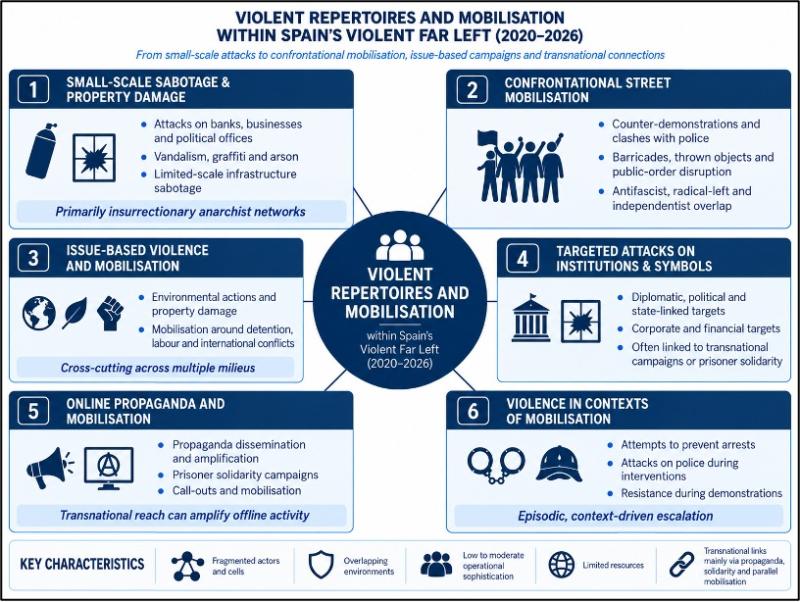
Figure 4: Violent Repertoires and Mobilisation within Spain's Violent Far Left. Source: Author's synthesis based on Fiscalía, police, and case reporting cited in the text. Categories overlap and do not imply prevalence.
The 2021 disturbances following the imprisonment of Catalan rapper Pablo Hasél bring several of these dynamics together. Demonstrations in several cities involved barricades, property damage, and attacks on police. In Barcelona, a Guardia Urbana (Urban Guard) van was set alight while an officer remained inside. Eight suspects were subsequently remanded in custody on allegations including attempted homicide, public disorder and membership of a criminal group. Police believed the wider group involved comprised around 12–16 people, with different participants carrying out, directing, and monitoring the action, suggesting some degree of role differentiation and coordination. In official reporting, the incidents associated with the Hasél protests were recorded by the Fiscalía under extrema izquierda rather than terrorism. This distinction is also reflected at the European level: Europol’s TE-SAT recorded no left-wing or anarchist terrorist attack in Spain in 2021, while Spanish domestic reporting documented a broader range of violent activity under extrema izquierda.
These episodes do not establish a single violent network moving between causes. They instead illustrate a recurring mobilisation structure: wider political controversies create temporary convergence points within which established radical milieus, issue-based activists, and confrontational actors may overlap. The security relevance lies less in the ideological content of any particular cause than in whether such convergence produces recurrent violent actors, greater coordination, or capabilities that persist after the mobilising event ends.
On 27 February, during the Barcelona protests that followed Hasél’s imprisonment, eight people were detained who subsequently became known as the presos del 27F. Their detention generated a solidarity campaign extending beyond Spain, including fundraising for legal and prison expenses, while the Fiscalía reported that Italian militants supported propaganda efforts around their case. The 27F case illustrates how domestic street violence can acquire a transnational dimension after the event through international solidarity, fundraising, and propaganda activity around those detained.
The sequence is significant because different forms of connectivity emerged at different stages. The initial mobilisation generated a temporary operational grouping around street violence; detention then provided a new focal point around which transnational solidarity, propaganda, and material support developed. Transnationalisation therefore need not precede domestic violence or indicate external operational direction. It can also emerge retrospectively, as local confrontations and imprisoned participants become symbols around which wider networks mobilise.
Transnational Networks and Foreign Conflict Participation
The 27F campaign was not an isolated example, and the significance of FAI/FRI in Spain is not limited to the domestic threat identified by prosecutors. Spanish-linked activity sits within a transnational anarchist ecosystem extending particularly to Italy and Greece, in which connectivity is expressed less through formal organisational structures than through shared propaganda, prisoner-solidarity campaigns and parallel actions undertaken in response to common causes or events. The 2023 mobilisation around imprisoned Italian FAI militant Alfredo Cospito involved a more direct form of cross-border action: the Italian consulate in Barcelona was vandalised amid an international campaign that also generated violent actions against Italian diplomatic targets in Berlin and Athens.
The broader picture of limited domestic anarchist activity combined with continuing transnational connections also appears in other official assessments. Spain’s 2024 National Risk Assessment addendum on money laundering and terrorist financing likewise describes violent anarchist activity as low and contained, while noting that international campaigns circulated through anarchist websites continue to have repercussions in Spain. Taken together, these sources point to a limited domestic operational footprint but continuing exposure to wider transnational anarchist mobilisation.
Transnationality should therefore be treated as a variable rather than a binary characteristic. The available evidence supports different degrees of integration, ranging from ideological affinity and propaganda exchange through prisoner solidarity and parallel mobilisation to financing, training, skills transfer, and operational cooperation. These forms are not equivalent. In the Spanish case, evidence is strongest towards the ideological and mobilisational end of this spectrum and becomes progressively weaker as the threshold moves towards sustained operational integration.
Foreign conflict participation adds a more concrete dimension to these transnational links. Its scale is difficult to precisely establish because available estimates cover different populations and periods. Fiscalía reporting referred to Spanish nationals who had travelled over preceding years to Iraqi Kurdistan, while broader reporting documented travel to Rojava or Sinjar since 2015. The latter travelers encompassed anarchists, communists, and other ideological profiles. These differently scoped accounts point to a heterogeneous Spanish presence in Kurdish armed theatres.
The clearest organisational example remains Reconstrucción Comunista (Communist Reconstruction), which in 2015 became the Partido Marxista-Leninista (Marxist-Leninist Party, a.k.a. PML-RC), although the case itself predates the main period covered by this report (2020–26). In late 2014, the organisation created a committee in solidarity with the Kurdish cause, sought volunteers to join the Kurdish People’s Defense Units (YPG) in Syria, and selected Álvaro Fernández Ruiz and Pablo Díaz Ocampo, who departed Spain the following month and subsequently received military training in Rojava. Spanish National Court proceedings later documented weapons possession, preparations for violent confrontation, and attacks or threats against political opponents and former members. The case therefore establishes an unusually direct overlap between organised foreign deployment and a violent domestic communist environment, while the court itself distinguished those criminal acts from the party’s formal political programme.
The Donbas conflict generated a separate Spanish cohort. Eight Spanish nationals were detained in 2015 after returning from pro-Russian separatist formations, and contemporary reporting identified several as coming from antifascist or radical-left environments. According to contemporaneous judicial reporting, the Audiencia Nacional dismissed the case in October 2015. Sergio Becerra and Héctor Arroyo, for example, had served together in Unit 404, while other Spaniards were integrated into the Prizrak Brigade and associated international units. Arroyo, who described himself as antifascist and politically closer to anarchism, later returned to the front and rejoined Prizrak despite having already come under investigation in Spain. His trajectory therefore illustrates repeat ideological mobilisation, but the broader cohort is equally important: foreign deployment was not confined to isolated individuals, but included small groups of Spanish volunteers entering the same armed formations. Reporting from 2022 continued to identify Becerra, Ángel Arribas, Arroyo, and other Spanish volunteers within the earlier pro-Russian contingent.
Other trajectories show the acquisition of capabilities abroad more directly. A Spanish volunteer using the alias “Demhat,” described as anarchist and antifascist, said he had never handled a firearm before travelling to Syria to fight alongside Kurdish forces. Foreign conflict experience also remained connected to domestic political milieus after deployment. In December 2021, a Spanish Donbas veteran using the alias “Vadim” appeared publicly with Roberto Vaquero, leader of Frente Obrero (Proletarian Front), and Fernández Ruiz (identified under his alias Álvaro Martos), the Syria veteran who had been selected as a volunteer by PML-RC v to join the YPG in 2014. The same reporting identifies Frente Obrero as PML-RC’s street-level organisation and describes Vadim as having entered Prizrak from an antifascist background before later identifying as communist. The significance lies less in the discussion itself than in what the post-deployment links reveals: veterans of different conflicts remained connected to a Spanish Marxist-Leninist political environment after returning from the conflict zone.
More recent cases bring the issue directly into the article’s timeframe. Two young Catalans, described by Spanish intelligence sources as fitting a far-left profile, returned independently from Kurdistan in July 2023 after spending roughly a year there. A young Catalan nurse close to the okupa milieu was among at least five participants in Kurdish militias repatriated with Spanish diplomatic assistance since 2021. These cases indicate that the overlap between foreign fighting and Spanish radical-left or okupa environments did not end with the earlier PML-RC episode.
Not every trajectory led back to Spain. Martin Klamper, a Spanish-German veteran of the YPG in Syria and later of the YBS in Sinjar, was by 2026 associated with the Anti-Fascist Internationalist Front in Myanmar. Klamper’s trajectory complicates a purely returnee-focused assessment: continued involvement across successive conflict theatres may deepen combat experience, broaden transnational networks, and reinforce militant socialisation, potentially complicating disengagement and reintegration should such individuals later return to Spain.
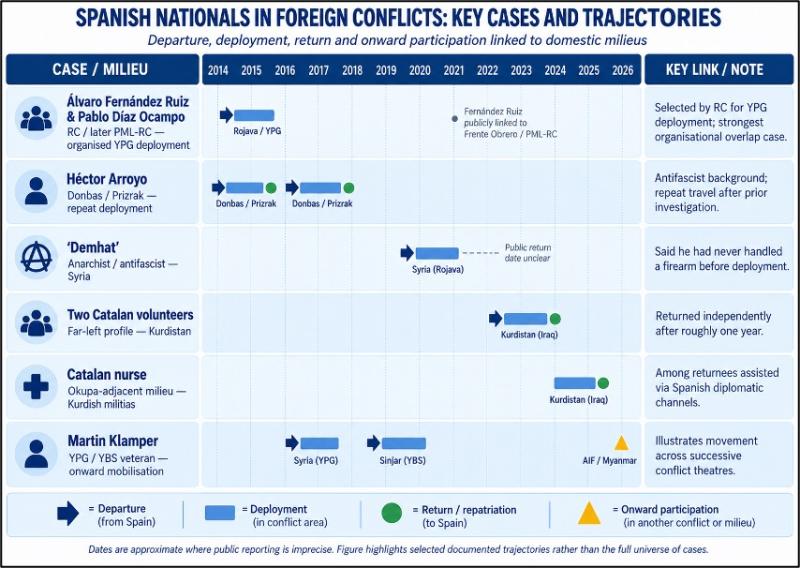
Figure 5: Spanish-Linked Foreign-Conflict Cases Relevant to the 2020–2026 Assessment. Source: Author's synthesis based on court records and reporting cited in the text. Labels distinguish reported affiliation from proven violent conduct. Selected sources: Audiencia Nacional judgment (2018); Supreme Court judgment (2020); Arges Artiaga profile. Artiaga is included as a boundary/comparator case: the reporting establishes combat experience but no documented link to a Spanish violence-oriented far-left milieu.
Taken together, the cases document organised deployment, repeat travel, combat-skill acquisition, post-return veteran networking, recent returnees linked to radical-left milieus and onward mobilisation into new conflicts. They show that some individuals acquired military skills and transnational contacts exceeding the capabilities ordinarily visible in Spain’s domestic violent far-left milieu.
Public reporting has not identified systematic transfer of those capabilities into domestic violent activity. Spanish authorities have themselves recognised the potential risks associated with returning non-jihadist combatants. Fiscalía 2020reporting explicitly described Spaniards fighting in foreign conflict zones as a potential threat upon return.
For the non-jihadist returnees examined here, however, the most specific later public assessment appears in the Fiscalía’s report covering 2022, which stated that it had no record of incidents involving those returning from Ukraine, Syria, or Iraq. The relevant escalation indicator is therefore not return, but capability transfer: evidence that skills, contacts or operational experience acquired abroad are being transmitted to domestic networks, incorporated into planning, or used to increase the sophistication of violent activity.
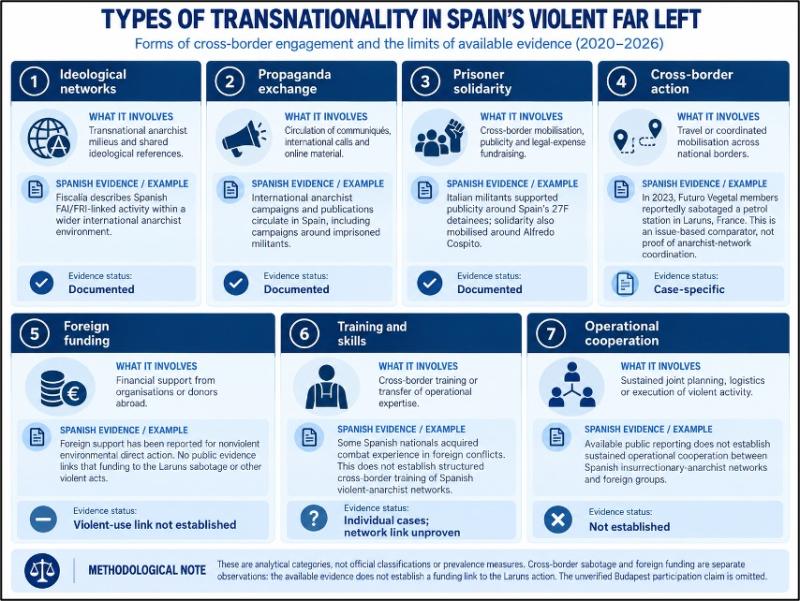
Figure 6: Types of Transnationality Applied to Spain's Violent Far Left (2020–2026). Source: Author’s analytical typology based on the cases cited in the text; categories are not official classifications or measures of prevalence. Selected sources: Spanish Ministry of the Interior on the Laruns sabotage; Climate Emergency Fund on its support for nonviolent disruption. Available reporting does not establish that foreign funding supported the Laruns action or other violent activity. The Budapest participation reference is based on movement reporting and has not been independently verified.
Institutional Response and Coordination
The fragmented character of Spain’s violent far-left landscape is reflected in Spain’s institutional architecture. The Spanish authorities address different manifestations of violent far-left activity through several channels, with responsibility determined by conduct, legal threshold, and security context.
The resulting public record of violent far-left activity is correspondingly dispersed across several institutional and legal frameworks. The Centro Nacional de Inteligencia (CNI) assesses intelligence relevant to national-security threats, while the Ministry of the Interior’s CITCO (Intelligence Centre Against Terrorism and Organised Crime) integrates intelligence on terrorism and violent radicalism and coordinates police and international information exchange. Policía Nacional and Guardia Civil conduct investigations alongside regional forces including the Mossos d'Esquadra and Ertzaintza. Terrorism cases fall within the Audiencia Nacional's specialised judicial and prosecutorial architecture, while the Departamento de Seguridad Nacional (Department of National Security, or DSN) incorporates these threats into its broader national-security assessment. Taken together, this architecture reflects the fact that Spain does not treat the violent far left as a single, self-contained security category. Different manifestations are instead addressed through terrorism, violent-radicalism, public-order and broader national-security frameworks, which explains why the publicly available picture remains institutionally and statistically fragmented.
This distribution of responsibilities reflects the different legal thresholds engaged by street disorder, violent radicalism, insurrectionary anarchism and terrorism, including where participants emerge from overlapping ideological milieus. Trends therefore cannot reliably be inferred from any one institutional dataset. Changes in recorded terrorism, for example, may say relatively little about changes in confrontational street violence or small-scale sabotage, and vice versa.
Spain’s response is not limited to intelligence, policing, and prosecution. At the broader counter-radicalisation level, the current framework is anchored in the 2020 Plan Estratégico Nacional de Prevención y Lucha contra la Radicalización Violenta (PENCRAV), which replaced an earlier 2015 strategy and adopts a multi-agency approach to preventing violent radicalisation across ideological contexts. The wider architecture also includes the Strategic Plan against Terrorist Financing. Alongside this, the Interior Ministry’s 2022 framework for violent youth groups updated a separate police plan first introduced in 2005 and renewed in 2014, strengthening prevention in educational and social settings, coordination with prosecutors to support disengagement from violent groups, and monitoring of online mobilisation and incitement.
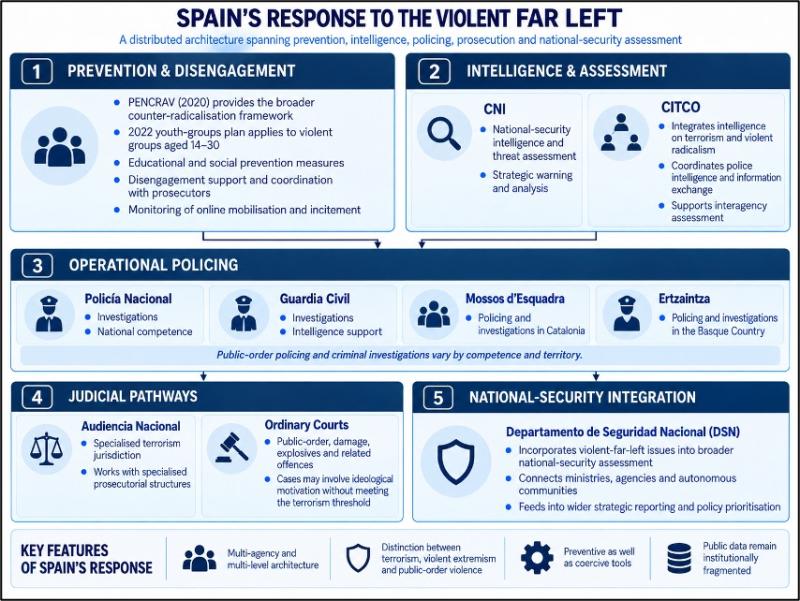
Figure 7: Spain's Response to the Violent Far Left. Source: Author’s synthesis based on official descriptions of CNI, CITCO, police, Fiscalía, Audiencia Nacional, DSN and Interior’s prevention framework. Institutional source: Centro Nacional de Inteligencia.
Operational Limits and Escalation Potential
Taken together, the evidence points to a violent milieu oriented less towards an achievable revolutionary seizure of power than towards disruption, symbolic targeting, confrontation with perceived adversaries, and the amplification of wider political struggles.
Demonstrated domestic operational sophistication within Spain’s violent far-left milieu has remained generally limited since 2020. Spain contains small cells capable of surveillance, role differentiation, and repeated attacks; individuals with military training and combat experience acquired abroad; transnational networks capable of propaganda circulation and solidarity mobilisation; and broader milieus capable of episodic street mobilisation. These capacities appear dispersed rather than systematically integrated into a durable domestic violent infrastructure.
This distinction helps reconcile two apparently contradictory features of the contemporary landscape: persistent violent activity and transnational connectivity coexist with very low recorded levels of left-wing and anarchist terrorism. Mobilisation capacity is greater than organisational consolidation, transnational connectivity exceeds demonstrated operational integration, and individual or small-cell capability is superior to demonstrated collective capability.
Operation Phiros and the 27F investigation show how those distinctions can change. Phiros demonstrates that greater sophistication can emerge within a small domestic cell through surveillance, repeated targeting, role differentiation, and increasingly powerful devices. The 27F case shows differentiated roles emerging within episodic street mobilisation. Together, they identify observable mechanisms through which domestic violent capability could develop.
What to Watch
Several developments would indicate a change in the operational capacity of Spain’s violent far-left milieu: the emergence of persistent violent networks from episodic mobilisation; renewed operational activity among insurrectionary-anarchist groups; evidence of sustained cross-border logistical, financial or operational cooperation; and the transfer of foreign-acquired military skills into domestic violent activity. These indicators would help distinguish fluctuations in recorded incidents from changes in organisational capacity. A meaningful shift in capability would be indicated less by isolated confrontations than by repeated target surveillance, more sophisticated devices, common procurement or communications, or evidence that transnational contacts were providing logistical or operational support.
These indicators matter because each would represent movement across one of the boundaries that currently constrain the milieu: from mobilisation to organisation, from connectivity to operational integration, or from individual expertise to collective capability.
Summary
Spain’s contemporary violent far left comprises an uneven distribution of mobilisation, connectivity and capability across overlapping milieus. Fragmentation constrains sustained violent organisation while allowing episodic convergence around political events, prisoners, conflicts, or perceived adversaries. Transnational connections broaden this environment, and foreign conflicts have produced individuals with capabilities exceeding those ordinarily demonstrated domestically. Public reporting has not identified systematic integration of these elements into a more sophisticated violent infrastructure. The relevant escalation indicators are episodic mobilisation becoming sustained organisation, transnational solidarity becoming operational support, and individually acquired skills becoming transferable collective capability.
Stay up to date on our latest news.
Get the latest news on extremism and counter-extremism delivered to your inbox.