Europe’s Violent Extreme Left — Part 6: The Case of the Netherlands — Violence, Connections, and Unanswered Questions
This article is part six of CEP’s series on the violent extreme left in Europe. It examines the Netherlands’ anarchist, communist, antifascist, and issue-based actors and milieus, including those involved in pro-Palestinian and antimilitarist mobilization. It reviews documented assaults, intimidation, property attacks, and sabotage since 2020, as well as transnational connections, foreign-conflict participation, and the relationship between antisemitism and violent extremism. It also examines Dutch authorities’ threat assessments, institutional responses, and significant gaps in publicly available evidence. It concludes by assessing what is known about perpetrators, organizational structures, and operational cooperation, and what additional evidence is needed to distinguish isolated incidents from sustained militant activity or emerging capabilities.
Berrie Hanselman and Alexander Ritzmann
Assessment
The Dutch cases reveal a clear picture of tactics and targets. Documented incidents demonstrate how militant milieus can intimidate opponents, damage institutions, and disrupt public or commercial activities. However, the available data rarely establishes whether individual attacks are connected, which actors sustain campaigns over time, or whether transnational contacts translate into operational cooperation.
For policymakers, the central challenge is distinguishing isolated incidents from sustained militant activity and identifying changes in violent capabilities. More systematic recording of political motives, perpetrators, organizational links, and claims of responsibility would strengthen future threat assessments. Without such evidence, it remains difficult to determine whether the documented incidents reflect single incidents, a stable pattern, or an evolving threat.
Key Findings
- Documented incidents involving Dutch left-wing extremists and broader protest movements include assaults, intimidation, property damage, and sabotage. Courts have convicted individual protesters of assault, criminal damage, and dangerous road obstruction. However, the available evidence varies considerably in identifying extremist affiliations, organizational responsibility, and coordination between perpetrators.
- Dutch authorities describe organized left-wing extremism as small, fragmented, and ideologically diverse. However, the available public evidence does not permit an independent assessment of the movement's organizational structure, the continuity of militant networks, or possible coordination between perpetrators of different attacks.
- The Israel–Palestine conflict and antimilitarism have become important causes for parts of the extreme left. Palestine Action NL has publicized confrontational actions since 2024 and claimed or publicized several property attacks since 2025. Dutch intelligence also identifies Samidoun Netherlands as a group that glorifies violence and legitimizes actions by terrorist organizations. The extent of operational cooperation between these actors and other extremist networks remains unclear.
- Transnational connections include joint campaigns, cross-border travel, and support for foreign fighters. Dutch activists have participated in demonstrations supporting the British Palestine Action movement. Dutch court records also document volunteers returning from Kurdish armed groups in Syria, including one who fought alongside revolutionary-left formations. Dutch anarchist initiatives have reported fundraising for Ukrainian anti-authoritarian fighters.
- Official data and research provide an incomplete picture of violent left-wing extremism in the Netherlands. There are no comprehensive public statistics showing how many left-wing politically motivated violent offenses have occurred, who committed them, or which organizations were involved. Antisemitism statistics also rarely identify perpetrators' political affiliations. These gaps make it difficult to assess changes in the threat.
- For policymakers and security practitioners, key priorities include identifying recurring violent actors, establishing responsibility for sabotage, investigating cross-border operational links, and improving the recording of politically motivated offenses. Better data and renewed research are needed to determine whether the Dutch threat is changing in scale, organization, or capacity to cause harm.
National Framework and Data Limitations
The Netherlands has a long history of political violence involving parts of the extreme left. Since the 1960s, some Marxist-Leninist, anarchist, anti-imperialist, and other radical-left groups have used intimidation, property destruction, arson, and explosives. Berrie Hanselman's 2025 doctoral dissertation examines left-wing political violence in the Netherlands between 1965 and 2015. It documents divisions within radical-left movements, including disagreements over the use of violence. The study provides historical context for understanding today's fragmented extreme-left scene.
Dutch authorities distinguish between activism, extremism, and terrorism. Under the NCTV's definitions, extremism covers ideologically motivated activities intended to undermine the democratic legal order; these may involve violence or other means. Terrorism involves ideologically motivated violence or serious disruption intended to spread fear or influence political decisions.
The General Intelligence and Security Service (AIVD) monitors threats to national security and the democratic legal order. The National Coordinator for Security and Counterterrorism (NCTV) produces periodic national threat assessments, while police and prosecutors investigate and prosecute criminal offenses.
The AIVD's 2025 annual report describes vandalism, intimidation, and doxxing—the publication of personal information to intimidate opponents—as recurring left-wing extremist activities. In its June 2026 assessment, the NCTV reported no current terrorist threat from left-wing extremism in the Netherlands, although lower-level extremist activity continued.
Available statistics are incomplete. Police records, intelligence assessments, and terrorism statistics use different definitions and recording methods. Politically motivated offenses, including threats, property damage, and sabotage, may be registered as ordinary crimes without recording or publicly identifying their political motivation.
In January 2026, the Dutch government confirmed that police and prosecution records could not provide the requested breakdown of criminal offenses linked to specific pro-Palestinian protests or organizations.
In March 2026, the government estimated that the Netherlands had no more than a few dozen insurrectionary or violence-oriented anarchists. It described the wider organized extreme-left scene as small, fragmented, and ideologically diverse, consisting mainly of anarchists and communists. The government said willingness to use violence was limited and had not apparently increased since 2024. It also referred to a 2018 study documenting violent and property offenses among some extremist groups' methods, while stating that current assessments did not justify another dedicated study of left-wing extremist radicalization.
As a result, systematic research on developments since 2020 has been limited. Public sources provide an incomplete picture of who carries out politically motivated violence, how attackers select targets, whether the same networks remain active over time, and whether they cooperate with groups abroad.
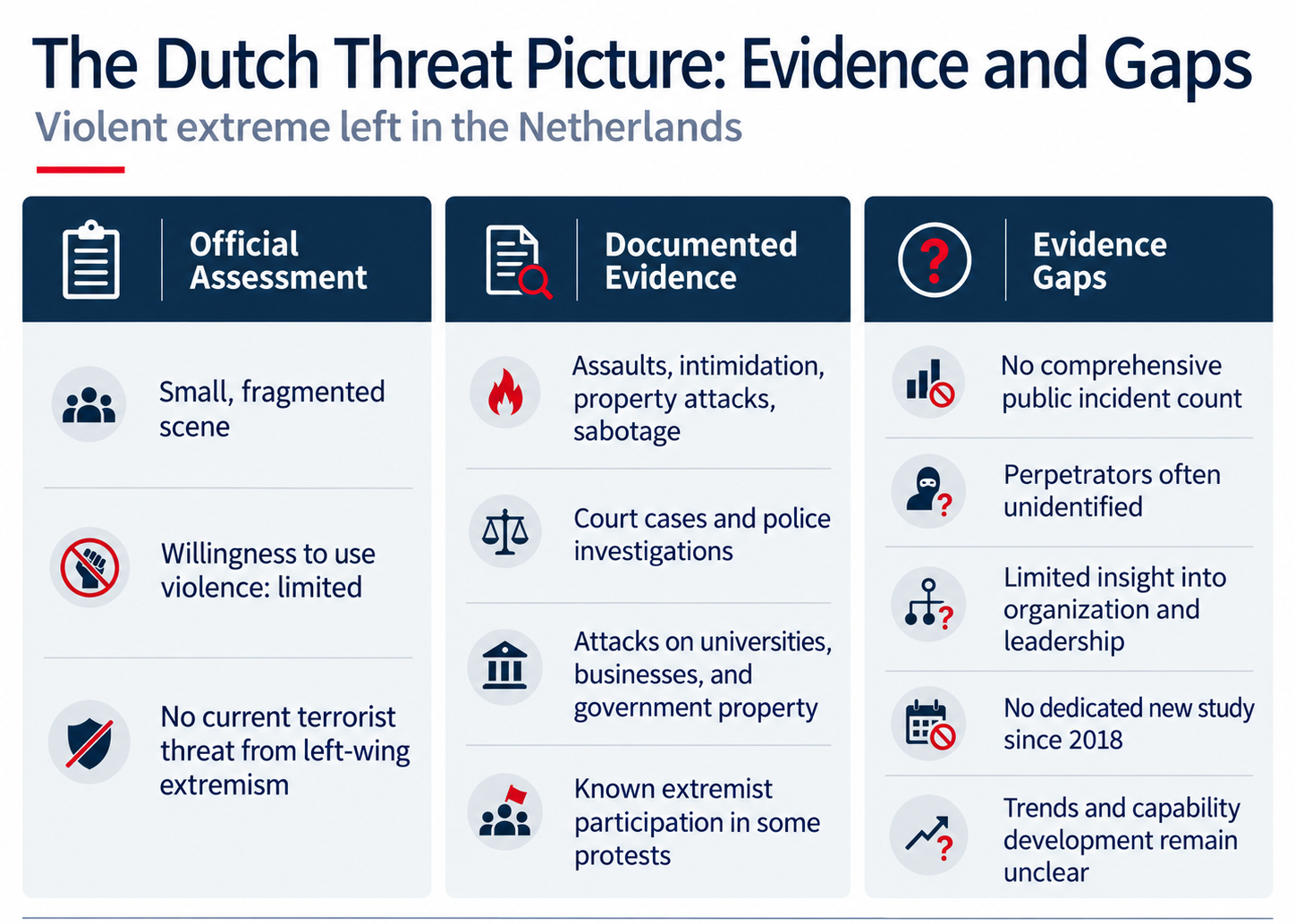
Figure 1: The Dutch Threat Picture — Evidence and Gaps. Source: Authors’ synthesis based on the AIVD Annual Report 2025, the NCTV Terrorism Threat Assessment (2026), and Dutch parliamentary reporting (2026).
Current Landscape of Left-Wing Political Violence
Dutch intelligence and law-enforcement reports document several forms of violence and intimidation associated with parts of the extreme left. These include assaults, threats, property damage, and sabotage. The people involved come from anarchist, militant antifascist, anti-imperialist, and other political groups and networks.
The NCTV identifies police officers, security personnel, and right-wing extremists as targets of violence by left-wing extremists. Threats, intimidation, and property damage are reported more often than physical attacks. In its June 2026 assessment, the NCTV said willingness to use violence remained limited.
Militant Antifascism: Targeted Intimidation and Property Damage
Militant antifascism is an established part of Dutch left-wing extremism. The AIVD reported increased activity by anarchist and antifascist groups in 2023, particularly against people and organizations they considered right-wing or fascist.
Reported methods include damaging meeting venues, putting glue into door locks, publishing opponents' personal information online, and pressuring venue owners to cancel political events. Targets include political parties, politicians, organizations, and private individuals.
The AIVD's 2025 assessment describes these practices as continuing features of extremist antifascist actions. Activity around the 2025 parliamentary elections was more limited than the heightened mobilization seen in 2023.
Such attacks and intimidation can disrupt political opponents and pressure venue operators to deny them access to public or private premises.
Violence During Political Mobilization
Pro-Palestinian demonstrations and occupations at the University of Amsterdam escalated into violence against police officers and extensive damage to university property in May 2024. Police documented attacks involving stones, fireworks, a corrosive liquid, and an improvised spear. Several officers were injured.
The AIVD's 2024 report assessed that known left-wing extremists helped escalate the university occupation and directed anger toward police officers. The NCTV also reported participation by anarchist, communist, and antifascist activists. It considered it possible that extremists participated in the violence but unlikely that the attacks resulted from an organized extreme-left operation. The individual attackers' organizational affiliations remain largely unknown.
Extinction Rebellion: Criminal Direct Action and the Limits of Extremism Classification
Extinction Rebellion (XR) illustrates the distinction Dutch authorities draw between disruptive environmental activism and left-wing extremism. In June 2025, the government confirmed that the NCTV continued to classify XR demonstrations as activism, despite criminal offenses associated with some actions.
In May 2026, The Hague District Court convicted five XR protesters of offenses committed during demonstrations between 2023 and 2025. These included property damage and dangerous motorway obstruction. The court described the demonstrations as peaceful, without violent intent or incitement, but found that specific actions constituted criminal offenses.
In July 2026, The Hague District Court also convicted an XR protester of assault for grabbing a security guard by the throat during an attempted disruption of an energy industry conference in April 2024.
The cases highlight differences in how European authorities classify comparable movements. Spanish prosecutors have examined XR within their reporting on radical environmental activism, while Italian police reporting has included XR under left-wing extremism. The Dutch approach places greater emphasis on distinguishing civil disobedience and criminal offenses from extremist objectives.
Palestine Action Netherlands: Repeated Targeted Attacks
The Israel–Palestine conflict has become a major issue for Dutch anarchist, Marxist-Leninist, and anti-imperialist groups. The AIVD reported numerous attacks on businesses accused of supplying Israel or supporting Israeli settlements. Government buildings and universities were also targeted, often with paint or smashed windows. The perpetrators were not identified in every case.
Palestine Action NL has repeatedly publicized or claimed responsibility for attacks on political and commercial targets. Its documented activity dates back to at least March 2024, when it publicized the disruption of Jewish singer Lenny Kuhr's concert in Waalwijk. Protesters confronted Kuhr and referred to her relatives in Israel. Police later identified and questioned one participant. The incident is examined further below.
On October 7, 2025, Palestine Action NL claimed responsibility for spraying red paint and political slogans onto the Royal Palace in Amsterdam. The group linked its action to restrictions on a proposed pro-Palestinian demonstration and the Netherlands' colonial history. Amsterdam authorities disputed the group's account of those restrictions. A later government response confirmed that police had investigated the damage but identified no suspects and closed the investigation.
On December 13, 2025, unidentified individuals damaged three Utrecht University buildings, smashing dozens of windows and spraying paint. The university reported damage costing thousands of euros. According to a later government response, Palestine Action claimed responsibility online and threatened further attacks unless the university ended its cooperation with Israeli institutions.
On January 26, 2026, an ING office in Amsterdam was attacked, leaving at least 13 windows damaged. Palestine Action NL published footage showing windows being smashed and red liquid sprayed onto the building. According to broadcaster AT5, police attended the scene to investigate and ING filed a criminal complaint.
On June 17, 2026, approximately five people in dark clothing attacked Utrecht University's administration building, smashing dozens of windows and spraying red paint. Palestine Action NL subsequently contacted the university's independent newspaper and published footage of the attack. The precise relationship between the perpetrators and Palestine Action NL remains unclear.
These incidents show that the Palestine Action NL name has repeatedly been used to claim or publicize attacks on selected institutions. The attacks share methods and political demands. However, the identities of many perpetrators remain unknown, and the available evidence does not establish whether the same people planned or carried out the attacks.
Antimilitarist and Environmental Sabotage
Opposition to NATO and the defense industry has become a more prominent issue for parts of the Dutch radical left. The NCTV's June 2025 assessment identified increased antimilitary activity, including property damage and sabotage targeting companies accused of supporting military operations.
The NCTV cited the December 2024 sabotage of two cranes at Damen's shipyard as an example of this development. It placed the incident within the wider radical-left and left-wing extremist antimilitary environment. Public sources provide limited information about who carried out the sabotage or how it was organized.
In May 2026, an anonymous statement published on Indymedia claimed that railway cables near Rotterdam had been set on fire twice between February and April. The statement described the alleged actions as protests against war, militarism, and environmental destruction and called for further action.
No publicly available police or court findings independently confirm the alleged incidents or identify those responsible.
In June 2025, a fire at Plukon's poultry-processing facility in Oosterblokker destroyed several trucks. An Animal Liberation Front (ALF) symbol was found near the vehicles, raising suspicions of animal-rights extremist involvement.
The Dutch government confirmed that police and prosecutors were investigating the fire. Publicly available evidence has not established that the ALF was responsible or identified who caused the damage.
The cases document a range of politically motivated violence and intimidation, including assaults, threats, property attacks, and sabotage. However, the evidence differs considerably between incidents. Courts have established individual criminal responsibility in some cases; intelligence agencies have identified extremist participation in certain protests; and some alleged attacks are known only through public claims or investigative suspicions.
These differences matter when assessing whether repeated offenses involve the same individuals or more organized violent networks.
Principal Actors, Organizational Forms, and Capabilities
According to the AIVD, the Dutch extreme left consists mainly of anarchists and, to a lesser extent, Marxist-Leninists. These groups are involved in issues including antifascism, climate policy, antimilitarism, and the Israel–Palestine conflict.
Issue-based cooperation also connects environmental activism with other political causes. XR Justice Now!, for example, links climate activism with social justice and the Israel–Palestine conflict. Such overlaps illustrate how activists mobilize across different campaigns.
Recent court cases establish offenses committed by individual protesters. There is no evidence available to determine whether group leaders authorized the offenses or that they formed part of a continuing violent campaign.
Palestine Action NL has repeatedly claimed or publicized attacks involving similar targets, methods, and political demands. However, little is publicly known about its membership, leadership, planning, or resources. In December 2025, Recorded Future's Insikt Group classified Palestine Action NL as a "franchise" of the international Palestine Action movement, based on shared ideology, targets, and tactics. This research classification does not establish that the Dutch group receives orders, funding, or operational support from the British organization.
Public sources identify recurring methods and political targets. They provide less information about who plans attacks, the role of group leaders, training, access to weapons, and coordination between incidents. It remains difficult to establish whether particular campaigns involve lasting organized networks.
Antisemitism, Anti-Zionism, and Political Violence
The Israel–Palestine conflict has also raised concerns about antisemitism, arguments used to justify political violence, and attacks on individuals and institutions by actors associated with the extreme left.
The disruption of Jewish singer Lenny Kuhr's concert provides an example of targeted intimidation. On March 24, 2024, four pro-Palestinian activists interrupted her performance in Waalwijk. They accused her of terrorism and genocide and referred to her children and grandchildren living in Israel. Police subsequently identified and questioned one suspect, who acknowledged involvement. Palestine Action NL publicized footage of the incident. The National Coordinator for Combating Antisemitism, Eddo Verdoner, described the disruption as antisemitic intimidation. The protesters' references to Kuhr's family in Israel were particularly relevant to this assessment.
In August 2025, two activists threw flour and ketchup at the office of the Centre for Information and Documentation Israel (CIDI) in The Hague while employees were inside. Police arrested the suspects in September. In March 2026, a court convicted both women of criminal damage, but did not find an antisemitic motive. According to CIDI, the defendants had previously participated in XR activities.
Samidoun Netherlands illustrates how extremist organizations can justify political violence through their messaging. The AIVD identifies it as part of an international Marxist-Leninist organization that glorifies violence against Israelis and legitimizes actions by terrorist organizations. The AIVD also states that Samidoun Netherlands does not directly call for violence. In October 2024, the United States sanctioned Samidoun, describing it as a front organization and international fundraiser for the Popular Front for the Liberation of Palestine (PFLP), a designated terrorist organization. Germany banned Samidoun's activities and dissolved its German branch in November 2023, citing its support for political violence and glorification of Hamas's October 7 terrorist attacks. According to the AIVD, Samidoun has a small following in the Netherlands, although no membership figure is given. Its messaging reaches a broader audience through interactions with other, predominantly left-wing, groups involved in pro-Palestinian and anti-Israel protests. The AIVD assesses its direct threat to Dutch national security as limited.
CIDI recorded 281 antisemitic incidents in 2025, compared with 421 in 2024 and 379 in 2023. Dutch police separately recorded 867 antisemitic incidents in 2025. The two organizations use different criteria and recording methods, so their figures are not directly comparable.
These figures rarely establish perpetrators' political affiliations and cannot reliably measure antisemitism within violent left-wing extremist networks. The AIVD's 2025 assessment reported no actions by the left-wing extremist movement explicitly targeting Jewish people or institutions that year, while documenting numerous attacks on institutions associated with Israel.
The cases show different forms of activity: intimidation officially assessed as antisemitic, property damage without an established antisemitic motive, and the justification of terrorist violence. These distinctions are important when assessing antisemitism and political violence within the extreme left.
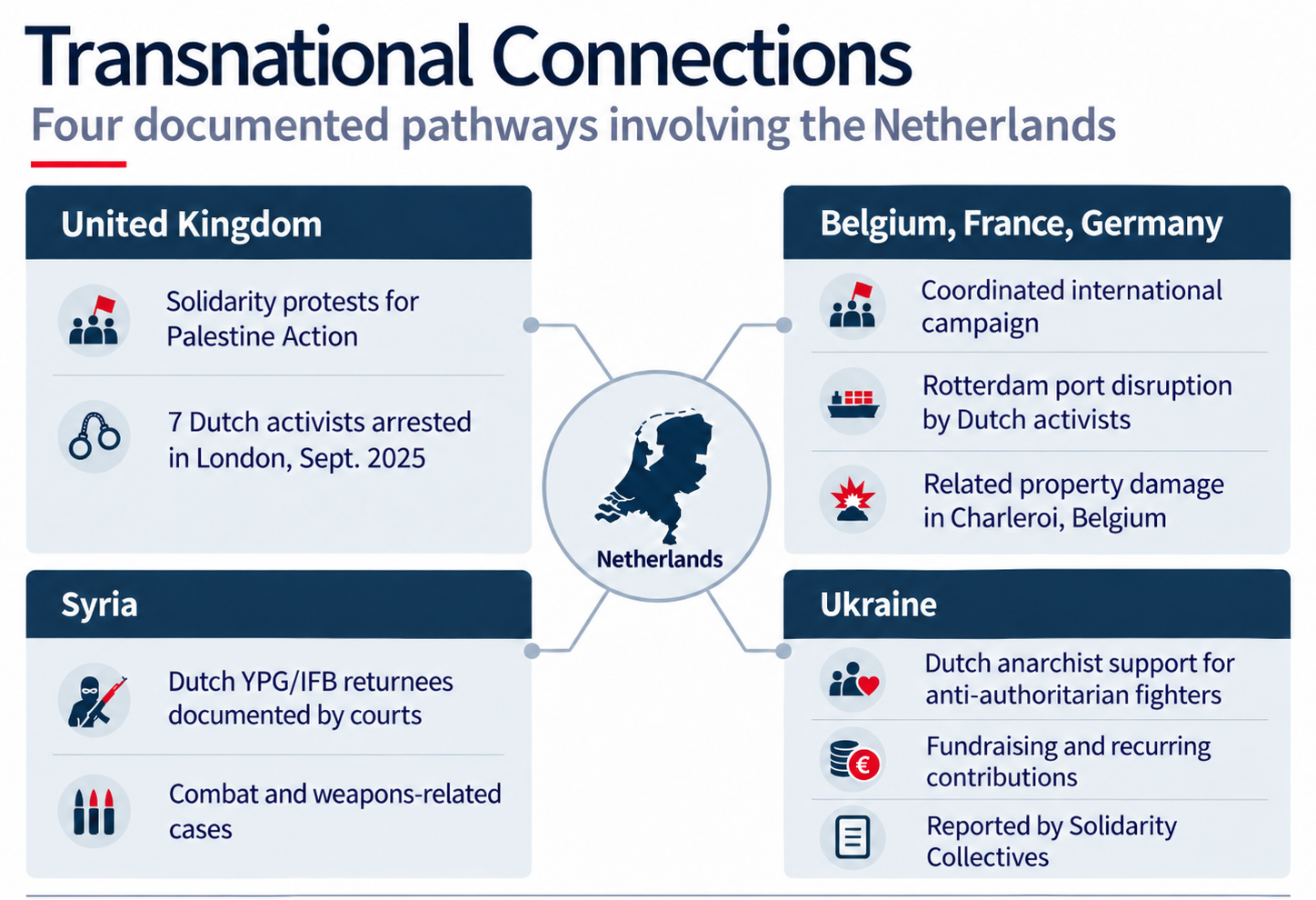
Figure 2: Transnational Connections — Four Documented Pathways Involving the Netherlands. Source: Authors’ synthesis based on Dutch court judgments, reporting on Dutch activists in the United Kingdom, documentation of coordinated European campaigns, and Solidarity Collectives' reporting on Dutch support for Ukraine.
Transnational Connections
International cooperation has long been part of Dutch extreme-left activity. During the RAF period, some Dutch radical-left activists maintained contacts with or supported German militants. Today, Dutch anarchist, antifascist, and antimilitary groups participate in international campaigns and networks.
In March 2026, the Dutch government reported that more people from abroad had become involved in the Dutch extreme-left scene. It suggested that some more radical foreign activists might seek like-minded contacts because they considered Dutch protest culture comparatively moderate. The government had not observed a corresponding rise in willingness to use violence. It did not identify the individuals involved or say whether they had experience in foreign armed conflicts.
Cross-border participation and coordinated direct action
In October 2025, the Dutch group Geef Tegengas joined an internationally coordinated campaign with organizations from Belgium, France, and Germany. Dutch activists disrupted access to the Port of Rotterdam. During a related action in Belgium, protesters caused substantial damage at the Industeel facility in Charleroi, which campaign participants accused of supplying steel to the Israeli military. The sources support coordinated international mobilization but do not establish joint planning of the Belgian property damage.
Following the United Kingdom's ban on Palestine Action in July 2025, Dutch XR activists joined solidarity demonstrations in London. On September 6, 2025, seven Dutch activists were arrested during protests involving displays of support for the banned organization. All seven were released the following day. No subsequent charges against these individuals could be established from publicly available reporting.
In December 2025, a Hague-based activist admitted damaging the British embassy in The Hague. According to local reporting, he said the action expressed solidarity with detained UK activists linked to Palestine Action. Dutch prosecutors reported painted slogans, a broken window, as well as five earlier arrests during 2025 linked to damage at other institutions. In January 2026, a court imposed a two-year exclusion order around the embassy.
Foreign Fighters and Support Networks
Foreign fighters returning to Europe may bring combat experience, tactical skills, and contacts with foreign armed groups into domestic extremist networks. These skills could increase the ability of violent extremists to plan and carry out attacks. A June 2021 EU Counter-Terrorism Coordinator discussion paper identified this potential risk and called for further research into Europeans who had joined Kurdish armed groups in Syria or armed formations in Ukraine.
Dutch courts have documented the return of volunteers who served with Kurdish armed groups in Syria, including groups with revolutionary-left connections. In March 2021, the Rotterdam District Court convicted a Dutch volunteer who had joined the International Freedom Battalion (IFB), alongside Kurdish People's Defense Units (YPG) forces, and participated in fighting around Raqqa between 2017 and 2018. The court convicted him of preparing manslaughter or serious bodily harm and unlawful firearms possession, but acquitted him of preparing murder. Investigators also found insignia of Özgürlük Güçleri, a revolutionary-left group associated with the IFB, among his belongings.
Other Dutch volunteers have returned from Kurdish armed groups in Syria. In June 2020, the Rotterdam District Court convicted another Dutch volunteer of preparatory offenses involving manslaughter or serious bodily injury after receiving firearms training and carrying an automatic rifle while serving with the YPG's Tactical Medical Unit. In a separate case, a former Dutch soldier returned after joining the YPG in 2015. Prosecutors discontinued their investigation in 2016 because his alleged involvement in specific killings could not be substantiated.
Neither case establishes personal involvement in revolutionary-left extremism, but they concern involvement in a left-wing militant revolutionary group and links to Kurdistan´s Workers' Party (PKK), which the United States and the European Union classify as a terrorist organization.
Dutch anarchist initiatives also maintain links with Ukrainian anti-authoritarian fighters. Since Russia's full-scale invasion in 2022, Dutch groups have cooperated with Solidarity Collectives, a Ukrainian network supporting fighters in Ukrainian armed formations alongside humanitarian work. In June 2025, Solidarity Collectives reported cooperation involving Anarchist Group Amsterdam, Vrije Bond, the Anarchist Bookfair Amsterdam, Vrankrijk, and other Dutch initiatives. According to the organization, 40 Dutch supporters provided about €1,000 per month, alongside fundraising events and other support for frontline fighters and civilians. These figures are self-reported.
Together, these cases document combat participation, military training, and support for foreign armed groups. However, the number of Dutch volunteers, their political motivations, and their activities after returning home remain insufficiently documented. There is no established evidence that military skills acquired abroad have been transferred to violent extremist networks in the Netherlands. The government's latest dedicated commissioned study of Dutch left-wing extremist groups dates to 2018. In March 2026, the government stated that current threat assessments did not justify another dedicated study of extremist radicalization.
State Response and Outlook
Dutch authorities respond to violent left-wing extremism through intelligence monitoring, police investigations, criminal prosecutions, and security measures for public institutions and infrastructure.
The AIVD and NCTV assess the threat from serious left-wing extremist violence as limited. Intelligence reporting nevertheless documents intimidation, property attacks, sabotage, and the justification of political violence.
In March 2026, the Dutch government's response addressed whether more violent extreme-left networks elsewhere in Europe might influence developments in the Netherlands. It assessed the Dutch situation as considerably smaller in scale and less willing to use violence than those in Germany, France, or Italy.
Recent investigations and court cases show that Dutch authorities prosecute assaults, criminal damage, and other offenses committed during political protests. Police and prosecution statistics do not consistently identify perpetrators' political motives or organizational affiliations, complicating assessments of violent networks and international links.
What to Watch
Four developments merit particular attention.
1. Changes in the severity of violence. Monitor whether property attacks and intimidation develop into serious assaults, arson, attacks on critical infrastructure, or other acts capable of causing major harm.
2. The emergence of organized violent networks. Investigate whether repeated attacks involve the same individuals, shared equipment, coordinated planning, or stable groups. Palestine Action NL's repeated claims of responsibility warrant particular attention.
3. International links and transfer of skills. Examine cooperation between Dutch and foreign extremist groups, including joint attacks, funding, training, and logistical support. Assess whether returning foreign fighters or more experienced foreign activists contribute military skills, operational knowledge, or contacts to violent networks in the Netherlands.
4. Better evidence on perpetrators and organizations. Improve the recording of politically motivated offenses, including perpetrators' identities, motives, and organizational links. More systematic research is needed to distinguish individual offenders, loosely connected activists, and organized violent groups.
Stay up to date on our latest news.
Get the latest news on extremism and counter-extremism delivered to your inbox.