Europe’s Violent Extreme Left — Part 8: The Case of Ireland — Street Violence, Airport Breaches, and Revolutionary Republicans
This article is part of CEP’s series on Europe's violent extreme left. It examines Ireland’s landscape of militant antifascist, socialist-republican, and Palestine-focused direct-action actors, including overlaps with dissident republicanism. Drawing on police and Europol reporting, court proceedings, media coverage, and movement publications, the article investigates politically motivated assaults, property damage, airport incursions, and alleged explosives offenses alongside the responsible groups’ ideologies, organizational structures, capabilities, and mobilizing issues. The article also explores transnational connections, Irish volunteers returning from foreign conflicts, potential capability transfer, and the response of Irish authorities, identifying developments relevant to future threat assessments. It does not seek to provide a comprehensive inventory of the Irish left or to define the ideological criteria for categorizing political organizations as extremist. Instead, it uses a small number of case studies to better understand the organizational profiles, capabilities, strategic objectives, and categorization challenges associated with far-left violence in Ireland today.
Introduction
Irish counterterrorism legislation does not distinguish between different ideologies, and successive Irish contributions to Europol´s EU Terrorism Situation and Trend Report (EU TE-SAT) have not recorded any left-wing or anarchist terrorist attacks or arrests. A number of violent or otherwise unlawful incidents have been publicly attributed to actors who are part of, or loosely aligned with, the extreme left. These instances include interpersonal political violence, property-damage and unauthorized-access campaigns, and overlaps between dissident republicanism and the far-left.
Key Findings
- Ireland has no dedicated legal category for “left-wing extremism,” and successive Europol TE-SAT reports contain no record of left-wing or anarchist terrorist attacks or arrests. The absence of systematic public data and analysis makes it difficult to assess the scale, trajectory, or threat level of far-left violence. Irish counterterrorism law is ideologically neutral, although ideological labels appear in Europol reporting and occasionally in Garda operational language.
- The Irish far-left appears fragmented, with no single dominant organization or figurehead. Documented activity ranges from interpersonal political violence to property damage, unauthorized site access, and alleged possession of explosives.
- Palestine Action Éire (PAE) is the clearest example of a hybrid actor, combining pro-Palestine mobilization, anti-imperialist rhetoric, and organized direct action.
- Several cases show transnational and cross-milieu links: AIA’s and Saoradh’s international political and solidarity activity, PAE’s links to the wider Palestine Action milieu, and overlaps between dissident republican and far-left networks.
Definitions and Institutional Framework
The Offences Against the State Acts 1939–1998, the Criminal Law Act 1976, and the Criminal Justice (Terrorist Offences) Act 2005 are among the principal legislative instruments addressing State-security and terrorist offenses in Ireland. Definitions of terms such as “terrorist activity,” “terrorist group,” and “terrorist-linked activity” were established through the 2005 Act, originally giving effect to the EU Framework Decision on Combating Terrorism of 13 June 2002. The framework was subsequently updated through the Criminal Justice (Terrorist Offences) (Amendment) Act 2026, which amended the 2005 Act to give effect to Directive (EU) 2017/541, replacing the earlier Framework Decision.
Within the principal legislation discussed here, “violent extremism” and “political violence” are not separate statutory offenses, although both terms are employed in Irish security and policing practice. For example, An Garda Síochána’s (Ireland’s National Police and Security Service) 2024 Annual Report describes the Special Detective Unit (SDU) as responsible for preventing “terrorist activity and violent extremism,” including anti-government extremism, while Garda Commissioner Justin Kelly has referred more broadly to “violent political and religious extremism.” In legal terms, however, criminal liability depends on the conduct involved and the applicable statutory requirements. The same Garda Annual Report records SDU investigations resulting in charges under the Non-Fatal Offences Against the Person Act 1997, illustrating that activity addressed within the national-security framework does not necessarily result in terrorism charges. Politically motivated violence may therefore be prosecuted under ordinary criminal law, State-security legislation, or terrorism legislation where the relevant statutory requirements are met.
In this context, Ireland has no separate statutory category of “left-wing extremism,” and its domestic legal framework is explicitly ideology-neutral. However, Irish reporting to Europol uses ideological categories. In the 2026 EU TE-SAT, Ireland reported two terrorist attacks: one jihadist and one right-wing. Eleven arrests for terrorist offenses were also reported: four jihadist, three right-wing, and four ethnonationalist/separatist. No attacks or arrests were attributed to left-wing or anarchist terrorism. The preceding 2025 TE-SAT recorded one attack and one arrest in Ireland, both classified as jihadist. Importantly, Europol itself distinguishes these quantitative terrorism statistics from the broader range of violent extremist incidents and activities that may be discussed qualitatively but are not included in those totals.
Ideological distinctions are also visible in Garda public communications. Following the November 2023 Dublin riots, then Garda Commissioner Drew Harris explicitly attributed elements of the violence to far-right ideology, and subsequently identified the role of far-right online instigators as an issue under investigation. In September 2025, when Garda Headquarters was questioned by a media outlet about the use of equivalent terminology concerning far-left extremism, it stated that it monitored violent extremist threats from individuals and groups “aligned to an ideology or none.” When subsequently presented with examples of earlier Garda references to “far-right” extremism and asked about its reluctance to use the corresponding “far-left” designation, Garda Headquarters replied that it had “no further comment on the matter.” The distinction therefore concerns the public use of ideological terminology rather than the existence of different statutory standards for politically motivated offenses.
For the purposes of this report, “left-wing political violence” is used as an analytical, conduct-based category, consistent with the wider series. The category encompasses actors and networks that use, prepare, facilitate, support, or explicitly legitimize political violence, irrespective of whether particular conduct is classified or prosecuted as terrorism. This analytical classification does not itself constitute a legal designation or imply that every activity examined amounts to a criminal offense. Irish terminology is retained where relevant, including Garda references to “violent extremism” and the statutory categories of terrorist and terrorist-linked activity. Ideological affiliation is not itself a required element of terrorist offenses under Irish law, although ideological distinctions are employed for analytical, operational, and international-reporting purposes. Consequently, the absence of left-wing or anarchist terrorist attacks and arrests in TE-SAT cannot be interpreted as evidence that there is no left-wing political violence or violent extremist activity.
Scale and Trend
No far-left attacks or arrests have been reported in Ireland in the 2020–2026 TE-SAT reports. However, the 2023 TE-SAT report specifically acknowledges the difficulties of ideological categorization where left-wing, ethnonationalist and separatist motivations overlap. In particular, Europol highlights the often unclear distinction between left-wing extremism and separatism in the Basque Country and Catalonia, including in terms of motivations for attacks. It then identifies Ireland as an additional case in which left-wing extremism and separatism overlap (Europol 2023).
An illustrative example: In August 2024, RTÉ reported that Gardaí regarded dissident republicanism as “the violent wing of the far left.” The report also stated that Gardaí considered the New IRA to have a significant presence in the State, including weapons procurement, engineering support, finance and fundraising, and, to a lesser extent, recruitment and training. The previous month, the Gardaí arrested a man under section 30 of the Offences Against the State Act 1939 in connection with an investigation into suspected dissident republican activity in Ballyfermot, Dublin.
Yet the 2025 EU TE-SAT data, covering events in 2024, records no Irish arrests categorized as left-wing/anarchist or ethnonationalist/separatist. While publicly available data does not make it clear whether the Ballyfermot arrest qualified for inclusion in TE-SAT, this highlights a persistent issue: Irish authorities may publicly associate certain activity with far-left or dissident republican violence, but that activity may not appear under the relevant TE-SAT categories. Such activity may be reflected in domestic security reporting without appearing under the left-wing/anarchist or ethnonationalist/separatist categories in Ireland’s TE-SAT returns.
Current Violence Landscape
Given the limited availability of systematic domestic data specifically concerning left-wing extremism or left-wing terrorism in Ireland, each instance discussed here must be treated with appropriate caveats. The information presented here is neither comprehensive nor definitive. It is intended to illustrate significant cases of left-wing political violence, understood through the conduct-based analytical approach outlined above, whether or not the incidents qualify as terrorism. Europol’s narrower working definition of left-wing/anarchist terrorism, as set out in its annual TE-SAT reports, provides a useful point of reference:
Left-wing terrorist groups seek to trigger a violent revolution against the political, social and economic system of a state, in order to establish socialism and ultimately establish a communist and classless society. Their ideology is often Marxist-Leninist. Anarchist terrorism is a term used to describe acts of violence committed by groups or individuals who promote the absence of authority as a societal model. Anarchists pursue a revolutionary, anti-capitalist and anti-authoritarian agenda. (Europol 2026)
Accordingly, the listing of an incident or group below should not be read as a formal legal designation of the incident, person or group as terrorist or extremist. Rather, inclusion is based on the conduct involved and its political context, including stated motivation, ideological orientation, and target selection. Europol’s definition serves as a point of comparison, not a requirement for inclusion.
Current Violence Patterns
The available evidence suggests that the observed activity is not a sustained campaign under a common left-wing umbrella but a small number of heterogeneous incidents. However, the limited availability of official reporting and dedicated research on left-wing political violence in Ireland makes it difficult to assess its actual scale or determine whether these incidents reflect a broader pattern. The illustrative instances in this report span a spectrum: direct physical violence against political adversaries; property damage and unauthorized access framed as organized direct action; and an alleged possession of explosives primarily associated with dissident republicanism.
The incidents vary considerably in political purpose and should not be viewed as representative of a single movement, strategy, or escalation pattern. They are best understood as a fragmented, overlapping picture of violence rather than evidence of a coherent Irish far-left movement.
Principal Actors and Organizational Forms
Available open-source information does not suggest the existence of a sizeable, cohesive far-left extremist network in Ireland. Instead, the picture is fragmented: a handful of ideologically diverse organizations and activist networks with varying aims and differing levels of involvement in unlawful or violent activity. The Irish Left Archive (the Archive) is a useful resource for gauging the wider political left-wing landscape in Ireland.
The Archive emerged from the left-wing Cedar Lounge Revolution project and operates as a digital archive of material relating to the Irish left. A person or entity’s inclusion in the Archive does not constitute evidence of left-wing extremism. It is a curated record of the political and organizational history of the Irish left, not an inventory of extremist actors. However, some organizations represented in the Archive have subsequently appeared in media reports in connection with violence, vandalism, or other unlawful activity.
Anti-Imperialist Action Ireland
Anti-Imperialist Action Ireland (AIA) is a self-described socialist, republican, anti-imperialist organization that positions itself within the international communist movement and the struggle against British, EU, and US imperialism. It describes the Irish struggle as part of a “world socialist revolution.”
On 13 September 2025, an X account claiming to represent AIA posted photographs and a video depicting a physical altercation with members of Clann Éireann in the Dublin 8 district. The post described the incident as an “ambush” and suggested that several members of Clann Éireann were hospitalized. An Garda Síochána later confirmed in a media statement that it had been notified of a public-order incident involving a group of individuals in Dublin 8 and was investigating. No further public reporting of arrests, charges, or outcomes related to the incident was identified in publicly available Garda or court reporting as of September 2026.
The following screenshots are from an X account claiming to represent AIA. They are included for informational purposes only and do not independently confirm the authenticity of the account or the accuracy of the claims made in the posts.
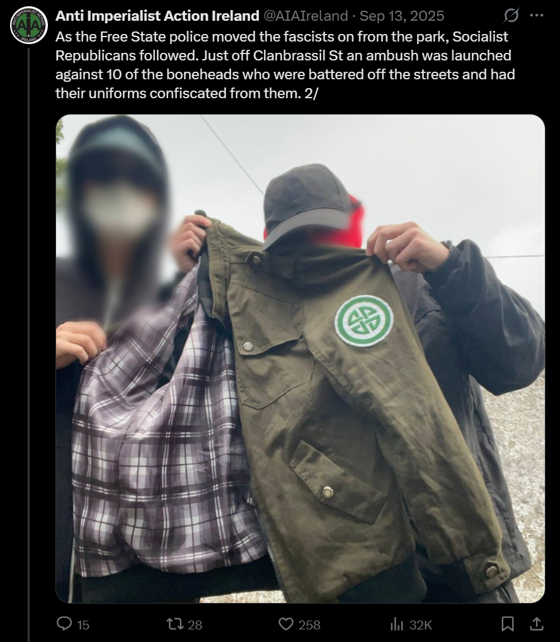
Figure 1. Screenshot from the @AIAIreland X account claiming that socialist republicans and antifascists clashed with approximately ten Clann Éireann members and seized clothing bearing their insignia. Source: @AIAIreland/X, 13 September 2025; screenshot retained by the author.
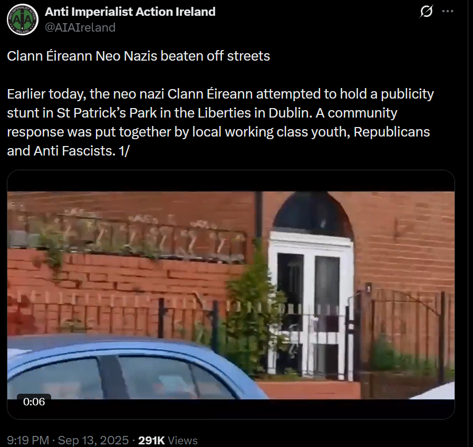
Figure 2. Screenshot from the @AIAIreland X account describing Clann Éireann as “neo-Nazis” and the confrontation as an intervention by local youths, republicans and antifascists. These are the account’s claims. Source: @AIAIreland/X, 13 September 2025; screenshot retained by the author.
Content note: The following image depicts an apparently injured person following a physical confrontation.
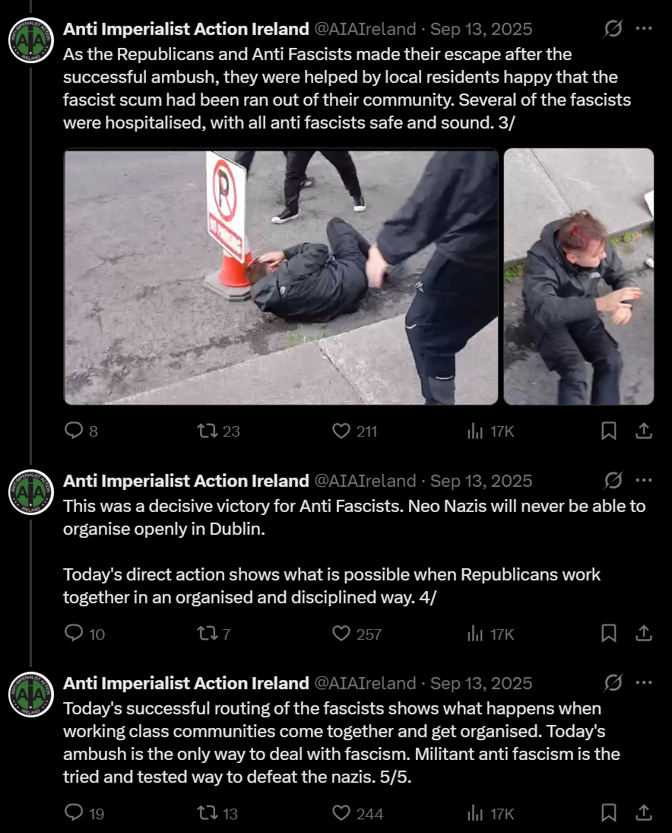
Figure 3. Screenshots of posts describing the confrontation as a successful “ambush,” claiming that several Clann Éireann members were hospitalised, and endorsing organised “militant antifascism.” These are the account’s claims. Source: @AIAIreland/X, 13 September 2025; screenshots retained by the author.
Saoradh
Another example from the Archive is Saoradh, which describes itself as a revolutionary republican movement and, according to the Archive, emerged in 2016. Its constitution sets out the objective of establishing a 32-county Irish Socialist Republic based on sovereignty, self-determination, public ownership, democracy, liberty, equality and international fraternity. It envisages building alliances with groups and individuals sharing similar objectives nationally and internationally. The constitution identifies capitalism and imperialism as interconnected systems of social and economic injustice.
A recent incident involved an individual alleged to be a member of Saoradh. It arose from a July 2026 Garda operation targeting dissident republican activity. On 22 July, the Gardaí’s Special Detective Unit stopped a vehicle on the N2 road south of Carrickmacross, County Monaghan. The Defence Forces’ Explosive Ordnance Disposal team was called to assist. Two individuals were arrested as part of the investigation.
Further details emerged in subsequent court proceedings. In the High Court, it was stated that the Gardaí had found 394 grams of military-grade Semtex, a timer, a timing switch and an active detonator. One of the accused was alleged to have moved the device before it was found in the stopped vehicle in Monaghan. At a bail hearing, Detective Sergeant Shane Noone of the Special Detective Unit told the High Court that the individual was a member of Saoradh, which he described as a “far-left political group” formed by dissident republicans in the Republic of Ireland and Northern Ireland. He also described Saoradh as affiliated with the New IRA. The individual has been charged and the case is ongoing; the allegations should therefore not be treated as facts.
Palestine Action Éire (PAE)
One group not represented in the Irish Left Archive is Palestine Action Éire (PAE), which describes itself as a “direct action network against imperialism and genocide.” The British government proscribed the UK-based Palestine Action organisation under the Terrorism Act 2000 in July 2025; however, the proscription (applicable throughout the United Kingdom, including Northern Ireland) does not automatically extend to PAE. As of October 2026, the Irish government has not proscribed PAE or publicly announced a proposal to proscribe it.
Like AIA, PAE maintains a relatively active social media presence. Its X account is explicitly linked from its public Linktree profile, making it reasonable to assume that the account is official.
The events described below illustrate a pattern of “direct action” as described by PAE: 1) The network identifies companies it considers materially or commercially complicit in what it characterizes as the genocide of Palestinians; 2) It publicly names those targets; 3) It carries out actions including property damage and unauthorized entry; and 4) It releases images, video, and political rationale for its actions.
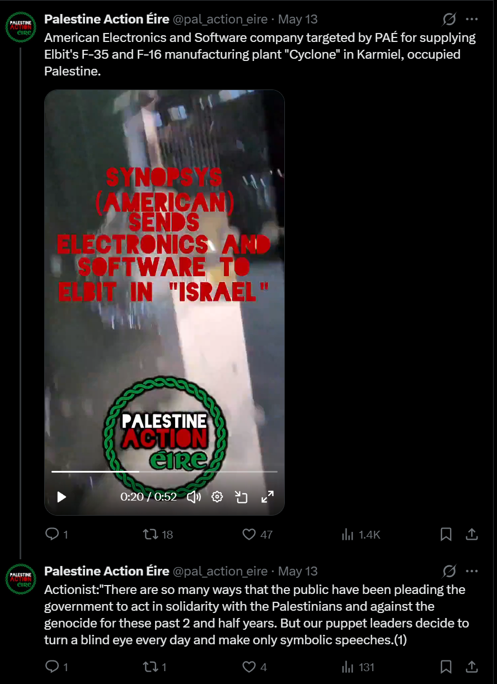
Figure 4. Post from the Palestine Action Éire X account claiming an action against Synopsys in Dublin. PAE alleged that the company supplied software and electronics connected to an Elbit Systems facility. Palestine Action Global subsequently published a communiqué claiming that three activists vandalised parts of the building and painted “Synopsys Drop Elbit.” Sources: Palestine Action Éire/X; Palestine Action Global.
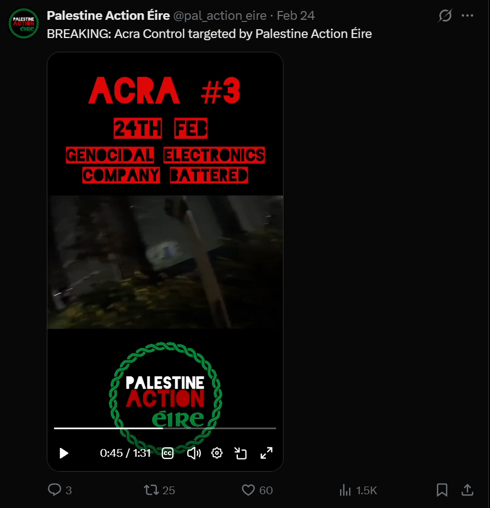
Figure 5. Post from the Palestine Action Éire X account claiming an action against Acra Control. The video title “ACRA #3” presents the incident as part of a repeated campaign. The allegations about the company’s involvement in the Israeli defense supply chain are PAE’s own. Source: Palestine Action Éire/X.
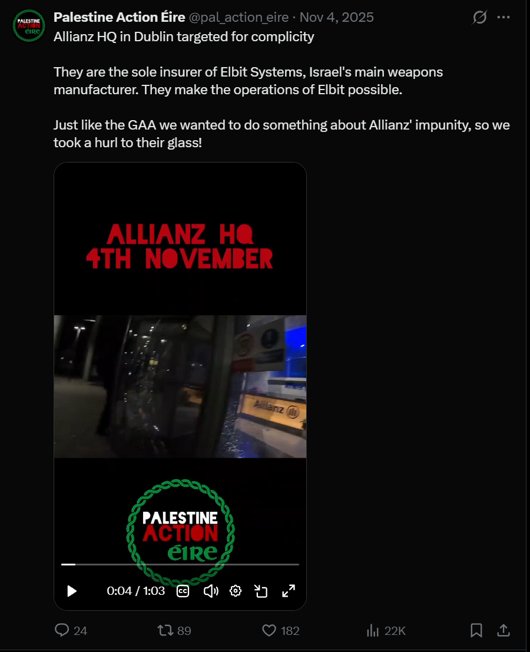
Figure 6. PAE post claiming responsibility for damage to Allianz’s Dublin headquarters on 4 November 2025 and alleging a connection to Elbit Systems. Irish reporting documented broken windows and red graffiti, with Gardaí investigating criminal damage. Allianz denied having a commercial relationship with Elbit Systems. Sources: Palestine Action Éire/X; The Irish Times, 4 November 2025.
Among PAE’s more visible actions have been multiple incidents at Shannon Airport. PAE frames the instances as opposition to the use of the airport by the US military and to Ireland’s policy of military neutrality. On 1 May 2025, three people were arrested after a van breached the airport’s perimeter fence and individuals gained access to the airside, causing a temporary halt to airport operations. PAE claimed responsibility.
On 17 May 2025, three women entered the restricted airside and approached an Omni Air International aircraft, which PAE described as linked to the US military. PAE referred to the action as ‘Operation Siren’. The women allegedly applied red paint to the aircraft. The three women were arrested. During the arrest, a female Garda was injured; the injury was described as non-life-threatening, and she was taken to University Hospital Limerick. Flights were suspended for approximately 30 minutes. Subsequent court reporting confirmed that the three women were charged with criminal damage to the aircraft and unauthorised entry into the restricted area of the airport.
Subsequent court proceedings in May 2025 included the refusal of an application to relax one defendant’s bail conditions, while December 2025 reporting confirmed that all three defendants were contesting the charges and had been returned for trial at Ennis Circuit Court. As of October 2026, the Courts Service legal diary lists the next court date for the case as 13 November 2026, when the court will set trial dates.
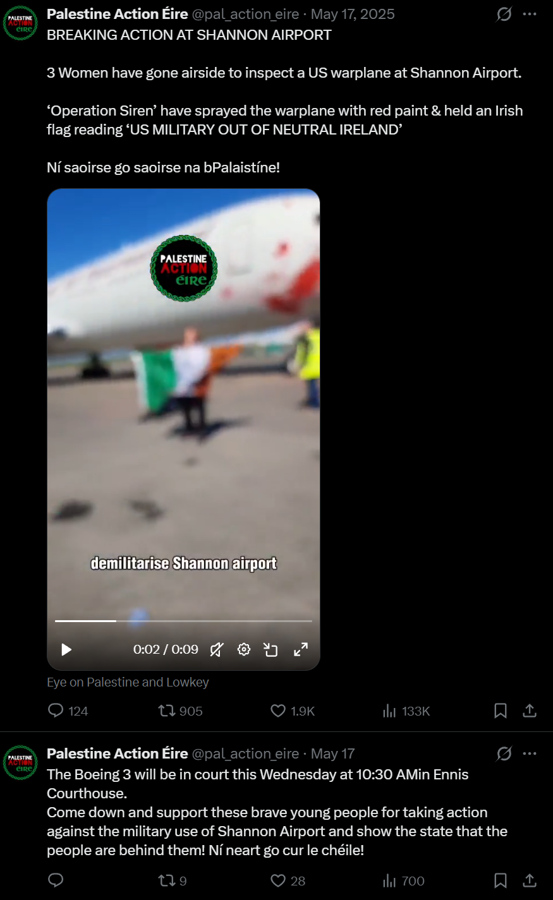
Figure 7. Material published by Palestine Action Éire concerning Shannon Airport. The upper post claims that three women breached a restricted area on 17 May 2025 and applied red paint to an aircraft described by PAE as military-linked. Independent reports confirmed the breach, damage to an Omni Air International aircraft and arrests. RTÉ reported that the aircraft was transiting through Shannon and was not engaged in military activity. The lower post calls for court solidarity and need not concern the same defendants. Source: Palestine Action Éire/X; RTÉ; The Irish Times.
The cases examined above reveal recurring and overlapping mobilizing issues rather than neatly separated ideological agendas. AIA combines socialist republicanism and militant antifascism with broader revolutionary anti-imperialism directed against British, EU, and US influence; NATO; and US military activity, while incorporating international national-liberation struggles, including the Palestinian one, into that framework. PAE approaches several of the same issues principally through Palestine-focused mobilization, anti-Zionism, and opposition to US military activity and alleged corporate complicity. Saoradh remains rooted in revolutionary socialist republicanism and opposition to British rule and partition, but its international activity also incorporates Palestine, anti-imperialism, opposition to NATO and solidarity with foreign revolutionary movements.
In the material considered here, AIA uses antifascism as a mobilizing and self-descriptive category, including the phrase “militant antifascism.” Given the organization’s educational canon, which is heavily rooted in revolutionary socialist, Marxist-Leninist and Maoist traditions, the group’s antifascism is best understood within that broader ideological framework rather than as a separately articulated doctrine. The principal distinction between these actors, therefore, lies less in the issues around which they mobilize than in the ideological frameworks through which those issues are interpreted and the forms of action used to pursue them.
Capabilities and Strategic Logic
Given limited visibility into the ideological nature of violent or politically motivated incidents in Ireland, and the explicitly ideologically neutral legal framework within which such incidents are recorded, little is known with certainty about the capabilities or strategic logic of left-wing political violence overall.
That said, tentative observations can be drawn from the examples discussed above. Rather than a common pattern of behavior, the examples represent a spectrum of activity: from interpersonal political violence and property damage to organized breaches of restricted sites and, in the case of Saoradh, alleged possession of explosive material.
AIA and PAE illustrate different types of activity. The most distinct AIA example discussed above involves direct physical violence against a rival political movement. PAE, by contrast, has a more sustained record of organised small-group direct action. This appears to involve repeated targeting of companies and infrastructure, the use of tools to cause property damage, and entry into restricted areas. The ability to breach the perimeter and airside of a functioning airport to access and interfere with aircraft represents a significantly more serious form of activity, regardless of whether causing physical injury was part of the plan.
The Saoradh-related case presents a different and potentially more serious prospect. The 2026 proceedings discussed above concerned the alleged possession of military-grade explosives and related components. The allegations remain before the courts, and the available evidence does not establish organizational direction or control. If true, the allegations would indicate access to significantly more destructive capabilities than those apparent in the direct-action and street-violence incidents discussed above.
There is likewise little evidence of a common strategic logic across the three cases. AIA’s documented violence was directed at an ideological competitor and appears linked to militant antifascism. The Saoradh-related case arises primarily in the context of dissident republicanism and republican political objectives. PAE, by contrast, appears primarily focused on advancing external political objectives associated with the Israeli-Palestinian conflict, US military activity, and companies perceived as complicit in Israeli military operations.
Overall, the available evidence indicates significant diversity in activities, capabilities, targets, and political goals.
Transnational and Cross-Milieu Connections
The actors discussed above all display forms of transnational political connection, although the nature and depth of those connections vary considerably. They range from explicit ideological internationalism and solidarity with foreign revolutionary movements, through participation in international political events and wider transnational activist networks, to long-standing overlap between republican, separatist and far-left milieus. Within these different environments, mobilization around the Israeli–Palestinian conflict constitutes the most evident point of cross-milieu convergence identified in the cases examined here. The available material supports conclusions about political solidarity, ideological affinity, shared political spaces and, in some cases, direct contact. It does not by itself establish operational cooperation, material support, or capability transfer.
AIA is perhaps the clearest example of ideological internationalism. It self-identifies as part of the international communist movement and frames its struggle in Ireland as part of a wider “world socialist revolution.” AIA publicly declares solidarity with revolutionary and national-liberation movements in the Philippines, Palestine, the Basque Country, and elsewhere, and has described its relationship with the National Democratic Front of the Philippines as “warm and comradely.” AIA’s activities also show significant thematic overlap between Irish socialist republicanism and broader anti-imperialist mobilization. In 2025, for example, it brought together opposition to NATO, British rule in Northern Ireland, US military activity at Shannon Airport, and solidarity with Palestine within a single political framework.
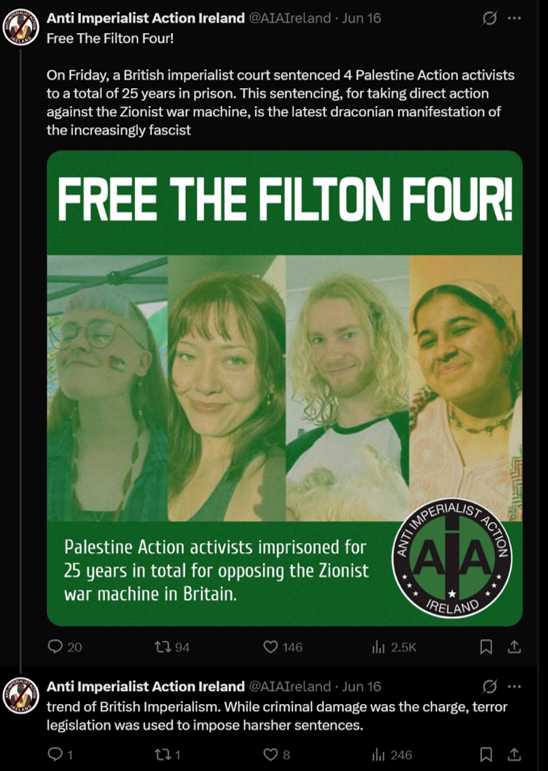
Figure 8. AIA X post supporting the “Filton Four” Palestine Action defendants, described by AIA as “revolutionary prisoners.” It illustrates the organization’s public solidarity with the wider Palestine Action milieu. Source: @AIAIreland/X, 16 June 2026; screenshot retained by the author.
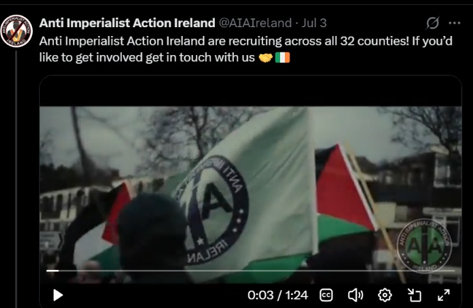
Figure 9. AIA recruitment post advertising recruitment “across all 32 counties.” It includes AIA and Palestinian flags, reflecting the organisation’s all-Ireland self-presentation and integration of Palestine into its anti-imperialist agenda. Source: @AIAIreland/X, 3 July 2026; screenshot retained by the author.
Saoradh likewise maintains sustained international political and solidarity activity through its International Department. Its public material includes solidarity with, or support for, revolutionary and anti-imperialist actors and movements in Colombia, Palestine, the Basque Country, Corsica, and elsewhere, as well as participation in international anti-imperialist events. Its relationship to Palestinian armed movements is particularly explicit. On 7 October 2023, Saoradh publicly “saluted” the “Palestinian resistance” as Operation Al-Aqsa Storm unfolded, framing the operation as part of the struggle against Israeli occupation and imperialism. It subsequently reproduced and disseminated material from the Popular Front for the Liberation of Palestine (PFLP) presenting the operation within the same framework, and has continued to publish material received from, or relating to, the PFLP. This goes beyond generic support for the Palestinian cause and demonstrates that Saoradh incorporates armed Palestinian resistance into its own revolutionary anti-imperialist political framework. The material considered here does not, however, establish whether these political relationships translated into practical or operational cooperation. The PFLP has been listed as a terrorist organization in the European Union since 2002.
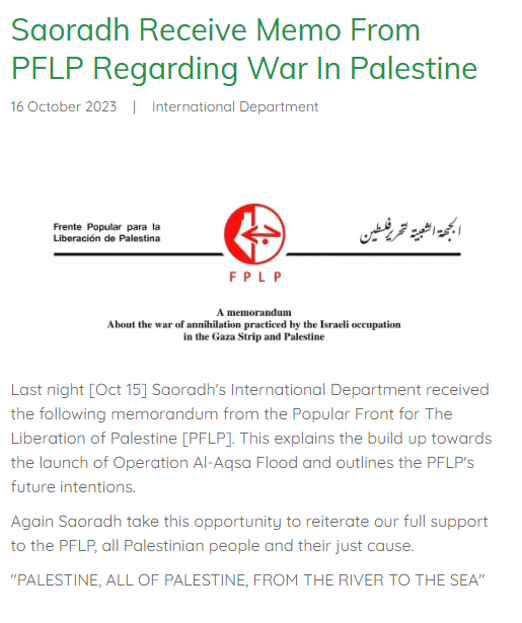
Figure 10. Saoradh International Department post reproducing a memorandum attributed to the Popular Front for the Liberation of Palestine (PFLP) regarding the 7 October attacks. Source: Saoradh International Department, 16 October 2023; screenshot retained by the author.
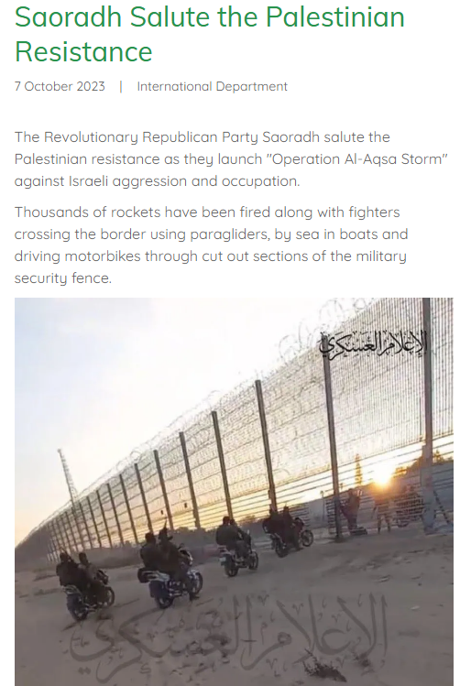
Figure 11. Saoradh International Department post published on 7 October 2023 saluting Palestinian “resistance” and referring to “Operation Al-Aqsa Storm.” Source: Saoradh International Department, 7 October 2023; screenshot retained by the author.
PAE offers a different kind of transnational link. Its ties to the broader Palestine Action movement are identifiable, and the group adopts the wider movement’s name and branding while channeling activity and communiqués through Palestine Action Global. In a September 2025 statement, Palestine Action Global explicitly distinguished its international operations from the UK-based organization, stating that the United Kingdom was excluded from its activities. The material reviewed here does not allow a firmer conclusion about the underlying organizational relationships. PAE should not be treated simply as an Irish offshoot of the UK organization, nor does the UK proscription automatically carry over. What is clearer is its placement within a wider transnational milieu, one organized around Palestine, anti-Zionism, anti-imperialism, corporate complicity, and direct action.
Thematic overlap exists. So does documented political solidarity. AIA addresses Palestine, opposition to US military activity, and anti-imperialism through an established revolutionary socialist-republican lens. PAE, by contrast, reaches many of the same concerns mainly via post-7 October mobilization around Palestine and direct action. AIA has campaigned publicly for Palestine Action activists linked to the Filton case. Saoradh’s International Department has separately expressed solidarity with them. These are political and solidarity-based links to the wider Palestine Action milieu. They do not, on the available evidence, amount to operational cooperation among AIA, Saoradh, and PAE.
The Israeli–Palestinian conflict is consequently more than a parallel concern appearing independently within these organizations. In the cases examined here, the conflict functions as a common mobilizing issue across otherwise distinct political milieus. PAE is organized primarily around Palestine-focused mobilization and direct action; AIA incorporates Palestine into an established revolutionary socialist-republican and anti-imperialist framework; and Saoradh places Palestinian resistance within its own revolutionary republican and anti-imperialist politics. AIA has publicly campaigned in support of Palestine Action activists associated with the Filton case, while Saoradh’s International Department has separately expressed solidarity with Palestine Action activists and publicly supported Palestinian armed resistance. Anti-imperialism provides much of the common political vocabulary connecting these positions. This convergence should not, however, be confused with organisational convergence. The available evidence demonstrates shared mobilizing issues, political solidarity and overlapping political milieus, but does not establish operational cooperation between AIA, Saoradh and PAE.
Foreign conflicts represent another potential avenue for the transnational transfer of capabilities, although no evidence has been identified thus far that the Irish individuals examined here have subsequently applied such capabilities to political violence in Europe. For example, Philip O’Keeffe, an Irish-American volunteer with the YPG in Syria, went on to work with specialized counter-terrorism units trained by Western forces and later with a European project examining counter-drone strategies and systems in a counter-terrorism context. He subsequently resided in Brussels. Similarly, Joshua Molloy, a Laois native and former British soldier, also fought for the YPG, where he was trained in the use of Kalashnikov rifles and grenades before engaging in combat. He later returned to Ireland after leaving the area via Germany. Contemporaneous reporting also confirms Molloy was in Germany in May 2016.
State Response and Outlook
The Gardaí investigate crimes under Ireland’s existing criminal and counter-terrorism legal regimes irrespective of the actors’ ideological affiliation, whether left-wing, right-wing, or otherwise. The state response is therefore predominantly behavior-based rather than ideology-based.
Counter-terrorism and national security investigations are embedded within An Garda Síochána’s national security architecture at institutional level. Key components include the Garda National Crime and Security Intelligence Service, which detects and analyses terrorist threats; the Security and Intelligence Unit, which provides intelligence services and acts as the central contact point for external law enforcement and security agencies; and the Special Detective Unit (SDU), which investigates State security threats and functions as the national counter-terrorism investigation unit. The SDU was directly involved in the Saoradh case outlined above.
The cross-border dimension is especially relevant in the context of dissident republican activity, which involves organizations and networks spanning Ireland and Northern Ireland. There is well-established cooperation between An Garda Síochána and the Police Service of Northern Ireland. In April 2026, the British and Irish governments specifically welcomed the two services’ ongoing cooperation in combating terrorism, paramilitarism, and related criminality.
However, Irish practice also involves some degree of ideological classification of violent activity. For example, Ireland provides terrorism data to Europol, classified under ideological categories. In addition, as demonstrated above, individual Garda officers have used labels such as “far-left” to describe certain organizations. There is a documented case of An Garda Síochána’s operational use of the “far-left” label in the Saoradh case, even though Irish counter-terrorism law contains no separate statutory category of “left-wing extremism.”
Ideological classification is therefore not required for domestic prosecution, although it may be used for analytical, operational or international reporting purposes. This is particularly relevant to understanding Ireland’s reporting to Europol. For several years, terrorist activity in Ireland has been reported to Europol in its EU Terrorism Situation and Trend Report (TE-SAT) under labels such as jihadist, right-wing, and ethno-nationalist/separatist terrorism, with the absence of left-wing or anarchist terrorist attacks or arrests consistently noted. This absence should not be taken as a complete count of all politically motivated unlawful or violent activity in the State, but rather as a product of reporting and classification.
The 2024 example is particularly marked: RTÉ reported that Gardaí regarded dissident republicanism as “the violent wing of the far left”. This was in addition to an arrest made under section 30 of the Offences Against the State Act 1939 in connection with suspected dissident republican activity. However, the corresponding 2025 TE-SAT recorded no Irish arrests in the left-wing/anarchist or ethno-nationalist/separatist categories. It cannot be determined from public sources whether the arrest fell within TE-SAT inclusion criteria, but it illustrates a divergence between domestic security and ideological labeling and European reporting categories.
Publicly available evidence does not indicate that Ireland is moving towards an official domestic schema in which violent political activity is routinely categorized in public as “far-left,” “far-right,” or otherwise. The Government’s current stance addresses threats to State security and terrorism in general terms (Department of Justice, Home Affairs and Migration, Statement of Strategy 2025–2028). It remains to be seen whether the ideological labeling visible in Europol reporting or isolated Garda testimony will become more regular in domestic operations.
Developments to Watch
Three near-term developments are particularly salient: the rise of hybrid post–7 October direct action movements, such as Palestine Action Éire (PAE), which may be the most significant; the further development, or standardization, of the distinction between ideology-neutral domestic enforcement and ideology-specific Europol reporting; and, to a lesser degree, the interplay between dissident republican and far-left politics.
First, the rise of hybrid post–7 October direct action groups such as PAE matters because these groups do not neatly fit the usual left-wing/anarchist categories in the TE-SAT framework. For PAE, the primary political issue is Palestinian solidarity and opposition to Israel. These aims are framed within an anti-imperialist political lexicon and accompanied by a sustained program of what PAE terms “direct action.” As outlined above, this has involved a sustained campaign of property damage, unauthorized access to commercial premises, attacks on businesses the movement considers complicit in Israeli military activity, and incursions into the restricted area of Shannon Airport.
PAE is important because of its hybrid nature: it draws on aspects of radical-left activism while focusing primarily on the Israeli-Palestinian conflict. This makes PAE difficult to categorize within the usual ideological silos of terrorism and violent-extremism reporting.
Second, Ireland clearly has a model for the ideological classification of terrorist incidents and arrests for European reporting. It remains unclear how far this will be reflected in greater domestic visibility.
Third, the overlap between dissident republican and far-left politics remains relevant, albeit to a lesser degree. As seen in the 2026 Saoradh case, Garda officers may sometimes use both terminologies. This is less significant than the rise of new hybrid activist groups such as PAE.
The significance of the post-7 October development extends beyond PAE itself. Across the cases examined in this article, the Israeli–Palestinian conflict has emerged as the clearest common mobilizing issue linking otherwise distinct revolutionary-left, republican and direct-action milieus. PAE is the most direct organizational expression of that mobilization. AIA and Saoradh, by contrast, fold Palestine into older revolutionary anti-imperialist frameworks. Palestine-focused mobilization is therefore both a significant cross-milieu development and a challenge to conventional ideological classification. None of these developments points to the emergence of a cohesive far-left violent movement in Ireland. Nor was that the report's purpose. The cases and material reviewed point instead to fragmentation in politically motivated violence and unlawful direct action, involving groups that differ significantly in ideology, aims, and tactics.
Stay up to date on our latest news.
Get the latest news on extremism and counter-extremism delivered to your inbox.