Europe’s Violent Extreme Left—Part 7: The Case of Greece—Clandestine Networks and Criminal Connections
By Dr. Triantafyllos (Akis) Karatrantos
This article is part seven of CEP’s Europe’s Violent Extreme Left series. It examines contemporary violence-oriented extreme-left and anarchist actors in Greece, focusing on recent attacks, the principal organizations and networks, their capabilities, and the role of criminal and transnational connections. This article also assesses how international conflicts influence domestic mobilization and identifies developments relevant to law enforcement and policymakers.
Greece’s violent extreme-left landscape remains heterogeneous. Clandestine bombing cells coexist with incendiary networks and actors legitimizing intimidation through revolutionary narratives. Assessment must connect organization, capabilities, targets, and enabling relationships. Terrorist attack counts alone cannot capture the threat.
Key findings
• Greece remains one of the EU countries with persistent left-wing and anarchist terrorist activity. Europol recorded one failed attack in 2023, three attacks in 2024 and one completed attack in 2025. Arrests peaked at 20 in 2024 before declining to one in 2025. These figures cover terrorism-related cases and do not include other forms of politically motivated violence.
• Clandestine actors retain explosives and incendiary capabilities. Revolutionary Class Self-Defense claimed bomb attacks against a Greek government ministry and a railway operator. The fatal July 2026 incendiary attacks on residences associated with New Democracy demonstrate the risk to political figures, their families and other civilians; suspects were subsequently investigated for alleged links to the anarchist milieu.
• Organizational fragmentation coexists with continued violent activity. Greece's landscape includes clandestine cells, informal networks and publicly active anarchist collectives. New group names and differing structures can make it difficult to determine whether apparently separate attacks involve the same individuals or networks.
• The Partnership of Revenge case illustrates a crime–extremism nexus. Europol reported alleged paid participation by individuals with organized-crime backgrounds rather than shared anarchist ideology. Seven defendants were convicted in July 2025 of crimes connected to attacks in 2023–2024, highlighting the role criminal facilitators and prison connections can play.
• Transnational solidarity is better evidenced than systematic operational cooperation. Greek anarchist networks participate in international prisoner-support and ideological campaigns connecting Europe and Latin America. Evidence is more limited for coordinated cross-border attacks or systematic transfers of operational capabilities to Greek clandestine groups.
• The Israel–Palestine conflict has influenced militant narratives and potential targets. Revolutionary Class Self-Defense invoked Palestinian armed struggle in the group’s statements, while Rouvikonas organized an “anti-Zionist patrol” in Thessaloniki in June 2026 that prompted a police investigation. The cases raise distinct questions about violence justification, intimidation and target identification.
Definitions and evidence
“Violence-oriented” describes actors committing, preparing, facilitating, or explicitly legitimizing violence; it is not an official Greek personnel classification. Article 187A governs terrorism offenses. The Hellenic Police Counter-Terrorism Directorate investigates; prosecutors and courts determine responsibility. Other political violence may involve arson, assault, threats, racist incitement, or criminal-organization offenses. The reviewed sources provide no comparable nationwide estimate of the violence-oriented extreme-left population.
Evolution and current scale
Karatrantos and Panagiotopoulos’s National Centre for Social Research (EKKE) study identifies declining mass protest-related violence alongside expanding lower-intensity political violence during 2015–2019.
The researchers examined the groups involved, how they operated, their targets, and their connections to criminal activity. The findings suggest that a decline in violent mass protests does not necessarily indicate a decline in violence by smaller groups.
Successive Europol Terrorism Situation and Trend Reports (EU TE-SAT) recorded two arrests for left-wing and anarchist terrorism in Greece in 2023, 20 in 2024, and one in 2025. The 2024 peak was largely associated with major investigations, including those involving Partnership of Revenge and the Ampelokipoi apartment explosion. The number of reported terrorist attacks fluctuated less sharply: one failed attack in 2023, two completed and one failed attack in 2024, and one completed attack in 2025. Arrest figures therefore reflect the timing and scale of police investigations rather than the overall level of violent extremist activity. Europol's statistics also exclude politically motivated violence that national authorities prosecute under other criminal offenses.
The pronounced fluctuation in terrorism-related arrests partly reflects the timing of major investigations rather than a comparable rise and fall in all forms of political violence. Greece’s two terrorism-related arrests in 2023 concerned individuals affiliated with the Turkish Marxist-Leninist terrorist organization Revolutionary People’s Liberation Party/Front (DHKP-C). In 2024, investigations into Partnership of Revenge and a suspected cell following the Ampelokipoi apartment explosion generated multiple arrests.
The sharp increase in terrorism-related arrests in 2024 was largely associated with major police investigations, including those targeting Partnership of Revenge and the suspected clandestine cell investigated after the Ampelokipoi explosion. In July 2025, seven defendants in the Partnership of Revenge case were convicted for their involvement in attacks committed during 2023–2024. These developments help explain why annual arrest figures can fluctuate substantially without necessarily reflecting comparable changes in the overall level of extremist violence.
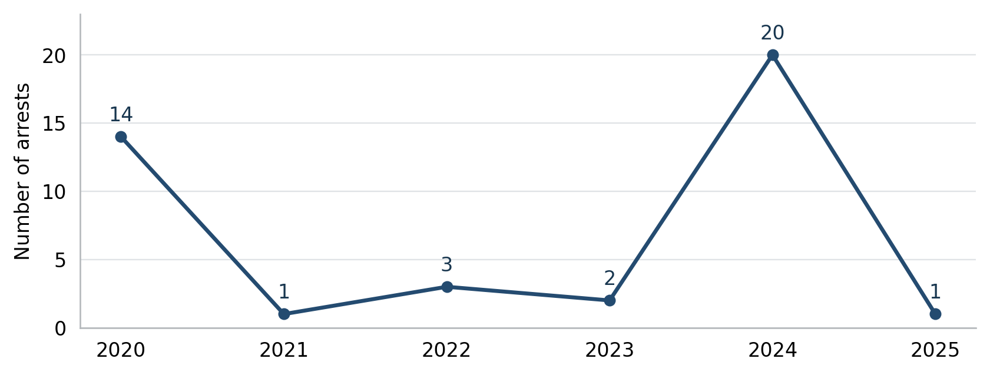
Source: Europol EU TE-SAT reports for 2022, 2024, 2025, 2026. Data for each year refer to arrests for left-wing and anarchist terrorist offenses, not report publication dates. Arrests do not establish guilt or measure the overall prevalence of political violence.
Annual U.S. State Department Country Reports on Terrorism provide additional information about the targets of politically motivated attacks in Greece. The 2022 report documents bombings and arson attacks attributed to anarchist groups against media organizations, journalists’ residences, Orthodox Christian institutions, and property associated with an Italian diplomat. The 2023 report records an attempted bombing near riot-police headquarters in Athens, claimed by Armed Proletarian Justice, a clandestine Greek extremist group.
Actors and organizational forms
Greece’s violent extreme-left landscape includes clandestine cells using organizational labels, informal affinity networks and publicly active anarchist collectives. Armed Proletarian Justice and Revolutionary Class Self-Defense exemplify the first category. Revolutionary Class Self-Defense claimed the Labour Ministry and Hellenic Train bombings. (Hellenic Train is Greece’s passenger-rail operator.) Rouvikonas (Rubicon), a publicly active Greek anarchist collective known for direct-action campaigns, represents a different organizational form; its activities and allegations involving individual members require separate assessment.
Partnership of Revenge warrants particular attention. On February 27, 2024, Greek counterterrorism police conducted coordinated operations in connection with a series of bomb and grenade attacks during 2023–2024. Six suspects were arrested, while four others were already imprisoned for unrelated offenses. According to Europol's 2025 TE-SAT report, some participants with criminal backgrounds received payment for attacks without sharing the group's anarchist ideology. This suggests that criminal connections and financial incentives contributed to the group's activities alongside political motivations. Europol's 2026 report records that seven defendants were convicted on July 18, 2025, for their involvement in attacks using explosives and grenades during 2023–2024. The case demonstrates how criminal actors can contribute personnel and resources to politically motivated violence.
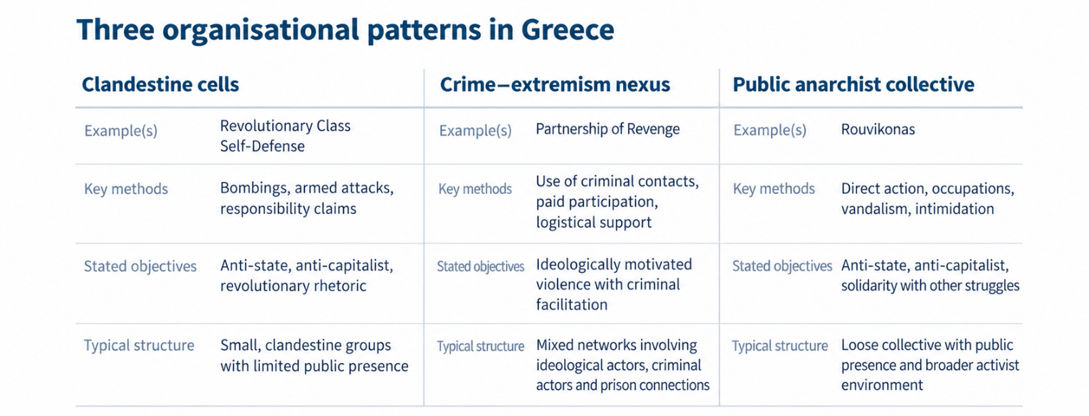
Figure 2. Three organizational patterns in Greece. The figure illustrates three distinct organizational forms within Greece’s violent extreme-left landscape: clandestine bombing cells, networks involving criminal facilitators and paid participants, and publicly active anarchist collectives. The examples represent documented activities and relationships, rather than a single organizational model or shared command structure. Source: Author’s synthesis based on Europol EU TE-SAT reports, as well as reporting by the Greek police and judiciary.
Capabilities and strategic logic
Bombings and incendiary attacks demonstrate continued access to explosive devices and the ability to prepare attacks. Revolutionary Class Self-Defense’s claims combine domestic grievances with Palestinian solidarity. Such attacks can serve purposes including publicity, retaliation, and institutional intimidation. On July 1, 2026, a series of incendiary attacks targeted residences associated with Greece’s governing New Democracy party in Thessaloniki, killing Vagia Nestora and injuring several others. Counterterrorism police subsequently arrested four suspects, some of whom reportedly had connections to the anarchist milieu. Prosecutors brought charges including homicide and participation in a terrorist organization. All four suspects remained in pretrial detention in September 2026, when prosecutors pursued additional charges.
The October 2024 explosion in an apartment in Ampelokipoi, Athens, killed one man and severely injured a woman. In its 2025 TE-SAT report, Europol identified five arrested suspects as members of a newly established anarchist terrorist cell with contacts in Germany and Switzerland. However, on April 24, 2026, an Athens court acquitted three defendants, including Nikos Romanos, after finding insufficient evidence to establish their involvement. The court convicted two women of offenses involving criminal organization, explosives, and weapons. They were subsequently sentenced to 19 and eight years in prison, respectively.
Transnational and cross-issue mobilization
CEP’s transnational analysis highlights personal networks, prisoner campaigns, digital infrastructure and potential capability transfer. Europol identifies solidarity relationships linking anarchist milieus in Italy, Greece, Spain, Chile and Argentina. The international campaign supporting imprisoned Italian anarchist Alfredo Cospito illustrates how prisoner solidarity can generate cross-border threats and attacks. Evidence is strongest for ideological and prisoner-solidarity links and more limited for coordinated operational activity or systematic capability transfers into Greek clandestine networks.
CEP’s antisemitism analysis identifies Gaza-related narratives within Revolutionary Class Self-Defense and discusses Rouvikonas’s 27 June 2026 “anti-Zionist patrol” in Thessaloniki. The collective presented the patrol as opposition to an Israeli economic presence. Police subsequently identified six alleged participants and prepared a case file concerning suspected racist incitement, threats, and criminal-organization or gang offenses. Jewish community representatives characterized the “patrol” as intimidation. The incident illustrates different pathways through which international conflict narratives may contribute to violence justification or domestic targeting. Relevant warning signs include collective blame, identification of targets, threats, and the explicit legitimation of violence.
Four threat scenarios
The following scenarios are analytical pathways, not official threat categories or predictions. They identify developments that would justify closer assessment.
Scenario one: Renewed clandestine bombing networks. New labels may conceal either organizational renewal or surviving relationships. Indicators include recurring personnel, linked preparatory activity, and repeated attacks against state, judicial, or commercial targets. Attribution requires investigative and judicial evidence.
Scenario two: Recurrence of lethal residential attacks. The July 2026 Thessaloniki attacks demonstrate that incendiary violence against occupied residences can produce fatalities. Indicators include further attacks against political figures and their families, repeated residential targeting, threats against identifiable individuals, and willingness to proceed despite foreseeable risks to occupants.
Scenario three: Criminal and transnational capability convergence. Paid participation, prison connections, and foreign relationships may increase access to resources. Indicators include financial transfers linked to attacks, recurring facilitators, and demonstrated transfer of operational expertise. Contacts alone are insufficient.
Scenario four: Antisemitic intimidation and target expansion. International grievances may be redirected towards local civilians and businesses. Indicators include identity-based targeting, repeated threatening patrols, publication of personal information, and movement from rhetoric to preparation or physical violence.
State response and priorities
U.S. State Department reporting recognizes Greece’s counterterrorism cooperation, passenger screening, financial-intelligence arrangements, and regional information exchange. Three priorities follow from the cases examined. First, investigative records and threat assessments should be updated to reflect judicial outcomes, rather than perpetuate preliminary organizational attributions. Second, police and prosecutors should examine enabling relationships—including criminal intermediaries, prison contacts, payments, and recurring participants—alongside ideological affiliations. Third, cross-border cooperation should distinguish solidarity and propaganda from evidence of shared personnel, financing, logistics, or transferred capabilities. Protection of identifiable targets and lawful preventive interventions remain essential. Effectiveness should be measured through disrupted preparations, judicial outcomes, repeat offending, and protection results, rather than arrest totals alone.
Stay up to date on our latest news.
Get the latest news on extremism and counter-extremism delivered to your inbox.