Who Drives the Riots? Europe's Extreme Left and the October Protest Wave
This article examines the role of Europe's extreme-left milieus in the current protests and riots across Europe. It investigates their involvement in violent confrontations, attempts to influence wider demonstrations, and the spread of calls for action and messages supporting political violence across borders. It also examines other left-wing actors whose activities, statements, or connections help explain these developments. Particular attention is given to the evidence of organized violence, competing political strategies, and possible cross-border coordination. CEP's series on the violent extreme left in Europe explains the underlying terminology and research approach in greater detail.
Since mid-September this year, high school students in France have protested against poor school conditions, staff shortages, and inadequate resources. The movement has expanded to include university students, teachers, workers, trade unions, and others concerned about rising living costs. Similar demonstrations took place elsewhere in Europe, often driven by local grievances. Most demonstrations remained peaceful, although clashes with police, arson, and property damage occurred during the preceding weeks. On October 17, violence escalated significantly in France. In Italy, demonstrations also turned violent, with attacks on police, fires, property damage, and looting.
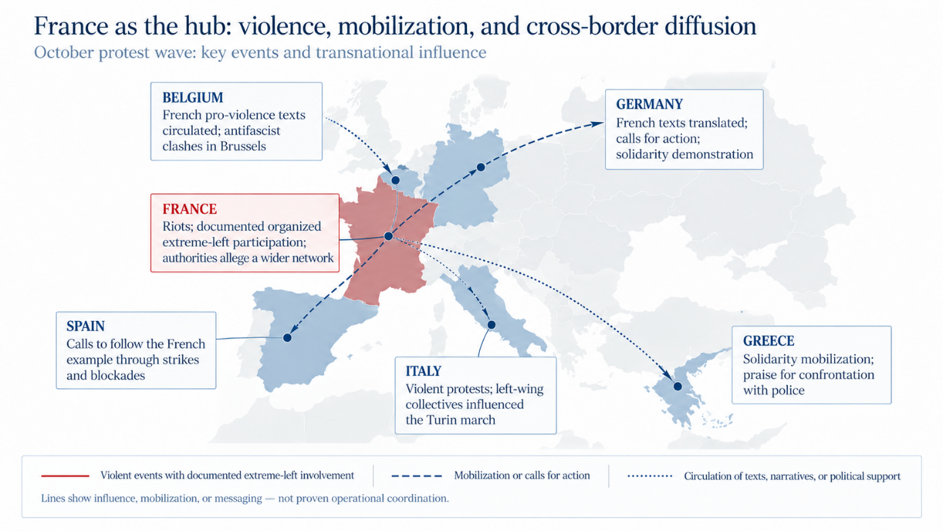
Figure 1. France as the hub: Violence, mobilization, and cross-border diffusion. The map summarizes documented violent incidents, political mobilization, and the circulation of protest narratives across six European countries in September and October 2026. It draws on official statements, news reporting, and publications by left-wing activist groups examined in this article. Connecting lines indicate reported inspiration, information sharing, or calls for action.
In France, journalists documented organized extreme-left groups attacking police, while authorities alleged that a wider network helped instigate the violence. In Italy, left-wing collectives took a leading role in demonstrations that turned violent. In Brussels, largely antifascist demonstrators clashed with police. These events have also fueled a debate within Europe's extreme left over the use and effectiveness of political violence.
The currently available evidence suggests different roles for extreme-left and related left-wing actors: participation in organized confrontations, attempts to influence wider demonstrations, and the spread of messages supporting violence across borders. French authorities also allege a broader network behind the unrest, although its leadership and operational connections have not been publicly established.
What the evidence shows so far: Actors, violence, strategies, and cross-border influence
Actors and activities. France and Italy have seen violent protests involving both loosely organized participants and established extreme-left activists. French authorities attributed part of the violence to organized groups from the ultragauche, or extreme left. In Italy, reports indicate that left-wing collectives became influential during a demonstration in Turin. Both countries also experienced violence involving young people whose organizational affiliations remain unclear. A September police intelligence report also documented outside extreme-left activists at some earlier French school protests. The identities and affiliations of many perpetrators remain unclear, as do the organizational links between attacks and the possible role of a wider network.
Violence. Some actors within the extreme left openly support or legitimize violent confrontation. In France, Contre Attaque, an autonomous-left media collective, celebrated the police's apparent loss of control during the riots. Cerveaux Non Disponibles, a French left-wing activist media collective covering protests and social movements, explicitly refused to condemn the violence. In Turin, police reported finding incendiary bottles and other objects associated with violent attacks. The available evidence documents public support for violent confrontation, reported preparations for attacks, and violent acts. The role of organized extreme-left groups in specific attacks remains under investigation.
Strategies and discussions. Publications associated with the extreme-left milieus in Europe disagree over how the protest movement should develop. Some favor spontaneous confrontations and independent groups. Others argue for clearer political objectives and stronger organization. In Turin, activists from left-wing political collectives joined a larger protest. Some took a leading role in the march, against the wishes of its original organizers. In France, some autonomous-left writers have criticized established left-wing parties and unions for attempting to lead the youth protests.
Cross-border connections. The protests in France have attracted support within extreme-left milieus across Europe, including before October 17. German platforms have translated French revolutionary texts discussing barricades and sabotage. Italian activists have discussed the influence of the French unrest on domestic protests. In Belgium, the activist platform Stuut circulated French texts praising attacks on police, burning barricades, and looting. In Spain, Izquierda Revolucionaria, a revolutionary socialist organization, urged students to follow the French example through strikes and school blockades. In Greece, revolutionary socialist activists called for a solidarity demonstration and praised confrontations with police.
These developments show how protest narratives, calls for mobilization, and messages supporting political violence currently spread across Europe. Earlier CEP research has already documented cross-border cooperation among violent extreme-left networks. Whether the current protest wave will lead to joint planning or coordinated violent attacks remains unclear.
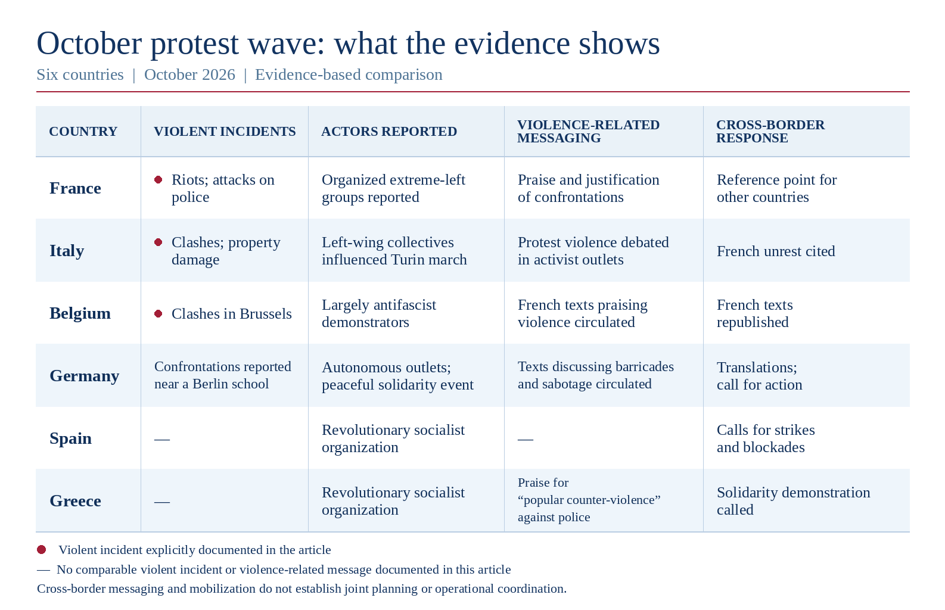
Figure 2. October protest wave: What the evidence shows. The matrix compares findings from the six countries examined in this article, distinguishing violent incidents, reported involvement of political actors, statements concerning violence, and cross-border mobilization. It is based on official sources, contemporary news reporting, and publications by the actors concerned. A dash indicates that no comparable violent incident is documented in this article. The matrix reflects the available evidence as of October 19, 2026.
France: Violence and the revolutionary opportunity
Student protests began in France in mid-September. Most demonstrations remained peaceful, but violent clashes and property damage accompanied the movement in several cities. By October 8, authorities had placed 6,877 people in police custody in connection with the unrest. On October 17, most demonstrators again marched peacefully, while groups in Paris, Marseille, Lyon, Limoges, and other cities attacked police, set fires, damaged public buildings, and looted shops. In Lyon, a tourist office was set on fire. Limoges City Hall was set ablaze. In Marseille, several dozen rioters broke into City Hall and damaged its entrance hall.
Interior Minister Laurent Nuñez attributed part of the violence to extreme-left groups, alleging that they had helped instigate attacks on police, businesses, and public buildings. Journalists documented organized groups attacking police, alongside students, young people from working-class neighborhoods, and looters.
A September 28 intelligence note from the Paris Police Prefecture alleged that extreme-left organizations had influenced the early student protests. The note identified outside students, union members, or politicians at six of 27 school protest actions in Seine-Saint-Denis. Le Monde, which obtained the document, questioned whether this supported the broader claim that such organizations directed the movement. On October 19, Prime Minister Sébastien Lecornu cited intelligence services in alleging that an extreme-left movement intended to sustain unrest through the April 2027 presidential election. Paris prosecutor Laure Beccuau said investigators had not established the political affiliations of those detained.
Within the extreme left, the response exposed differences over the use and effectiveness of violence. On October 18, Contre Attaque declared that police had lost control of parts of several cities. It described the confrontations as evidence of a possible revolutionary uprising. The article also acknowledged that the movement had failed to achieve a political victory because it lacked common objectives and a clear strategy.
On October 19, Cerveaux Non Disponibles openly refused to condemn the violence. Its statement was republished by Paris-Luttes.info, a Paris-based activist publishing platform. It described October 17 as the beginning of a wider struggle against the government.
Other actors took different positions. Révolution Permanente, a French Trotskyist political organization and online newspaper, accused the government of using allegations about the extreme left to discredit the demonstrations. FSU, a French trade union federation particularly active in education, condemned violent acts by a minority of protesters while criticizing police conduct.
On October 15, the French autonomous-left journal Lundimatin published an article that criticized established left-wing parties and student unions for trying to take control of the youth protests. It argued that students had organized themselves and should remain independent of party leadership.
The unrest also included reports of antisemitic incidents. Jewish-owned businesses were among those damaged in Marseille. However, the Jewish Community Protection Service, which monitors antisemitism and provides security for Jewish institutions in France, reported that evidence of deliberate religious targeting was lacking. Separately, a masked protester was reported carrying an antisemitic placard in Paris.
Italy: Who takes control of the protest?
Similar protests took place in Italy on October 17. Demonstrations in Milan, Turin, Bologna, and other cities led to attacks on police and extensive property damage.
In Milan, reports indicated that many violent participants were young people from suburban neighborhoods. Around 50 were taken to police headquarters, nearly half of them minors.
The demonstration had been announced as a nonpartisan protest against rising living costs. During the march, activists from left-wing political collectives, self-managed social centers, and pro-Palestinian networks took a leading role. Some tried to change the route. The original organizers objected and demanded that masked participants uncover their faces. Disputes broke out between protesters.
Police detained 12 people, including ten minors. According to police, the detainees possessed Molotov cocktails, fireworks, stones, and glass-breaking hammers. Investigators are examining their roles in the violence.
Contropiano, an Italian communist newspaper associated with the revolutionary communist organization Rete dei Comunisti, described the demonstrations as largely spontaneous. It argued that riots needed clearer political objectives, coordination, and organization to achieve lasting results.
InfoAut, an Italian autonomous-left activist media platform, welcomed the growing protests and rejected demands to isolate masked participants. It also suggested that the violence in France had helped inspire the Italian mobilization.
The Italian cases show how spontaneous unrest can create opportunities for organized left-wing actors to gain influence over broader protest movements. The strategic debate concerns how to turn confrontations into sustained political mobilization, whether through decentralized action or stronger organization. The extent to which established networks planned or directed the violence remains unclear.
Germany: French protests inspire calls for action
The French unrest is also attracting attention in Germany's extreme-left scene.
On October 9, Kontrapolis, a Berlin-based autonomous-left publishing platform, published a German translation of an article by authors writing under the name Groupe Révolutionnaire Charlatan. The text praised independent groups of young protesters and discussed barricades, sabotage, and confrontations with police. It criticized established left-wing parties and unions for trying to control the youth movement.
On October 16, an anonymous contributor to German Indymedia, an extreme-left website, called for an international youth uprising on November 20. The contribution expressed support for school blockades in Berlin and Hamburg.
Also on October 16, students blocked entrances to a Berlin school to demand more education funding and oppose compulsory military service. Police reported clashes involving protesters and officers, as well as an attack on a 67-year-old local resident. A 17-year-old suspect was detained on suspicion of assault. Police also reported that individuals from outside the school had joined the protests.
These cases show how French protest narratives circulated in Germany alongside local mobilization. No evidence has emerged linking German groups to planning or carrying out violence in France or Italy.
Elsewhere in Europe: Solidarity, mobilization, and violence
In Greece, OKDE, a revolutionary socialist organization, called for an October 17 morning demonstration in solidarity with French students. They praised the French youth movement and what it called popular counter-violence against police.
In Spain, Izquierda Revolucionaria, urged students to follow the French example by organizing strikes and school blockades. The international Trotskyist network associated with Révolution Permanente also promoted the French mobilization through its Spanish-language publications.
In Belgium, Stuut, a Brussels-based activist publishing platform, circulated French revolutionary texts praising attacks on police, burning barricades, and looting. On October 17, approximately 500–600 reportedly largely antifascist demonstrators clashed with police in Brussels. Rioters threw projectiles, erected barriers, and damaged property. The organizational affiliations of those responsible remain unclear.
Stay up to date on our latest news.
Get the latest news on extremism and counter-extremism delivered to your inbox.