Europe’s Violent Extreme Left — Part 4: Antisemitism, Anti-Zionism and Political Violence
This article is part of CEP’s series on the violent extreme left in Europe. It focuses on antisemitism and eliminationist anti-Zionism within violence-oriented left-wing milieus. The article provides examples and analysis from France, Germany, Greece, Italy, and Spain and asks how antisemitic and anti-Zionist narratives can justify violence, connect extremist actors, or contribute to target selection. It concludes with policy recommendations for EU and national authorities on identifying, assessing, and responding to violence-oriented antisemitic extremism.
Key Findings
- The Israel–Palestine conflict has become an additional mobilizing issue within parts of Europe’s existing violence-oriented extreme left. Several actors examined here have incorporated antisemitism and/or eliminationist anti-Zionism into established revolutionary, anti-imperialist, or antifascist agendas.
- Justifying violence as “resistance” is a recurring pattern. Some actors praise attacks or present militant action as a model for political action. The risk of violence increases when general support for “resistance” develops into endorsement of specific attacks, identification of concrete targets, or encouragement of further violence.
- Target expansion is an important escalation indicator. In several cases, hostility moves from Israel and Israeli institutions toward businesses, organizations, and identifiable people described as “Zionists.” Public lists, collection of identifying information, and intimidation reduce the distance between ideological hostility and physical targeting.
- Actors perform different functions: some legitimize violence, connect groups, identify targets, or organize and conduct attacks. These functions can overlap without common leadership.
- Available statistics cannot establish the scale of antisemitic violence attributable to left-wing extremist actors across Europe. National systems measure different phenomena, and perpetrators’ affiliations often remain unknown.
Policy Priorities - Full Recommendations Below
- Improve recording and analysis. Introduce violence-oriented antisemitic extremism (VAE) as an analytical threat category for cases where antisemitic worldviews are central to organizing or justifying violence.
- Connect information on organized violence-oriented antisemitism. Move beyond responding to individual incidents and identify the recurring actors, networks, financiers, and coordinators behind violence-oriented antisemitic activity.
- Assess cross-border linkages. Examine recruitment, financing, logistics, and other assistance linked to violence.
- Strengthen practitioner training. Help practitioners identify when rhetoric shifts toward targeting, threats, support for violence, or attack preparation, while distinguishing these indicators from lawful political expression.
Definitions, Concepts and Limitations
|
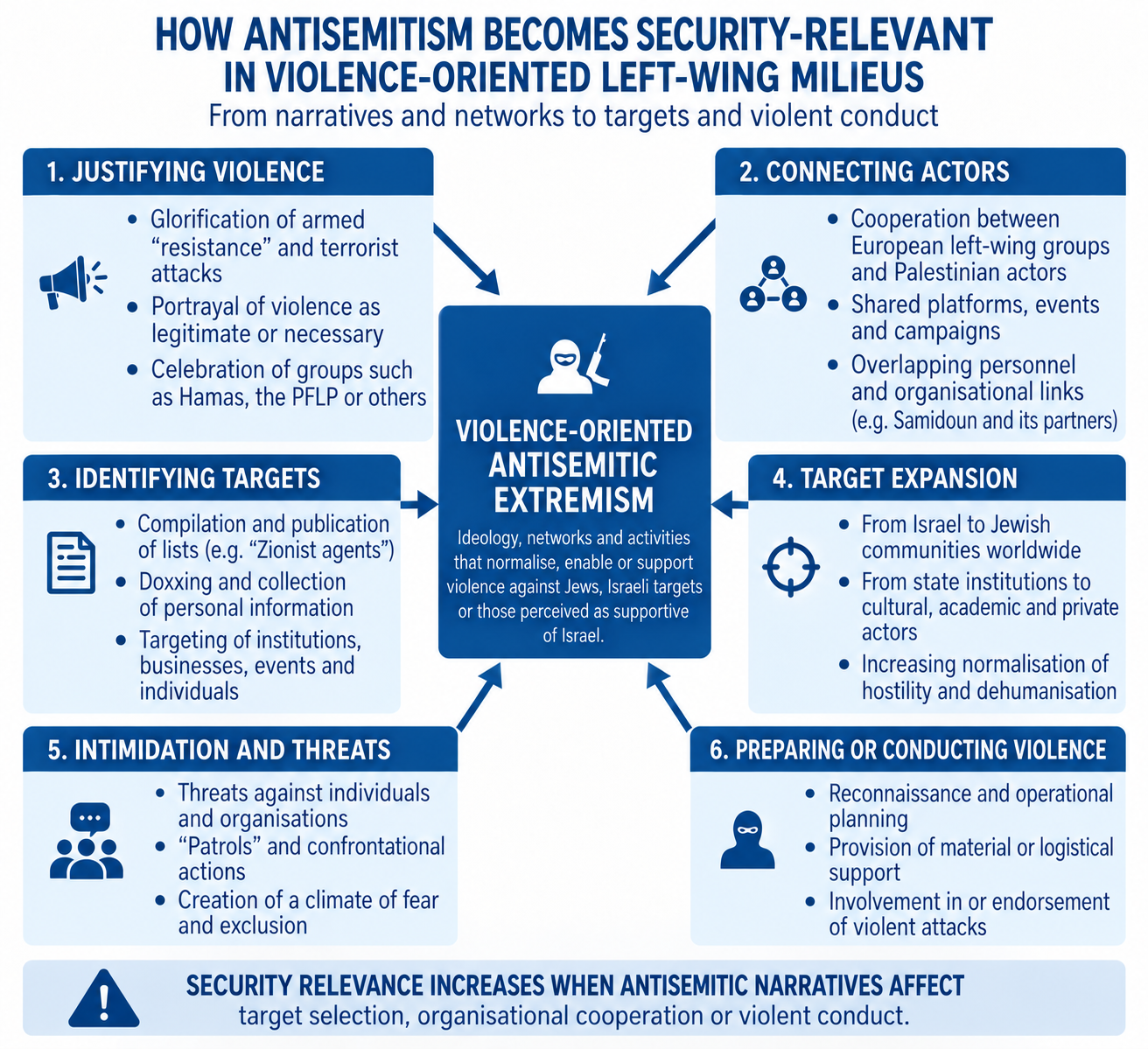
Figure 1: How Antisemitism Becomes Security-Relevant in Violence-Oriented Left-Wing Milieus. Source: Author’s synthesis based on the cases and sources cited in this article.
Five-country examples: different pathways from antisemitic narratives to violence
The relationship between antisemitism and violence-oriented left-wing extremism differs considerably across Europe. The cases examined indicate different relationships between political narratives, organizational connections, and violent conduct. Comparison is difficult because national data measure different phenomena. Germany records politically motivated crime according to ideological attribution, thematic fields, and antisemitic motivation. Italy and Greece feature particularly prominently in Europol terrorism data. France and Spain collect antisemitism and hate-crime data, but these usually do not establish whether perpetrators belonged to left-wing groups or networks. Jewish community monitoring adds a further layer by documenting incidents that affect Jewish life but do not necessarily result in extremism or terrorism classifications.
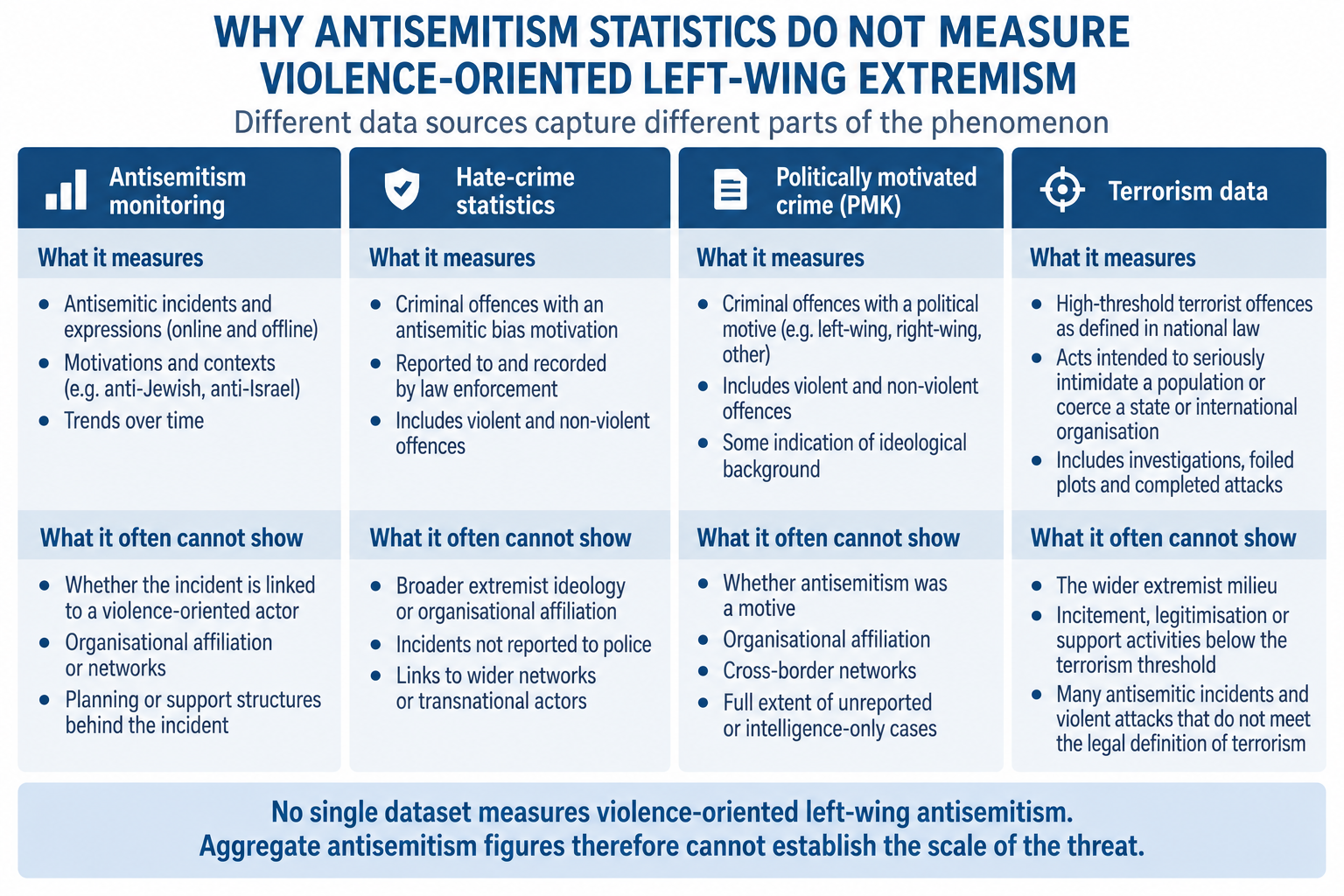
Figure 2: Why Antisemitism Statistics Do Not Measure Violence-Oriented Left-Wing Extremism. Source: Author’s synthesis based on the national monitoring, crime, and terrorism data discussed in this article. Recording systems measure different phenomena and are not directly comparable.
France: violent antifascism, eliminationist anti-Zionism and target expansion
France had an established violence-oriented ultragauche (‘ultra-left’) and militant antifascist milieu well before October 7. A 2020 official assessment described parts of this milieu as willing to use violence as a political instrument. It identified the police, symbols of state authority, companies, and infrastructure as recurring targets. Alongside this environment, revolutionary pro-Palestinian actors supported armed Palestinian “resistance.”
The case of Collectif Palestine Vaincra, a Toulouse-based revolutionary pro-Palestinian anti-Zionist collective, showed support for the Popular Front for the Liberation of Palestine (PFLP). The PFLP is listed as a terrorist organization by the European Union. In February 2025, the Conseil d’État upheld the group’s dissolution on the grounds that antisemitic and hateful comments under its social-media publications were attributable to the group and that it had failed to prevent or moderate them adequately. At the same time, the court found that the group’s own militant anti-Zionist positions did not, by themselves, constitute antisemitic speech.
The case of La Jeune Garde, a militant antifascist network, combines evidence of organized violence with a separate allegation of antisemitic targeting. In June 2024, eight alleged members were placed under formal investigation and judicial supervision following an alleged antisemitic incident involving a 15-year-old Jewish boy in the Paris Métro the previous month. The government dissolved La Jeune Garde in June 2025. The Conseil d’État upheld the dissolution in April 2026, finding a recurring pattern of violent confrontation and efforts to physically exclude perceived opponents from public space.
Jewish community monitoring adds important context. The Service de Protection de la Communauté Juive (SPCJ) recorded 1,320 antisemitic acts in France in 2025, including 126 incidents involving physical violence. SPCJ also identifies segments of the extreme left as one channel through which eliminationist anti-Israel rhetoric can turn Jews perceived as Israel supporters into targets.
Germany: cooperation between extremist networks
The Federal Office for the Protection of the Constitution (BfV), Germany’s federal domestic intelligence agency, describes autonomous left-wing extremists as often holding pro-Israel positions, while anti-imperialist and dogmatic communist milieus are predominantly pro-Palestinian. The agency explicitly states that anti-imperialist criticism of Israel does not automatically constitute antisemitism. It states that, depending on context, the denial of Israel’s right to exist, collective hostility toward Jews, or the reinterpretation of terrorist attacks against Israeli civilians and Jews as legitimate “resistance” can enter the field of Israel-related antisemitism.
Kommunistische Organisation (KO) is a German Marxist-Leninist organization that the BfV classifies as left-wing extremist. In the Israel–Palestine context, the BfV reports that KO expresses solidarity with Samidoun, rejects Israel’s right to exist, and has argued that Hamas, the PFLP, and Palestinian Islamic Jihad should not be regarded as terrorist organizations. According to the BfV, the PFLP’s international support network Samidoun endorsed violence and supported terrorist organizations, including the PFLP and Hamas. Germany prohibited Samidoun’s activities and banned its German organization in November 2023. The case illustrates how eliminationist anti-Zionism can combine with the legitimation of armed violence by Palestinian terrorist organizations.
Perspektive Kommunismus (PK) is a German revolutionary-communist alliance that the BfV places within the violence-oriented left-wing extremist spectrum. After October 7, PK condemned attacks on civilians but described Palestinian armed action as legitimate “resistance against Israeli occupation.” In 2024, it also portrayed PFLP member and aircraft hijacker Leila Khaled as an inspirational revolutionary figure, illustrating how an established violence-oriented group can incorporate Palestinian armed struggle into its broader anti-imperialist worldview.
Police figures show an increase in recorded Israel/Palestine-related left-wing offenses: 437 in 2024, up from 129 in 2023. The Federal Association of Research and Information Centers on Antisemitism (RIAS) is a German civil-society network that documents antisemitic incidents nationwide. Its 2025 report recorded 501 left-wing anti-imperialist incidents; 94 percent involved Israel-related antisemitism. RIAS also recorded 214 gatherings with antisemitic incidents attributed to a left-wing anti-imperialist background, up from 131 in 2024. Some cases contained explicitly violence-oriented rhetoric. In Bremen, for example, the slogan “9mm for Zionists” was spray-painted alongside a hammer-and-sickle symbol. The report does not, however, provide a breakdown showing how many of the 501 left-wing anti-imperialist incidents involved threats, assaults, or other violent conduct.
The available data show a measurable left-wing anti-imperialist component within contemporary antisemitism. Relevant patterns for Germany concern extremist network convergence, violence legitimation, and ideological bridging.
Greece: "Pro-Palestine" enters an established militant milieu
Greece begins from a different baseline. It has one of Europe’s most persistent contemporary anarchist and left-wing terrorist environments. Its principal targets have historically been the state, police, companies, prisons, infrastructure, and institutions or symbols associated with capitalism. Europol reports show left-wing and anarchist terrorism as a significant Greek security phenomenon. The clearest post-October 7 development is the incorporation of Palestinian armed struggle into claims of responsibility for terrorist attacks.
Revolutionary Class Self-Defense, a Greek urban guerrilla group, claimed responsibility for the 2024 Labour Ministry bombing and the April 2025 Hellenic Train bombing in Athens. Its communiqué combined domestic grievances with support for Palestinian resistance. It also used explicit anti-Zionist language, accusing Greece of complicity in what it described as an American-Zionist war in Palestine. This illustrates how a violent group can incorporate the Gaza conflict into its justification for attacks on domestic institutions.
Rouvikonas, a Greek anarchist collective known for violent direct actions against state, corporate, and diplomatic targets, presents a direct case of target expansion. In June 2026, Rouvikonas publicized what it called an “anti-Zionist patrol” through Thessaloniki. The group framed the action as opposition to Israeli investments and Israeli economic presence. Following a prosecutor-ordered investigation, police identified six participants in August 2026 and opened a case file concerning alleged incitement to violence with a racist motive, threats, incitement to commit crimes, and participation in a criminal organization or gang.
The Central Board of Jewish Communities in Greece (KIS) interpreted the action considerably more strongly. It described the patrol as intimidation directed at Jews, Israelis, tourists, and business owners and compared its appearance with historical antisemitic “assault squads.”
The two cases show different pathways. Revolutionary Class Self-Defense used Palestine to justify attacks on domestic institutions. The Rouvikonas case shows a different risk: political hostility toward Israel can expand into threats and intimidation tactics in Europe. The key warning sign is when opposition to Israel shifts toward collective blame or targeting of Jews or Israelis.
Italy: armed “resistance” as a model and domestic “Zionist” targets
Italy also entered the post-October 7 period with an established violence-oriented anarchist and revolutionary-left militant milieu. Much of its longstanding violent track record concerns the state, prisons, companies, police, and infrastructure.
The Partito dei CARC, an Italian revolutionary communist party, responded to October 7 by describing the attack as an unprecedented blow inflicted by the Palestinian “resistance” on the “Zionist occupier.” Its publications argued that the attack demonstrated that materially weaker forces could resist, counterattack, and inflict serious blows on a stronger opponent.
The (nuovo) Partito Comunista Italiano, or (n)PCI, is a clandestine Italian Marxist-Leninist-Maoist organization that advocates a long-term “revolutionary people’s war” to establish socialism in Italy. In August 2024, the organization published a list of supposed “Zionist agents in Italy.” The list included Jewish community representatives alongside journalists, politicians, academics, businesses, and other individuals. Readers were encouraged to provide further information about people considered part of the same enemy structure.
The Fondazione CDEC Antisemitism Observatory documented the renewed appeal by the (n)PCI asking supporters to provide names, photographs, and information about alleged agents of the “Zionist entity.” CDEC treats the blacklist as antisemitic where Jewish individuals are collectively defined as agents of an alleged Zionist power.
CDEC’s broader 2025 monitoring strengthens the context. It recorded 963 antisemitic incidents, up from 877 in 2024, 453 in 2023 and 241 in 2022. The report identifies Israel-related antisemitism as the principal contemporary matrix and describes extreme left, communist, student and trade-union actors participating within the wider Palestine mobilization. CDEC also documents that some pro-Palestinian demonstrations brought together radical-left, Palestinian and Islamist actors, while symbols of Hamas, Hezbollah and the PFLP appeared at some events. This indicates cross-milieu mobilization.
In Italy, October 7 supplied parts of the revolutionary communist left with a model of perceived legitimate armed resistance, while some actors translated the category “Zionist enemy” into the identification of domestic individuals and institutions.
Spain: growing antisemitism and transnational relevance
The most visible case in Spain is Masar Badil, the Palestinian Alternative Revolutionary Path Movement. The organization was formally launched through conferences in Madrid, Beirut, and São Paulo in 2021. Its Madrid declaration established a radical “popular resistance movement” against Zionism, rejected the Oslo process, and explicitly located the organization within a broader international revolutionary struggle.
An executive committee member of Masar Badil describes extensive personnel and organizational overlap with Samidoun and openly presents the movement as a bridge between Western activists and Palestinian terrorist organizations, including the PFLP, Hamas, and Palestinian Islamic Jihad. The same interview also documents involvement in Samidoun and describes how discussions organized through that network contributed to Masar Badil’s formation.
In August 2026, the U.S. Treasury sanctioned Masar Badil under counterterrorism authorities. The Treasury described Masar Badil as a front for Samidoun and stated that the two organizations share fundraising mechanisms, senior leaders, and executive-committee members. Because Treasury had previously designated Samidoun as a PFLP front, it also described Masar Badil as operating as a PFLP front.
Jewish community monitoring shows a wider antisemitism problem without resolving the attribution question. The Federación de Comunidades Judías de España (FCJE) and Movimiento contra la Intolerancia recorded 221 antisemitic incidents in 2025, compared with 193 in 2024. FCJE stated that the position of the extreme left contributed to increasing hostility toward Jews. Spain’s Interior Ministry reported a 60.9 percent increase in recorded antisemitic hate incidents in 2024. The figures do not provide a corresponding far-left classification.
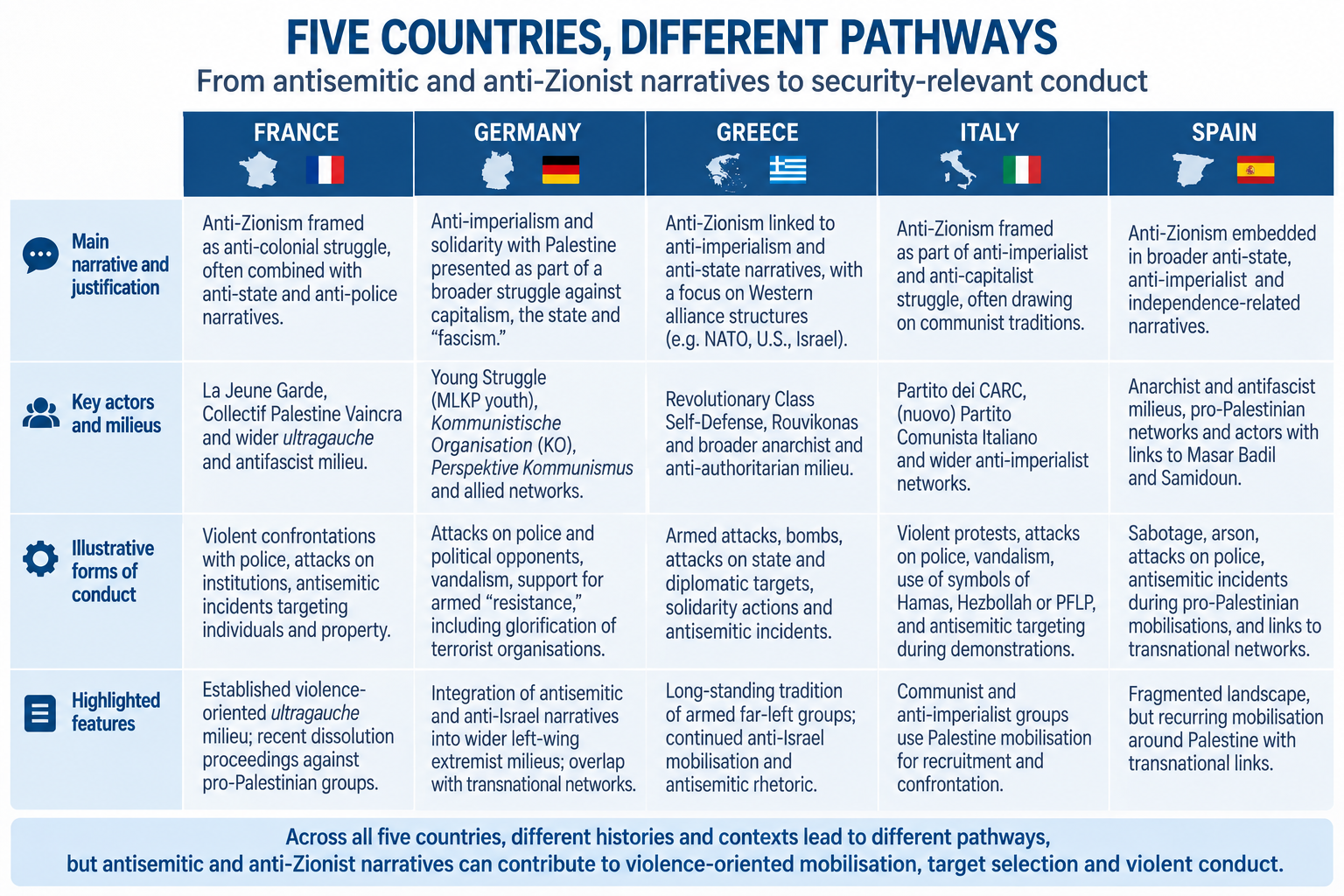
Figure 3: Five Countries, Different Pathways. Source: Author’s synthesis based on the country cases and sources cited in this article.
What the five countries show: narratives, networks and targeting
Across the five countries, the clearest common development is the legitimation of violence as “resistance.” Some revolutionary-left actors describe Palestinian armed struggle as justified, necessary or exemplary. In the strongest cases, this language appears in the claims of groups that themselves conduct terrorist attacks. Others build relationships with organizations that support armed struggle or identify domestic people and institutions as enemies.
Justifying violence can give existing political commitments a new focus
Some violence-oriented left-wing actors interpret Palestinian armed action through their existing opposition to capitalism, imperialism, or the state. Their statements can present violence as necessary, legitimate, or effective. The Italian CARC example illustrates explicit approval of the October 7 attack. The Greek bombing claims illustrate the incorporation of Palestine into an existing language of political violence.
The cases also show that online communication can perform different functions within violence-oriented environments. CARC publications presented the October 7 attack as evidence that materially weaker forces could successfully strike a stronger opponent. The (n)PCI went further by soliciting identifying information about alleged “Zionist agents.” These activities have different security implications. The first legitimizes violence as a political model. The second can facilitate intimidation or targeting by making identifiable people more visible to supporters.
Cooperation can develop around a shared cause despite ideological differences
Both the German cases and the Spanish Masar Badil material show how actors with different political objectives can maintain contacts, share campaigns, or provide platforms for armed organizations. Such connections matter because they may extend an actor’s audience, relationships, and access to support.
The type of connection determines its significance. Appearing at the same demonstration provides limited evidence of cooperation. Repeated joint organization, overlapping leadership, or shared fundraising establishes a closer relationship. Assistance with recruitment, logistics, or attack preparation would require a more urgent response. Each relationship should be assessed on its documented activities.
Identifiable domestic targets create a direct protection concern
The Italian targeting of "Zionist agents" appeals and the Greek "anti-Zionist" patrol case bring the analysis closer to the safety of people within Europe. Such activities can intimidate people and make them easier to locate. An assessment should consider the information published, the accompanying language, the audience addressed, and any subsequent threats. Where Jews are treated collectively as responsible for Israel’s actions, the targeting also has an antisemitic dimension.
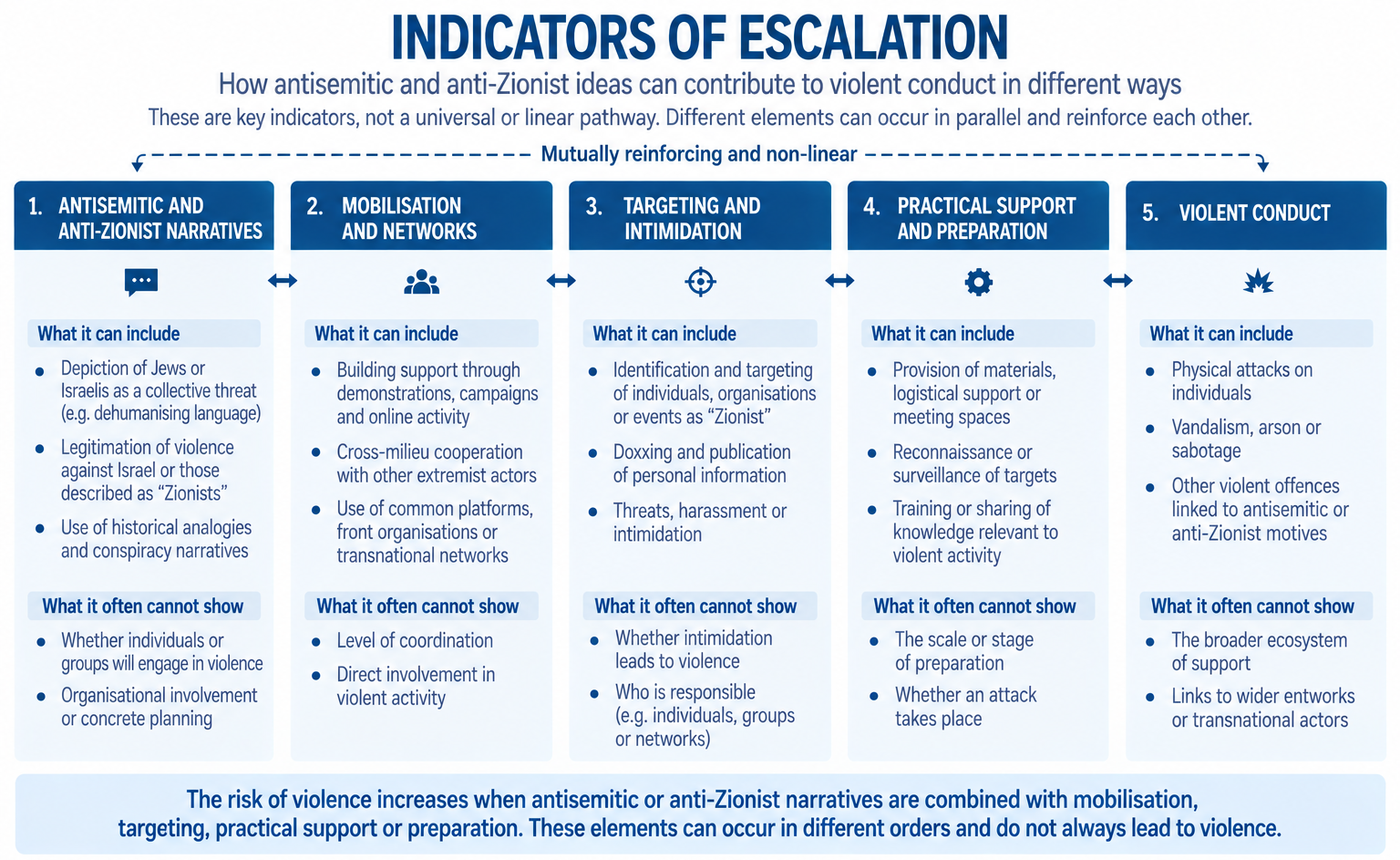
Figure 4: Indicators of escalation. Source: Author’s synthesis based on the mechanisms identified in the cases examined. The pathway is analytical and does not imply a universal or linear progression.
The cases identify concerns that aggregate figures cannot explain
Antisemitism monitoring, police statistics and terrorism reporting answer different questions. Their categories and coverage vary. An incident may have an identifiable antisemitic motive while the perpetrator’s affiliation remains unknown. A violent extremist act is likely to be recorded outside terrorism statistics. The five-country cases therefore support analysis of particular actors and mechanisms. They cannot establish their overall prevalence across Europe.
Recommendations for EU and national policymakers
1. Improve recording without treating different categories as interchangeable
Building on existing EU guidance, the European Commission and Member States should improve comparable recording of antisemitic motivation and violent conduct. They should develop common criteria for separately recording evidenced links to organizations or networks, including the strength of the evidence and cases where affiliation remains unknown.
Authorities should also introduce violence-oriented antisemitic extremism (VAE) as an analytical threat category for cases where antisemitic worldviews are central to organizing or justifying violence. This category should complement existing classifications and help authorities connect related cases, identify actors who organize or support violence, and coordinate prevention and disruption across ideological boundaries.
2. Connect information on organized violence-oriented antisemitism
Authorities should move beyond responding to individual incidents and identify the recurring actors, networks, financiers, and coordinators behind violence-oriented antisemitic activity. Where organized structures are documented, the objective should shift toward strategic disruption, using proportionate P/CVE, counterterrorism, administrative, and financial-investigative tools.
3. Examine extremist cross-border assistance where there is a connection to violence
Authorities should examine whether recurring contacts provide recruitment, financing, logistics, or other assistance linked to violent activity. Authorities handling relevant cross-border cases should use existing European cooperation mechanisms.
4. Train practitioners to distinguish political positions, intimidation, and preparation for violence
Training should use concrete cases from different ideological environments. It should help practitioners distinguish lawful political expression from conduct that signals escalation, including collective blame, target identification, threats, doxxing, practical assistance, reconnaissance, or other preparation for violence. It should also clarify when such indicators justify closer assessment and when the legal threshold for investigation or intervention has been reached.
Read more about CEP’s work on Violent Left-Wing Extremism and Terrorism here: Violent Left-Wing Extremism and Terrorism | Counter Extremism Project
Read CEP’s three cross-ideological papers on the role of antisemitism in the mobilization to violence:
|
Stay up to date on our latest news.
Get the latest news on extremism and counter-extremism delivered to your inbox.