Europe’s Violent Extreme Left — Part 3: The Transnational Dimension
This article is part three of a series on left-wing political violence in Europe and provides an illustrative overview of how violent left-wing extremists operate across borders. Parts one and two examined the rise in violent left-wing offenses and the current threat landscape in Germany.
A transnational connection involves the movement of people, skills, resources, communications, or campaigns across national borders. It can take the form of a joint operation, international recruitment, foreign training, shared infrastructure, coordinated solidarity activity, or the transfer of tactics between countries. These connections vary considerably in significance: some directly enable violence, while others expand networks, preserve relationships, or create opportunities for future cooperation.
The transnational dimension matters because it can allow domestic actors to draw on a wider pool of people, experience, infrastructure, and operational knowledge without requiring a formal European command structure.
Key findings
- The transnational dimension of Europe’s violent extreme left extends well beyond cross-border attacks. It includes international recruitment, combat training, tactical and capability transfer, shared digital infrastructure, prisoner-support campaigns, fundraising, and participation in armed conflicts abroad.
- The Antifa Ost–Budapest complex is the clearest recent example of an operational network moving from domestic violence to coordinated attacks in another European country. The case involved cross-border travel, surveillance, target selection, cooperation among militants of several nationalities, and subsequent support campaigns across Europe.
- Foreign conflicts can increase the capabilities of violence-oriented actors. European left-wing and anarchist volunteers have gained military training, weapons experience, combat skills, and international contacts in northern Syria and Ukraine. The greatest domestic concern arises when such experience is combined with continued involvement in violence-oriented networks.
- International demonstrations and solidarity campaigns can function as recruitment, networking, and operational environments.
- Transnational networks also depend on enabling structures that do not necessarily direct violence themselves. Digital platforms can facilitate communication, propaganda, tactical material, and attack claims, while prisoner-support campaigns can preserve networks, raise money, and generate new violent mobilization after arrests.
- The Gaza conflict has created an additional arena for cross-ideological convergence. Anti-Zionism can connect violent left-wing, Palestinian extremist, and Islamist terrorist actors around shared narratives, targets, campaigns, and methods.
- Formal European command structures are not necessary for transnational violence. The more significant risk comes from combinations of personal networks, operational experience, violent intent, technical knowledge, logistical support, and access to weapons or explosives across national borders.
The European picture: limited data, fragmented statistics
In 2025, EU member states reported 12 left-wing and anarchist terrorist attacks. Italy recorded 10 completed attacks and 1 failed attack. Greece recorded one completed attack. This was a decline from 21 attacks in 2024 and 32 in 2023. Most of the 2025 attacks used incendiary or explosive devices and targeted buildings, vehicles, companies, financial institutions, telecommunications infrastructure, law-enforcement facilities, or the prison system. No casualties were reported.
These figures show only one part of the violent extreme left threat landscape in Europe. National authorities use different legal categories. An assault may be prosecuted as attempted murder, membership in a criminal organization, or aggravated bodily harm. Violence at demonstrations may be recorded as assault, breach of the peace, arson, or an attack on police. These cases usually remain outside national terrorism statistics.
Hence, left-wing terrorism figures reported to Europol only cover a small part of the violent activity associated with left-wing, anarchist, antifascist, environmental, or anti-Israel causes.
Europol also reports that violent left-wing and anarchist extremists maintain “well-established international networks.” Members travel to other countries for demonstrations and solidarity actions. They also meet at concerts, political events, debates, and workshops.
Cross-border attacks: The Antifa Ost–Budapest complex
Antifa Ost developed as an organized network in Germany. The Dresden Higher Regional Court found that the group had formed by 2018 to carry out planned attacks against people it considered part of the right-wing scene. Members researched targets, trained for attacks, stored equipment, and used hammers, batons, irritant sprays, kicks, and punches. Thirteen people were injured, some seriously.
In 2023, Lina E. and three co-defendants received prison sentences for membership in or support of a criminal organization, dangerous bodily harm, and related offenses. The convictions became final in March 2025. The network acquired a transnational dimension in Budapest in February 2023. German prosecutors allege that members and associates joined militants from other countries and formed small teams to attack people they believed had attended the far-right “Day of Honor.” Participants allegedly conducted surveillance, selected and followed targets, concealed their identities, and changed their appearance after the assaults. Hungarian prosecutors reported five attacks in which nine people were injured. The investigations have involved German, Italian, Albanian, and Syrian nationals, several of whom moved between European countries.
The attacks led to prosecutions and extradition disputes in Germany, Hungary, Italy, France, and Finland. The Munich Higher Regional Court sentenced Hanna S. to five years in prison in 2025. A Hungarian court imposed a non-final eight-year sentence on Maja T. in February 2026. Further proceedings in Dresden and Düsseldorf concern allegations including attempted murder, membership in a criminal organization, and dangerous bodily harm.
Hungary added Antifa Ost to its national terrorism list in September 2025. In November, the United States designated it as a Specially Designated Global Terrorist and a Foreign Terrorist Organization.
The case shows how a network that developed operational experience in Germany could cooperate with militants abroad and carry out coordinated violence in another country. The evidence supports cross-border mobility, operational cooperation, and international support structures.
Training and capability transfer: Syria and Ukraine
Foreign conflicts can provide access to weapons, military training, combat experience, and experienced fighters. They can also connect volunteers from different countries. Germany’s domestic intelligence service warns that left-wing extremists with combat experience can present a particular security risk after returning.
Since 2013, an estimated 80 people from Germany’s left-wing extremist milieu have traveled to southeastern Turkey, northern Syria, or northern Iraq. Germany’s domestic intelligence service reports that most joined the Kurdistan Workers' Party (PKK), which the United States and the European Union classify as a terrorist organization, or organizations close to it. Their activities ranged from humanitarian assistance and propaganda to participation in combat.
Academic research on Italian volunteers documents travel to northern Syria, political and military training, integration into Kurdish armed units, combat experience, and return to Italy. These cases show how volunteers can return with practical skills and personal contacts that extend beyond their original domestic networks.
Researchers have also documented individual cases in which veterans of Kurdish-led formations later traveled to Ukraine. Following Russia’s full-scale invasion in 2022, Ukrainian anti-authoritarian groups recruited anarchists, antifascists, and other volunteers from Europe, Russia, and Belarus. Researchers estimate that between 100 and 150 European anti-authoritarian leftists joined relevant formations, although the estimate is based on incomplete public information.
French intelligence reportedly identified around 40 “ultraleft” militants among approximately 800 French citizens or residents who had considered traveling to Ukraine.
Foreign military experience can increase operational capability. The domestic risk becomes greater when returnees remain connected to violence-oriented networks, seek to transfer their skills, or retain access to weapons and operational resources. Travel and combat experience alone do not establish an intention to commit violence after returning.
International recruitment: Sainte-Soline and Val di Susa
Demonstrations can bring together violent actors from different countries. International events provide opportunities to recruit participants, arrange travel, build personal contacts, and observe tactics used by other groups. Some events also involve prepared attacks on police or infrastructure.
In March 2023, violent groups at Sainte-Soline in France attacked police with incendiary devices and other projectiles. A French parliamentary inquiry documented a recruitment caravan that traveled through Spain, Italy, Switzerland, Germany, and the Netherlands. Its purpose was to recruit and transport militants to the demonstration. The inquiry reported that 48 gendarmes were injured. Demonstrators also suffered serious injuries, and the policing operation became the subject of significant public and political dispute.
The July 2026 violence during attacks on the Turin–Lyon railway construction sites in Italy’s Susa Valley provides a second example. Italy-based media reported that masked groups broke through security barriers at railway construction sites in Chiomonte and San Didero. They reportedly attacked police with stones, fireworks, homemade mortars, and incendiary devices. The Italian government states that 120 officers were injured. Media reporting stated that investigators identified more than 400 people in connection with the events, including people from Germany, France, and Belgium. This confirms foreign attendance and supports allegations that some foreign participants were involved.
Sainte-Soline provides evidence of organized international recruitment for a demonstration at which prepared groups engaged in serious violence. Val di Susa demonstrates how an international protest environment can bring together foreign participants, prepared groups, weapons, and selected infrastructure targets. Both cases show how demonstrations can function as meeting points and operational settings for violent networks.
Shared digital infrastructure: Autistici/Inventati and linksunten.indymedia
Digital service providers can connect violent activists across borders without exercising operational control over their users. Their services can protect communications, host political material, distribute claims of attacks, and allow tactical manuals to circulate internationally.
Autistici/Inventati is an Italian technology collective that describes itself as part of the autonomous anti-capitalist and digital-rights milieu. It provides email, web hosting, mailing lists, chat, videoconferencing, and publishing services to activists and social movements. The U.S. Treasury stated that A/I provided services to violent far-left groups and the PKK. According to the Treasury, users employed A/I infrastructure to communicate and publish attack claims, propaganda, and sabotage material. The U.S. State Department designated A/I as a Specially Designated Global Terrorist in August 2026.
In August 2017, the German Federal Interior Ministry banned the association behind linksunten.indymedia. The ban prohibited the continued operation of its website and the use of its symbols, and ordered the confiscation of its assets. The ban order described linksunten as the most important platform for violence-oriented left-wing extremists in Germany. It accused the platform of publishing attack claims, calls for violence, and instructions for offenses, including the construction of delayed incendiary devices. The Interior Ministry’s ban order also described linksunten as an independent member of the global Independent Media Center network.
These cases show the importance of digital infrastructure as a transnational enabling function. A provider can facilitate communications and propaganda across borders even when it does not select targets, direct attacks, or control the organizations that use its services.
Prisoner support and violent solidarity: Cospito and Free Lina
Prisoner solidarity campaigns can preserve networks after violent offenders are arrested. They maintain the prisoner’s public profile, raise funds, organize demonstrations, and connect supporters in different countries. In some cases, imprisonment becomes the stated reason for further attacks.
The campaign for Italian anarchist Alfredo Cospito became an international mobilization during his 2022–2023 hunger strike. Cospito had been convicted of shooting and injuring a nuclear-industry executive, involvement in a bombing, and membership in a terrorist organization. Research on the campaign documents how his imprisonment became a transnational cause for insurrectionary anarchists. Italian officials connected attacks and threats against Italian diplomatic facilities abroad to the campaign. Actions occurred in countries including Germany, Greece, Spain, Switzerland, Argentina, and Bolivia.
Germany’s Free Lina campaign mobilized demonstrations, propaganda, and fundraising for Lina E. following her arrest and prosecution in the context of the Antifa Ost complex. Parts of the mobilization were accompanied by threats of militant action and serious violence. Police were attacked with stones, pyrotechnics, and a Molotov cocktail. Barricades and vehicles were set alight, and several officers were injured. Supporters connected the German case with the Budapest defendants, extradition disputes, and campaigns in other European countries.
Cospito provides the clearest example of a prisoner campaign generating attacks across borders. Free Lina shows how domestic prisoner support can maintain a network that later overlaps with a wider transnational solidarity environment.
Cross-ideological mobilization: Gaza and anti-Zionism
Anti-Zionism provides parts of the violent extreme left with a shared interpretation of the Gaza conflict. Israel is presented as a colonial and imperialist project supported by Western governments, capitalism, and the arms industry. This framing creates common targets and campaigns within Europe.
Europol reports that Gaza became a mobilizing issue that united different left-wing extremist actors around a perceived common enemy. Companies allegedly connected to Israel were among the targets of attacks. Germany’s domestic intelligence service also describes cooperation and shared online environments involving anti-imperialist left-wing extremists and Palestinian extremist actors.
Anti-Zionism can also connect ideologically different organizations. Hamas is an Islamist terrorist organization. The Popular Front for the Liberation of Palestine (PFLP) developed from Marxist-Leninist and Arab-nationalist movements. Parts of the violent extreme left present both organizations as components of an armed “resistance” against Israel. A shared enemy can support common demonstrations, propaganda, fundraising, and prisoner campaigns despite significant ideological differences.
Samidoun illustrates this bridging function. Germany banned the network in 2023 after finding that it supported and glorified Hamas and other terrorist organizations and celebrated the October 7 attacks. The United States later designated Samidoun as an international fundraiser for the PFLP. In August 2026, the U.S. Treasury designated Masar Badil as a transnational Samidoun front with shared leaders and fundraising structures.
Palestine Action demonstrates how anti-Zionist mobilization can become transnational. Its campaigns translate anti-Zionist narratives into coordinated attacks on defense companies, destruction of equipment, and violence against security personnel.
A UK government-commissioned review placed Palestine Action within the British far-left subculture, citing its anarchist affinity-group organization, direct-action methods, anti-imperialist framing, and operational overlap with radical environmental movements.
The UK government proscribed Palestine Action in July 2025, citing its campaign of serious property damage and its preparation and promotion of such attacks. The proscription remains in force, with a further appeal pending. In a separate criminal case, participants were convicted following violence in which a police officer suffered serious injuries.
The “Ulm Five” case presents another transnational pattern. In January 2026, the Stuttgart General Prosecutor's Office indicted five defendants of Irish, British, Spanish, and German nationality. It alleges membership in the criminal organization “Palestine Action Germany”, property damage, trespass, and use of symbols of unconstitutional and terrorist organizations. The trial is ongoing, and the allegations have not been finally adjudicated.
These cases demonstrate issue-based convergence. Anti-Zionism can provide violent left-wing, Palestinian extremist, and other extremist or terrorist actors with shared narratives, targets, campaigns, and methods.
Conclusion
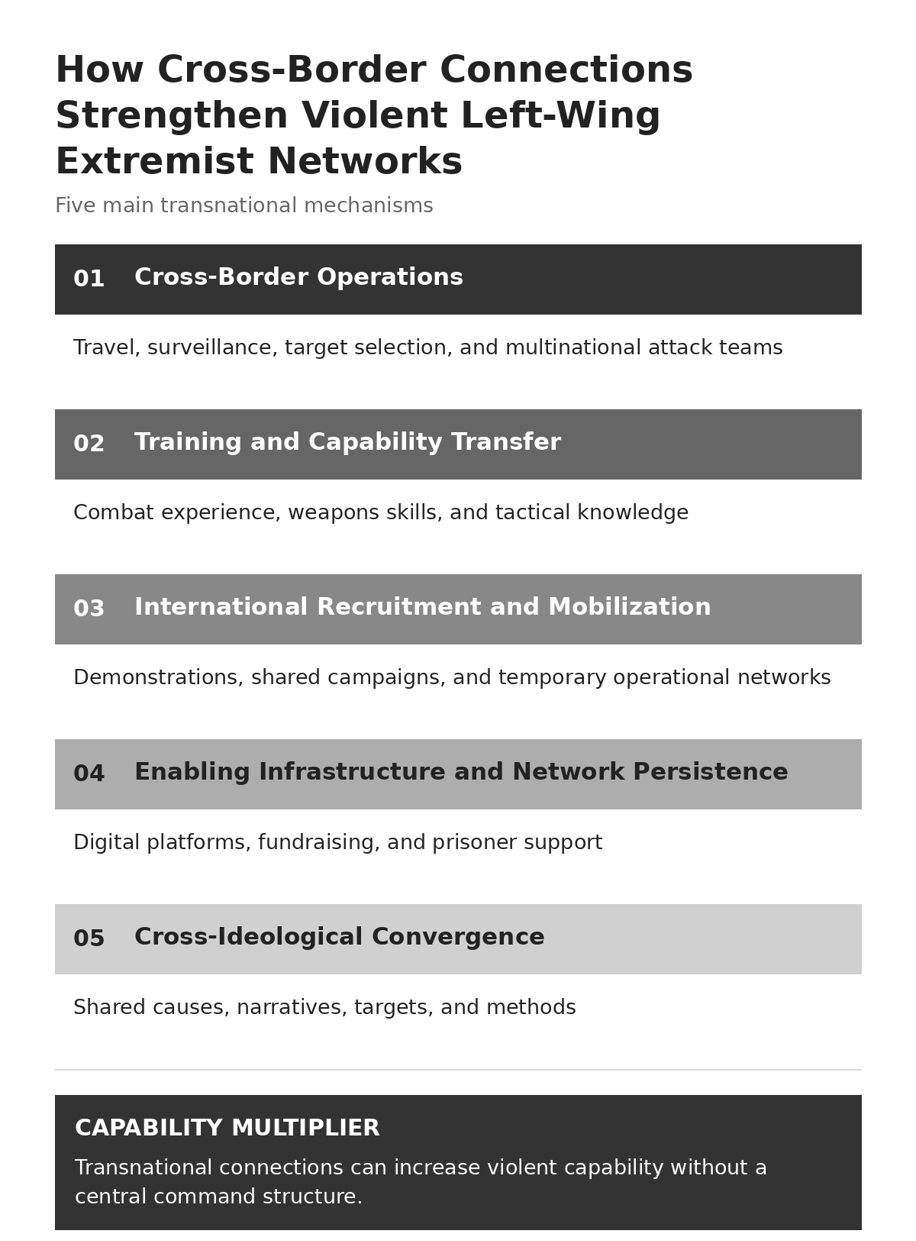
The transnational dimension can increase the reach and capabilities of Europe’s violent extreme left through several distinct mechanisms. Cross-border operations bring together participants from different countries. Foreign conflicts can provide military training and combat experience. International demonstrations create opportunities for recruitment, networking, and operational cooperation. Digital infrastructure supports communications and propaganda, while prisoner campaigns can preserve networks after arrests. International causes, particularly the Gaza conflict, can also create shared narratives and targets across otherwise distinct ideological milieus.
The Antifa Ost–Budapest complex provides the clearest recent example of direct operational development. A network that had conducted planned attacks in Germany became connected to coordinated violence abroad. The case involved surveillance, weapons, international travel, participants from several national backgrounds, and support campaigns spanning multiple countries.
Other forms of transnational activity are less direct. They can emerge through personal contacts, temporary attack teams, shared platforms, international demonstrations, foreign military service, prisoner solidarity, or issue-based campaigns. These connections vary considerably in significance. Direct operational cooperation presents a different level of risk from participation in the same demonstration, use of the same digital infrastructure, or support for the same prisoner. A formal European command structure is therefore neither evident nor necessary for transnational interaction to increase violent capability.
The scale of this activity also cannot be assessed through existing terrorism statistics. Many relevant cases are prosecuted as attempted murder, assault, arson, criminal-organization offenses, or violence against police. Consequently, they may remain outside terrorism statistics or be recorded differently in national data on violent extremism and politically motivated crime.
The greatest security concern arises when several factors converge: an intention to use violence, operational experience, continued participation in violence-oriented networks, and access to weapons, explosives, technical knowledge, or logistical support. In this sense, transnationalization functions primarily as a capability multiplier: it allows domestic actors to draw on people, skills, infrastructure, resources, and operational experience available across a wider European and international environment.
Read more about CEP´s work on Violent Left-Wing Extremism and Terrorism here: Violent Left-Wing Extremism and Terrorism | Counter Extremism Project
Stay up to date on our latest news.
Get the latest news on extremism and counter-extremism delivered to your inbox.