Islamic State Propaganda Evolution Since October 7 — Content
By Sean McCafferty, EU GLOCTER PhD Fellow, Seconded to CEP
This is the first entry in a two-part blog series discussing the evolution of Islamic State content and dissemination strategies since October 7, 2023.
Introduction
Since the Islamic State (IS) lost its final territorial holdout in Baghuz, Syria, in March 2019, the group’s global presence, propaganda output, and online ecosystem have evolved significantly. Before then, IS online content was clearly identifiable by its highly produced videos, showcasing the group’s governance, military prowess, and extreme violence. IS has since been forced to shift to a more decentralised approach, characterised by a surge in output from its regional affiliates in Africa and South Asia, alongside a steady stream of ideological messaging and attack claims. In tandem the group’s operational capabilities have also grown in key regions such as West Africa and Afghanistan.
The group’s official media arms continue to release statements, audio messages, and videos, but these are now often shorter, less polished, and focused on claiming responsibility for attacks or inciting supporters to carry out attacks. The overarching narrative since 2019 has been one of the group’s sustained resilience, its growing territorial influence via its affiliates, and a promise of return to the “glory days” of its caliphate in the Middle East. 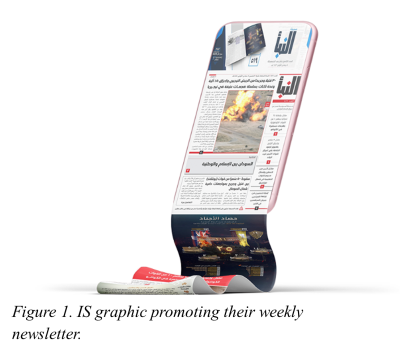
The IS online ecosystem has also adapted, forced to transition from mainstream platforms like Telegram to a patchwork of official and supporter websites, encrypted messaging platforms, and self-hosted chat forums. The geopolitical upheaval following the October 7, 2023, attack on Israel has provided IS with a new opportunity to exploit global tensions, weaving recent events into its propaganda to bolster recruitment and justify its continued attempts at global violence.
October 7 as a Global Shift?
The October 7 attack and the subsequent Israeli military response spilled into a regional conflict stretching across Gaza, Lebanon, Syria, Iraq, Yemen, and Iran. In the aftermath of October 7, the so-called ‘resistance front’—including Hezbollah, the Houthis, Iran and pro-Iranian militias in Syria and Iraq—all began to strike against Israel, creating a series of regional conflicts.
October 7 and its aftermath, particularly the devastation of Gaza, has reshaped the focus of global media and politics. As a result, international attention has centered on the region and its key actors, including Israel, Hamas, Hezbollah, and Iran’s Islamic Revolutionary Guard Corps (IRGC). Consequently, IS has sought to leverage this geopolitical crisis for its own ends. The group has drawn on the crisis in its own propaganda, reframing the key issues and grievances as reasons to join or support IS.
IS Propaganda Post–October 7
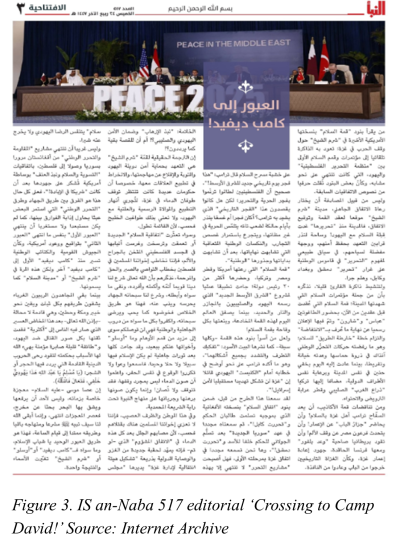
IS propaganda following October 7 began to reference Gaza directly and indirectly. While the vast majority of the group’s propaganda has not focused on the Israel-Hamas conflict, IS has actively sought to exploit the grievances linked to Israeli violence in Gaza. This propaganda has sought to bolster its own narrative and has framed the conflict as an opportunity to incite violence globally, particularly targeting Jews. IS weekly publication an-Naba has consistently exploited narratives linked to Gaza, including in editorials entitled “The Tragedy of Gaza” and “Crossing to Camp David.”
Unlike other groups such as al-Qaeda and the Houthis, IS does not endorse, support, or celebrate Hamas. IS has often criticised Hamas, viewing the latter as heretics for focusing on national struggle and participating in the 2006 Palestinian legislative election. IS also lacks a presence or support in the West Bank and Gaza. Consequently, IS propaganda presenting the group as a defender of Muslims has been unconvincing globally and irrelevant to Palestinians. However, while official IS media has not explicitly celebrated and endorsed Hamas, IS supporters on several platforms have produced or re-shared content celebrating the October 7 attack.
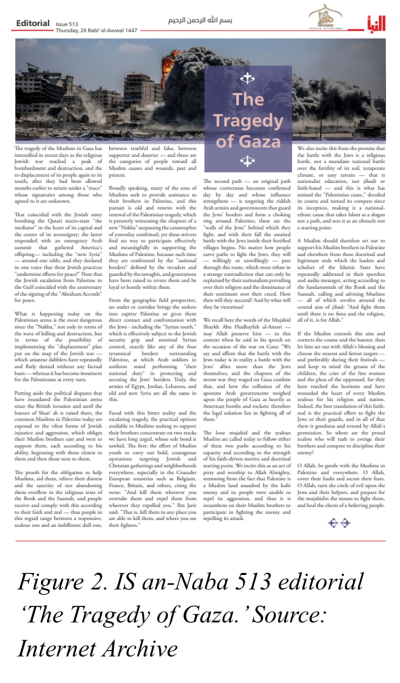
IS propaganda inciting violence globally
On January 4, 2024, an IS spokesman instructed supporters in the West to carry out attacks in solidarity with Gaza. IS propagandists have linked recent attacks in Europe to the crisis in Gaza, portraying them as acts of retaliation. On August 25, 2024, IS released an attack claim following the Solingen terrorist attack, which killed 3. According to German court records, an IS handler coordinated the attack with the perpetrator. The subsequent IS claim of responsibility was titled “In Revenge for Muslims . . . 11 European Christians Killed and Injured in Attack by Islamic State in Germany.” The claim also made it clear that the attack was “an act of revenge for Muslims in Palestine, Iraq, Syria and other Muslim countries.” Through these claims, IS links attacks by self-initiated individuals in Europe to grand narratives of revenge and retaliation and seeks to cast itself as a defender of Muslims globally.
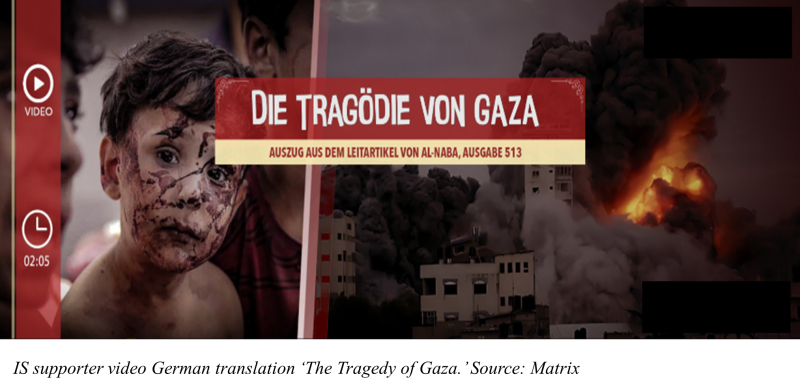
A significant number of these attacks have been carried out in Germany, with stabbings in Mannheim and Solingen emblematic of IS attempts to translate grievances linked to Gaza into attacks in Europe. The focus on Germany has also been paired with an increase in German-language content and translations of IS material into the German by pro-IS media outlets. This wave of attacks has also explicitly targeted Jews, matching IS rhetoric in their online propaganda campaigns with attacks such as the recent one on a Manchester synagogue, which was carried out by a perpetrator who claimed allegiance to IS.
A final, sustained strand of IS propaganda, also present in an-Naba 517, is commentary on developments in the Israel-Gaza conflict. In the editorial “Crossing to Camp David!” IS criticises the U.S.-brokered peace deal as a consolidation of Israeli and Western power. The group argues that Arab leaders are complicit in betraying Palestinians. They criticise Hamas by framing the conflict in religious terms rather than political or national struggle, stating that jihad, not national liberation, should be the only goal. IS has used key developments such as ceasefires and the U.S.-proposed peace deal as opportunities to attack and criticise Western governments, Israel, Hamas, and Arab states. Through this consistent commentary IS has attempted to maintain its relevance in the conversation evolving in response to major geopolitical crises.'
Conclusion
Causal links between the IS propaganda output discussed in this blog post and acts of real-world violence are difficult to establish. Nonetheless, October 7 and Israeli military actions in Gaza has been followed by a wave of terrorist attacks globally. Most of these acts appear to be self-initiated, with many perpetrators explicitly pledging allegiance to IS during or following their attacks. IS exploitation of October 7 and its aftermath is no surprise; the group has shown a pattern since 2019 of leveraging global events in its propaganda. IS has sought to position itself as a relevant actor in this crisis, leveraging it in its propaganda and incitement of global violence and using the resulting terror attacks by self-initated attackers to bolster its image among its sympathisers and supporters.
Stay up to date on our latest news.
Get the latest news on extremism and counter-extremism delivered to your inbox.