Europe’s Violent Far Left - Article 1 Germany’s New Landscape of Left-Wing Political Violence
This article opens a series examining the contemporary state of left-wing political violence in Europe. The series uses “left-wing political violence” as a conduct-based comparative category. National authorities classify such conduct differently: as politically motivated crime, public-order violence, anarchist or subversive activity, violent extremism, or terrorism. Country-specific statistics are therefore presented under their original official categories and are not treated as directly interchangeable.
This first article establishes the German baseline and draws primarily on court proceedings and police statistics on violent offenses attributed to a left-wing political motivation.
The overall series uses a conduct-based lens: it focuses on actors and networks that use, prepare, support, or legitimize left-wing political violence, without treating left-wing, antifascist, pro-Palestinian, climate, or other activism as extremist by association.
Follow-up publications in this series will examine the principal actors and networks of Germany’s violent extreme left; Germany’s efforts to prevent and counter left-wing violence; transnational networks; emerging communist youth networks in Germany and elsewhere in Europe; the role of combat sports, foreign-fighter experience and cross-border skills transfer; a crime–extremism nexus in Greece; developments in Italy; the financial strategies sustaining violent left-wing actors and networks, as well as recommendations for law enforcement and prevention policy.
Key Findings
- The German picture is marked by both a quantitative rise and a qualitative broadening of risk. Police-recorded violent left-wing-motivated crimes (PMK-left) rose by 42.7 percent in 2025, with particularly sharp increases in attacks on actual or perceived right-wing extremists and police officers.
- The Antifa Ost proceedings show that parts of a decentralized scene can form durable criminal organizations: courts and prosecutors describe repeated target selection, surveillance, training, operational role allocation, dedicated communications, equipment depots, and cross-border attacks.
- The right-wing populist party Alternative für Deutschland (AfD), which is suspected of right-wing extremism, has become a principal party-related target of left-motivated political violence.
- Vulkangruppen and related sabotage campaigns demonstrate how clandestine actors can produce disproportionate disruption by striking critical infrastructure.
- Since the Hamas attacks of 7 October 2023, German authorities have identified anti-Israel and anti-Zionist mobilization as an important field for parts of the violent extreme left.
Taken together, the cases suggest a threat landscape that is heterogeneous but increasingly transnational, operationally capable, and able to move between assaults on individuals, attacks on political institutions, and infrastructure sabotage. A central policy challenge is to distinguish lawful activism from the smaller number of actors and networks that convert political narratives into organized violence.
The Antifa Ost network
The "Antifa Ost" cases concern a militant, transnational extreme-left network. Across completed judgments and ongoing proceedings, courts and prosecutors have found or alleged the use of scenario training, target reconnaissance, recruitment, controlled equipment depots, burner phones, and specialized operational roles.
In May 2023, the Dresden Higher Regional Court convicted Lina E. and three co-defendants for their involvement in coordinated attacks against actual or perceived right-wing extremists between 2018 and 2020. The court found that the group constituted a criminal association under Section 129 of Germany’s Criminal Code. The court sentenced Lina E. to five years and three months. Her co-defendants received sentences of two years and five months, three years, and three years and three months. In March 2025, the Federal Court of Justice made the convictions final.
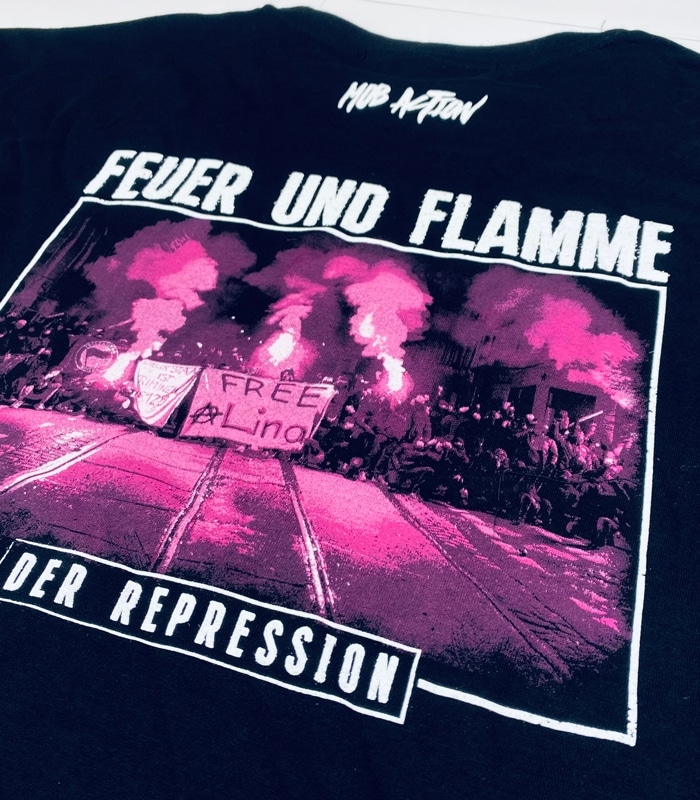
"Solidarity" T-shirt, sold for fundraising purposes: The text reads "Free Lina" and "Fire and Flame to the Repression", by "Mob Aktion"
The judicial findings described a criminal association united by militant left-wing extremist convictions and a sustained intention to attack selected opponents. Participants conducted surveillance, assigned roles, used masking and dedicated communications devices, and attacked victims in coordinated groups.
Two additional proceedings have produced first-instance judgments. In September 2025, the Munich Higher Regional Court sentenced Hanna S. to five years for membership in a criminal association and several bodily-injury offenses connected to Budapest; the court rejected the attempted-murder allegation.
Another major trial began in Dresden in November 2025 against Johann G. and six other defendants. Federal prosecutors accuse six defendants of membership in the same criminal association and one of supporting it. The charges include attempted murder, dangerous bodily injury, property damage, forgery, interference with road traffic, and armed theft, covering alleged attacks in Germany and Budapest. The court has scheduled hearings into 2027; all allegations remain subject to trial.
Another trial opened in Düsseldorf in January 2026 against six further alleged members. Federal prosecutors allege that victims were followed and ambushed before being struck with fists, telescopic batons, hammers, and other blunt instruments; some blows were directed at the head. Some defendants face attempted-murder charges.
In February 2026, a Hungarian court sentenced Maja T. to eight years in a first-instance judgment for participation in the Budapest assaults (see below).
In summary, the "Antifa Ost" proceedings show how a decentralized violent left-wing extremist milieu can contain durable, organized criminal networks that select targets, conduct surveillance, train for attacks, maintain equipment depots, and operate across borders.
Germany’s broader threat landscape
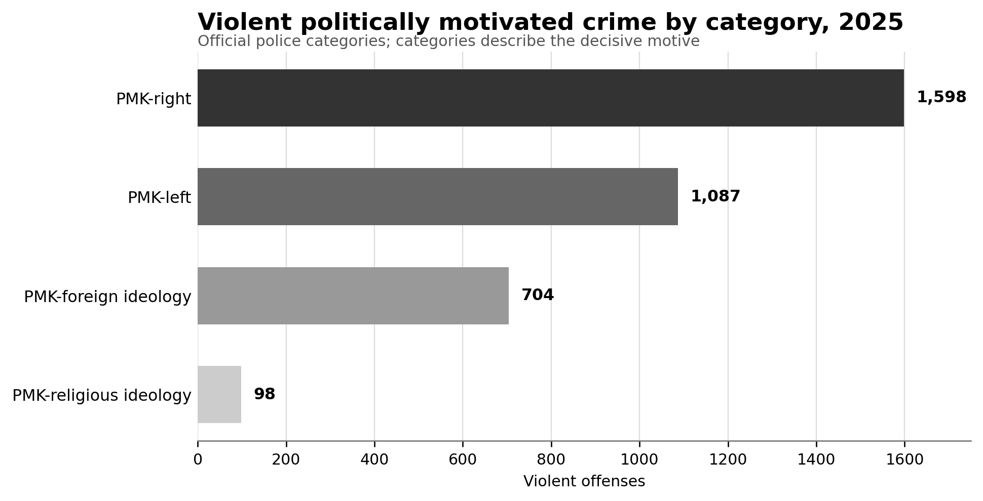
Violent politically motivated offenses recorded in 2025. “PMK-left” and “PMK-right” include offenses attributed to a left-wing or right-wing political motivation. “Foreign ideology” describes a motive focused on a non-religious ideology originating abroad; it does not describe the offender’s nationality. “Religious ideology” includes Islamist cases but is broader than Islamist extremism.
Vulkangruppen and Angry Birds: violent left-wing infrastructure sabotage
Violent left-wing extremism in Germany also includes an infrastructure-sabotage strand that differs from assaults on political opponents but can produce wider societal effects.
Since 2011, perpetrators using variants of the Vulkangruppen label have claimed arson attacks on critical infrastructure. On 3 January, 2026, an arson attack on a cable bridge near a power and heating plant damaged high-voltage lines and caused a major blackout in southwest Berlin. Around 45,000 households and 2,200 businesses lost electricity; hospitals, care facilities, telecommunications, transport, and heating were affected.
The Federal Prosecutor General is conducting four Vulkangruppen-related investigations. All concern suspected membership in a terrorist organization; one investigation bundles four earlier attack complexes from 2011 to 2020. All remain ongoing.
The infrastructure-sabotage strand extends beyond the Vulkangruppe name. Germany’s federal domestic intelligence agency (BfV) describes “Switch Off—The System of Destruction” as a militant campaign that links anti-capitalist ideology with climate-related targets; by 2025, more than 100 offenses had been associated with the campaign. The label Kommando Angry Birds has likewise appeared in claims concerning railway cable arsons and an attempted attack on an electrical substation.
These cases illustrate a recurring strategic logic: attacks on exposed infrastructure nodes can create economic losses, transport disruption, communications failures, and risks to hospitals, care facilities, businesses, and private households far beyond the immediate physical damage.
Extreme-left violence rose sharply in 2025
Germany has a police reporting system for politically motivated crime (PMK). State police classify and report cases, and the Federal Criminal Police Office (BKA) aggregates the national figures. PMK-left includes offenses attributed to a left-wing political motivation.
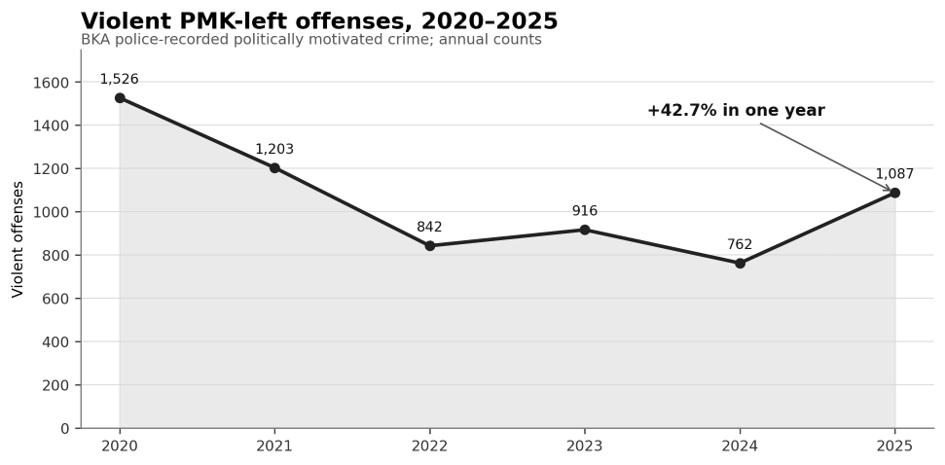
Police-recorded violent PMK-left offenses.
In 2025, police recorded 1,087 violent PMK-left offenses, an increase of 42.7 percent from 762 cases in 2024. Within this total, violent PMK-left offenses directed against the police increased by 45.4 percent, from 368 to 535 cases.
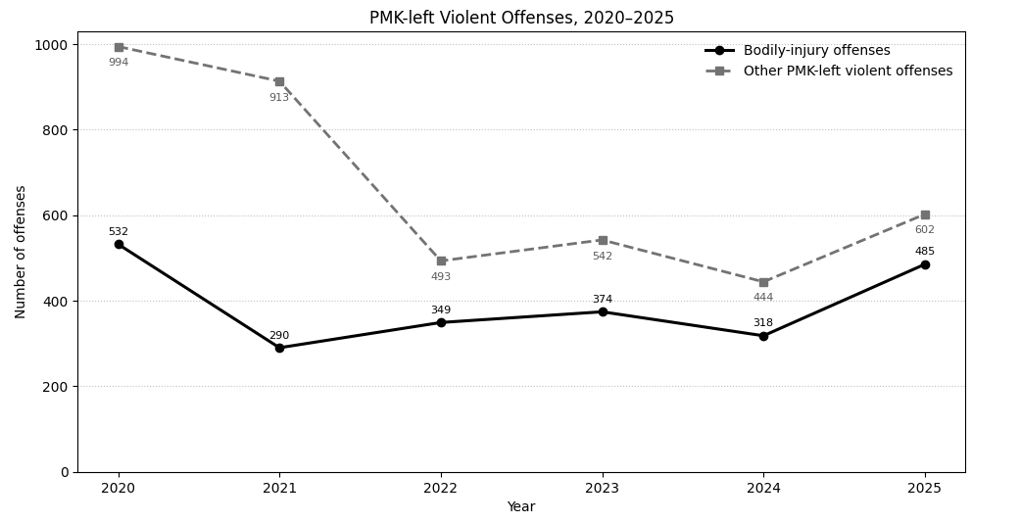
Of the 1,087 PMK-left violent offenses recorded in 2025, 485 were bodily-injury offenses. The remaining 602 cases consisted of other offenses classified as political violence, including resistance or assaults against law-enforcement officers, breach of the peace, arson and explosives offenses, dangerous interference with traffic, robbery, and other violent offenses.
The AfD is a primary target
The Alternative for Germany (AfD) was a major target in 2025. Police recorded 121 violent offenses directed against AfD representatives or members, the highest figure among the parties covered by the federal statistics. 103 were assigned to PMK-left. Police also recorded two PMK-left arson attacks against AfD party facilities.
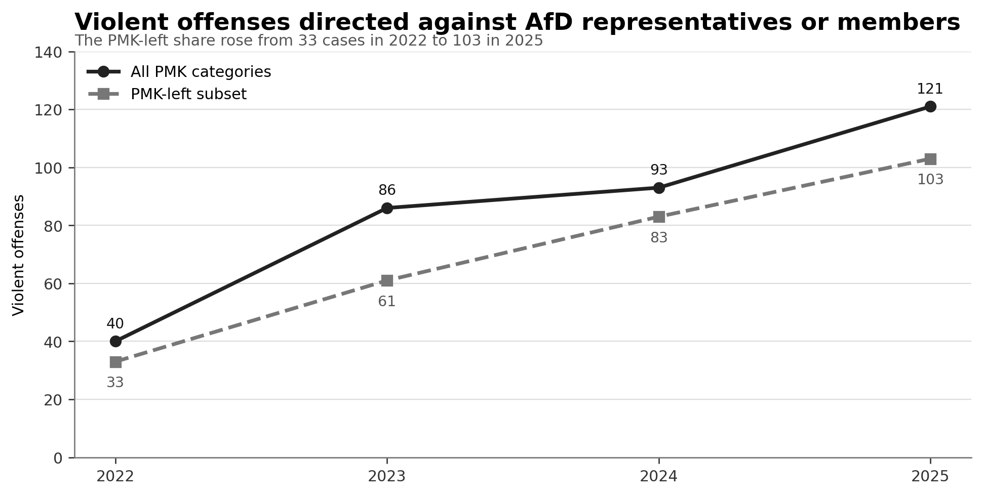
Violent offenses directed against AfD representatives or members rose from 40 in 2022 to 121 in 2025. The PMK-left subset rose from 33 to 103 over the same period.
Representatives or members of Die Linke (The Left) were targeted in 16 violent offenses, the Greens in 13, and the CDU and SPD in 12 cases each. Violence against Die Linke was mostly assigned as PMK-right, while most violent offenses against Die Grünen (Greens), CDU (Christian Democratic Union), and SPD (Social Democratic Party) representatives could not be assigned to a specific PMK category.
Antisemitism and anti-Israel mobilization
Since the Hamas attacks of 7 October 2023, German authorities have identified anti-Israel and anti-Zionist mobilization as an important field for parts of the anti-imperialist and dogmatic extreme left.
Police statistics also indicate that the Israel–Palestine conflict became a significant context for left-motivated political crime in 2025. BKA statistics show 61 PMK-left violent-offense entries under the Israel and Palestine thematic categories.
These figures require careful interpretation. The PMK system distinguishes between an offense’s principal ideological category and thematic designations such as “antisemitic,” “Israel,” or “Palestine.” An antisemitic offense may consequently be assigned to PMK-left, PMK-right, foreign ideology, religious ideology, or “other attribution,” depending on the motive identified by police. Participation by left-wing actors does not determine the classification of every offense committed during a mixed protest event.
The available judicial statistics provide an incomplete picture of subsequent proceedings. In its response concerning the first quarter of 2025, the federal government stated that the general judicial statistics are organized according to statutory offenses and do not record antisemitic motivation. It could therefore provide no corresponding figures on investigations, discontinued proceedings, or convictions for that period. The wider analytical consequences of this fragmented recording system are discussed in a CEP policy paper.
Events show an intersection that is obscured by formal PMK categories. At the April 2025 occupation of Humboldt University, activists associated with a radical-left and anti-imperialist student milieu displayed Hamas-glorifying symbols and antisemitic or eliminationist anti-Israel slogans while occupiers threw pyrotechnics and liquid toward police and two participants allegedly attacked officers. Authorities opened 107 investigative records involving 90 suspects.
At the July 2025 Internationalist Queer Pride, police reported repeated antisemitic slogans and attacks on officers. At the extreme-left Revolutionary May Day demonstration in 2024, Hamas glorification, calls for an Intifada, intimidation of journalists, and a stone thrown toward a journalist were documented.
The transnational dimension
The "Antifa Ost" cases provide the clearest evidence that this phenomenon has a transnational dimension. Suspects from several European and non-European countries allegedly traveled to Hungary, identified targets around the far-right “Day of Honor” gathering, and conducted coordinated assaults. The resulting proceedings involve German and Hungarian courts, as well as European arrest warrants.
In Italy and Greece, Europol recorded 21 left-wing and anarchist terrorist attacks in 2024 and 12 in 2025. The attacks primarily targeted buildings, vehicles, businesses, and infrastructure. Europol also reports international networks and cross-border travel.
In November 2025, the United States designated "Antifa Ost", the Italian Anarchist Federation/International Revolutionary Front, and two Greek groups as Specially Designated Global Terrorists and Foreign Terrorist Organizations. Hungary listed "Antifa Ost" in September 2025 and added Vulkangruppe to its national list in January 2026.
The “Ulm Five” case presents another transnational pattern. In January 2026, the Stuttgart General Prosecutor's Office indicted five defendants of Irish, British, Spanish, and German nationality. It alleges membership in the criminal organization “Palestine Action Germany”, property damage, trespass, and use of symbols of unconstitutional and terrorist organizations. The trial is ongoing, and the allegations have not been finally adjudicated.
The UK government proscribed Palestine Action in July 2025 and bases the proscription on a wider campaign of serious property damage and a case involving serious injury to a police officer. A UK government-commissioned review placed Palestine Action within the British far-left subculture, citing its anarchist affinity-group organization, direct-action methods, anti-imperialist framing, and operational overlap with radical environmental movements.
The described evidence points to a broader transformation of parts of Germany’s violent extreme left: intensified targeting of perceived right-wing opponents, increasingly deliberate attacks on individuals, more professional clandestine networks, infrastructure sabotage, and the emergence of new mobilizing issues around the Middle East, climate policy, and rearmament.
Stay up to date on our latest news.
Get the latest news on extremism and counter-extremism delivered to your inbox.