Núcleo Nacional: Adapting Neo-Nazi Narratives to Spain's Political Grievances
The November 2026 police operation against Núcleo Nacional (NN) brought renewed attention to Spain's neo-Nazi movement. Days later, a judge ordered the suspension of the organisation's activities, the closure of its premises and the blocking of its social media content. Although the restrictions on its online activity had not yet been implemented, the decision brought particular attention to the role of social media in NN's development. As previously examined, NN's evolution since late 2023 illustrates how established extremist networks can regroup, expand their recruitment activities and establish international connections. Its public communications offer an additional perspective on that development: how the organisation connects its ideology to Spain's changing political and social environment and contemporary sociopolitical grievances.
Drawing on 684 messages published through NN's Telegram channel between December 2023 and November 2026, including material linked to the organisation's own X account., this analysis examines how NN presents otherwise distinct political and social grievances as questions of national belonging and collective responsibility. Housing becomes a question of who deserves access to resources; neighbourhood insecurity is connected to who belongs in the community; failures of public institutions are portrayed as betrayals of the nation; and concerns about children and future generations become arguments about national survival. Rather than developing new ideological positions, NN applies familiar neo-Nazi narratives to contemporary disputes, presenting them as different manifestations of a common threat to Spain. Particularly revealing is the relationship between the language of unity and defence: while unity invokes a collective identity, defence introduces a responsibility to protect it. This relationship helps explain how NN connects its conception of national belonging to appeals for collective action.
Since its inception, NN has used social media not only to disseminate propaganda, but also to recruit supporters, promote demonstrations and coordinate participation in public activities. Its engagement with broader political controversies does not, however, establish influence beyond its existing networks, nor does its participation in wider protests imply ideological agreement among other demonstrators. The focus of this analysis is therefore on how NN's language evolves across different political contexts, rather than on establishing changes in its strategic objectives or intentions. Read alongside the organisation's documented activities, these communications offer insight into the role of social media in presenting, promoting and organising around an established extremist ideology within contemporary Spanish political life.
From the Extremist Fringe to Wider Political Controversies
Núcleo Nacional did not emerge in isolation. Its origins can be traced to the demonstrations outside the Socialist Party's headquarters in Madrid’s Calle de Ferraz in late 2023, where opposition to the government's proposed amnesty for Catalan separatists brought together protesters from different political backgrounds, including activists associated with established far-right extremist organisations.
From its earliest public communications, NN sought to establish an organisational structure extending beyond its online presence. In December 2023, the group began directing prospective members towards its recruitment system. By January 2024, it was announcing regional Telegram groups for militants, requiring applicants to complete a registration process before gaining access. Recruitment, territorial organisation and in-person gatherings were therefore part of its activities from the outset. Espacio Ardemans, a venue also associated with other nationalist and far-right organisations, provided a physical setting for that process. NN's April 2024 public launch at the Madrid venue was promoted with an appeal to historical inheritance: “Todo lo que nos dejaron en herencia nuestros antepasados está siendo demolido. Nuestra patria merece que estemos a la altura” (“Everything we inherited from our ancestors is being demolished. Our homeland deserves nothing less than for us to rise to the occasion”). The message combined a familiar narrative of national decline with an invitation to participate in the organisation's development.
NN also sought visibility through public demonstrations. In October 2024, it announced a march marking the first anniversary of the anti-amnesty protests outside the Socialist Party's headquarters in Madrid, under the slogan “Vuelta al origen, vuelta a Ferraz” (“Return to the origins, return to Ferraz”). However, the devastating Valencia floods on October 29, which killed 233 people, [KB1] gave NN an additional political grievance to incorporate into an already planned campaign. The organisation solicited relief supplies, claimed to have dispatched assistance to affected communities and, days before the November march, declared: “Cuando el Estado falla, aparece la Nación” (“When the State fails, the Nation comes through”). In doing so, NN went beyond denouncing institutional failure. It presented nationalist activism as a practical response to the state's alleged inability or unwillingness to protect its citizens, positioning itself as part of a community capable of responding where public institutions had supposedly failed. Although these activities do not establish the development of a parallel system of social provision, they illustrate how NN sought to derive legitimacy not only from its opposition to the government but also from its portrayal of itself as an organisation serving the Spanish population.
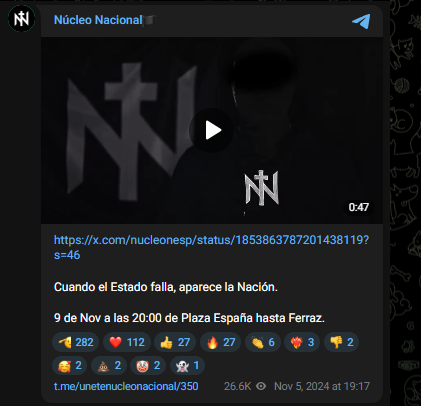
Image 1: NN Telegram post declaring “When the State fails, the Nation comes through” ahead of the November 2024 demonstration outside the Socialist Party's headquarters in Madrid, following the Valencia floods.
Its communications about Valencia continued into 2025, particularly in Catarroja, one of the municipalities severely affected by the flooding. In June, NN claimed that members of its Valencia delegation had attended a tribute to flood victims held there on May 29, denouncing the continued abandonment of affected residents and accusing political institutions of failing to provide adequate assistance. Later that month, NN announced that its delegations would support a demonstration in Madrid organised by residents affected by the floods in Catarroja. Rather than organising the protest itself, NN was publicly associating its political message with the residents' demands.
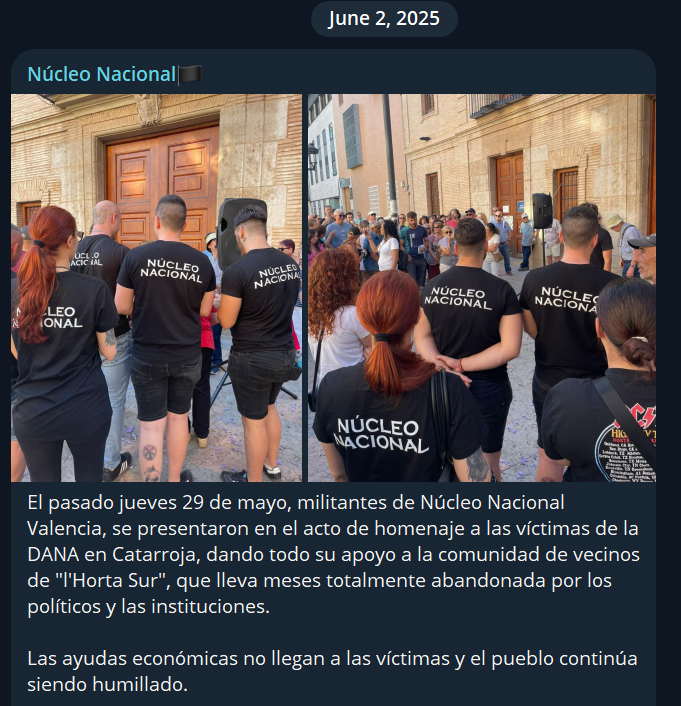
Image 2: NN Telegram post claiming members of its Valencia delegation had attended a tribute to flood victims in Valencia.
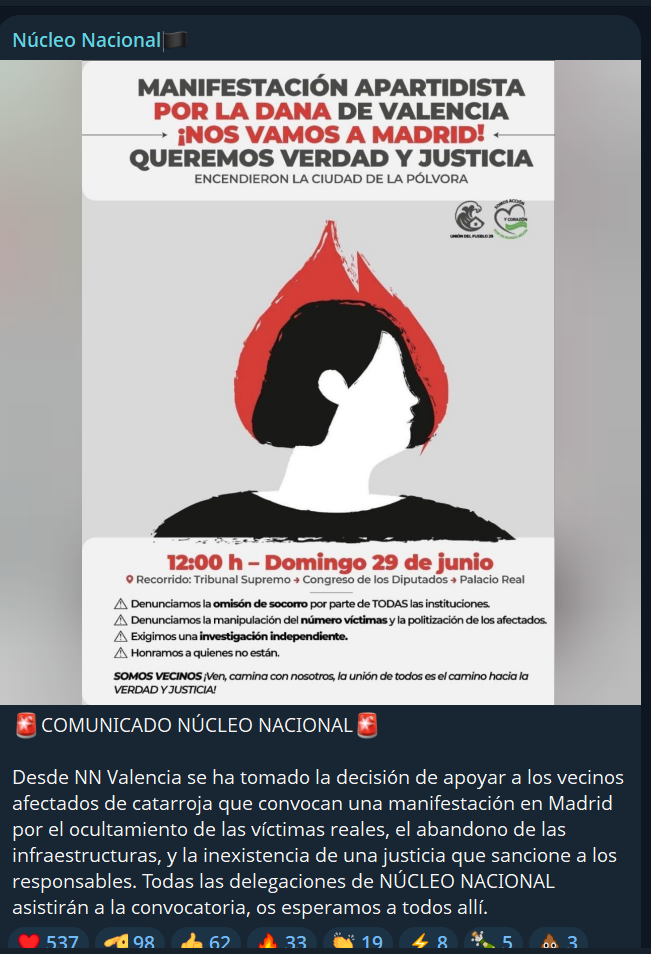
Image 3: NN Telegram post supporting a demonstration in Madrid organised by residents affected by the floods in Catarroja (Valencia).
Immigration provided another setting for NN's public activities, although the organisation's involvement varied considerably between events. In June 2025, NN advertised its own demonstration outside a migrant reception centre in Hortaleza, Madrid. Authorities prohibited the gathering, preventing the planned event from taking place. NN subsequently portrayed the prohibition as evidence of political discrimination, accusing the authorities of restricting its right to demonstrate while allowing counterprotests to proceed.
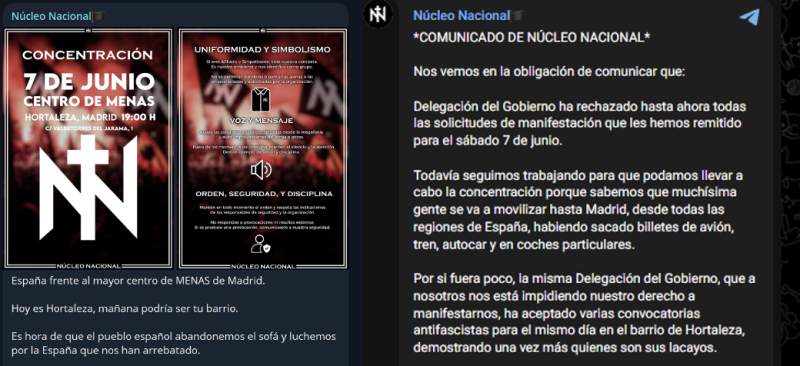
Image 4: NN Telegram posts showing an advertisement for the group's demonstration in Hortaleza (Madrid) and portrayals of political discrimination following the prohibition of said demonstration.
The distinction between promoting its own initiatives and associating itself with those organised by others became particularly apparent during the Ceuta border crisis in July 2026. NN endorsed a demonstration called by called by Falange youth, the youth activist component of the ultranationalist and national-syndicalist party Falange, outside the Moroccan embassy in Madrid and coordinated its own contingent. It also attempted to organise a separate gathering in Ceuta, which did not take place, before participating in a September protest outside Congress organised by Ceuta residents. These activities show NN seeking a place within the public response to the crisis, but they do not establish that the organisation directed the wider protests or that their participants shared its ideology. Although the Congress demonstration ended in clashes with police, the available evidence does not establish group-wide NN responsibility for the violence.
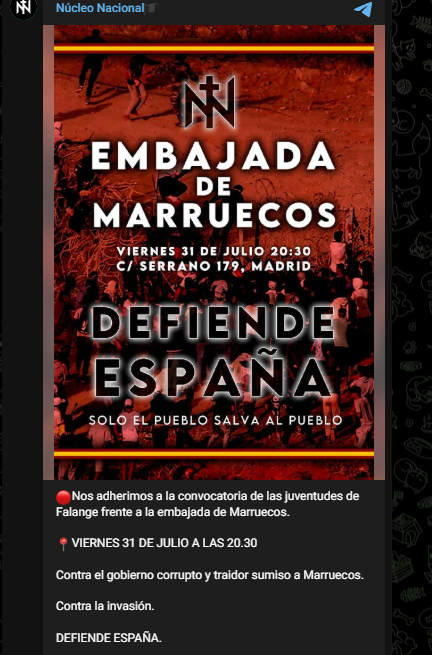
Image 5: NN Telegram post supporting a demonstration outside the Moroccan embassy organised by the Falange youth, following the July Ceuta immigration incident.
These examples illustrate the different ways NN sought to associate itself with political controversies attracting attention beyond established extremist circles. Whether through its own demonstrations, participation in protests organised by others or public endorsements, the organisation repeatedly connected its nationalist and anti-immigration messaging to contemporary disputes over government policy, public institutions and national identity.
NN's efforts to enter wider political controversies should not, however, be confused with evidence that it succeeded in influencing them. The prohibition of its planned Hortaleza demonstration, the failure of its proposed gathering in Ceuta to take place, and its participation in protests organised by others illustrate the different limits of its public activity. Its communications demonstrate an ambition to reach beyond established extremist circles, but they provide much less evidence about the extent of that reach. Announcing a demonstration, endorsing a public grievance or claiming to speak for a community does not establish that NN mobilised significant numbers of people outside its existing networks.
This raises a more interesting question than how frequently NN appeared at demonstrations: how did the organisation connect such different developments to a common political message? Its Telegram communications offer a way to examine how familiar neo-Nazi ideas were applied to contemporary Spanish controversies, and how those ideas were presented to appeal beyond the organisation's established supporters.
One Nation, Multiple Threats: How Núcleo Nacional Constructs Its Political Narrative
There is little that is ideologically novel in Núcleo Nacional's propaganda. The portrayal of immigration as an existential threat, accusations of betrayal by political elites, appeals to national identity and references to historical greatness are familiar features of European neo-Nazi and ethnonationalist movements. What makes NN's communications worth examining is not the individual themes themselves, but how the organisation brings them together, adapts them to developments in Spain and presents them as different expressions of the same national struggle.
At the centre of this narrative is an understanding of Spain as a threatened community whose identity extends beyond citizenship or political institutions. NN's references to nation, race, cultural inheritance, neighbourhoods and future generations suggest that national belonging is constructed through several overlapping ideas. In July 2024, for example, the organisation accused “globalist elites” of destroying “nuestra identidad, nuestros valores y nuestra raza” (“our identity, our values, and our race”). Although NN does not explicitly define race in this message, its references to racial identity, ancestral inheritance, population replacement and demographic continuity reveal an ethnonationalist conception of Spain in which national belonging is not simply a matter of citizenship. What is particularly relevant to NN's communications is how explicitly racial ideas are combined with references to Spanish culture, families and neighbourhoods. In doing so, the organisation connects its neo-Nazi ideological foundations to concerns closer to everyday life. The significance of these connections lies in how NN defines the community whose interests it claims to defend. Housing, neighbourhood safety and the future of children are not presented simply as matters of public policy. They become questions of national belonging: who is entitled to resources, who is portrayed as a threat to the community and whose future deserves protection. In this framing, NN turns grievances affecting different parts of society into arguments for an exclusionary conception of the Spanish nation.
References to children and future generations are particularly important to this framing. By presenting the future of Spanish families as inseparable from the survival of the nation, NN casts support for its political agenda as a responsibility towards those who will inherit the country. This gives its ideological claims a more personal dimension, linking national identity to family and community obligations.
The comparatively limited prominence of explicitly religious language is particularly interesting given the historical relationship between Catholicism and Spanish nationalism. Although NN identified its members as Christian on its now-inoperative website, it also stated that individuals of other faiths were welcome, provided their beliefs did not contradict Spanish values and traditions. This distinction is consistent with the organisation's Telegram communications, in which national belonging is articulated predominantly in ethnonationalist rather than confessional terms. Christianity features as part of Spain's cultural and historical inheritance, but religious affiliation is not presented as an indispensable condition of belonging. Instead, NN makes the acceptance of religious diversity conditional upon conformity with its own conception of Spanish identity.
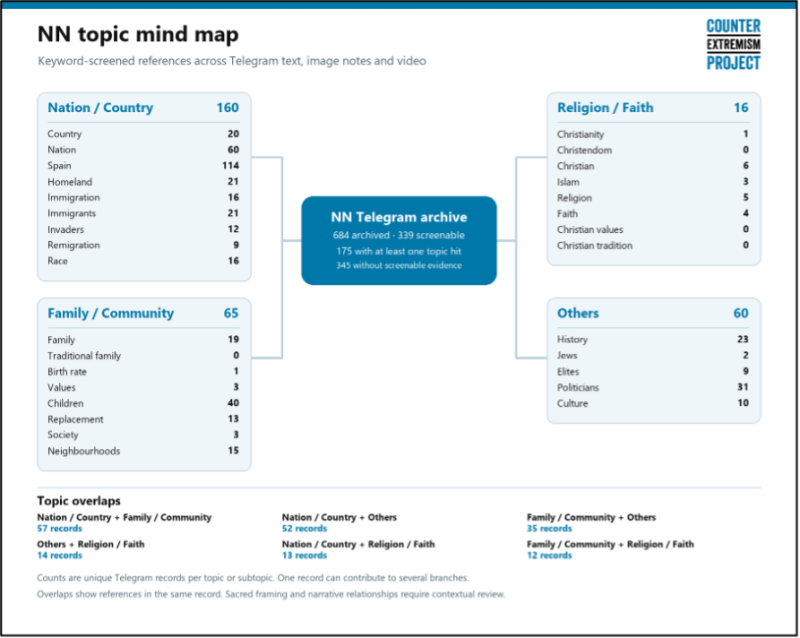
Figure 1: NN's principal narrative themes and their intersections. This figure maps the main themes identified in NN's Telegram communications, showing how references to national identity intersect with family, community, religion and political grievances. The analysis covers 339 publicly available posts from an archive of 684. Categories are not mutually exclusive: a single post may refer to several themes. The overlaps indicate which ideas appear together, rather than establishing how NN connects them in a particular message.
There is, however, an important distinction between the community NN claims to defend and the people it actually reaches. By invoking Spanish families, working-class neighbourhoods and future generations, the organisation presents its agenda as representative of concerns extending well beyond the neo-Nazi milieu. These references tell us how NN defines its intended constituency, not who follows its channels, joins its activities or accepts its arguments. The available communications reveal the audiences NN seeks to address, but they do not establish how successfully it reaches or influences them.
NN also distinguishes between the Spanish nation and the institutions governing it. Politicians are portrayed as betraying or abandoning the population, while national identity and historical continuity provide an alternative source of legitimacy. The slogan “Cuando el Estado falla, aparece la Nación,” circulated following the Valencia floods, captures this distinction: loyalty to Spain is presented as something separate from, and potentially opposed to, loyalty to its government. This allows NN to portray political opposition as a duty towards the nation itself.
Immigration is incorporated into this broader interpretation rather than treated exclusively as a policy question. NN's communications connect it to public safety, neighbourhood protection, housing and demographic change. Its May 2025 warning that the situation in Hortaleza could spread to other neighbourhoods translated opposition to a migrant reception centre into a claim about local vulnerability. In March 2026, the slogan "No es el patriarcado, es la inmigración" attributed insecurity to immigration, while the organisation's October housing message connected what it described as an invasion to demands for housing for Spaniards. These examples show how NN uses immigration to provide a common explanation for grievances that otherwise concern different areas of public policy. The organisation's references to racial identity and replacement further reveal the exclusionary assumptions underlying that explanation.
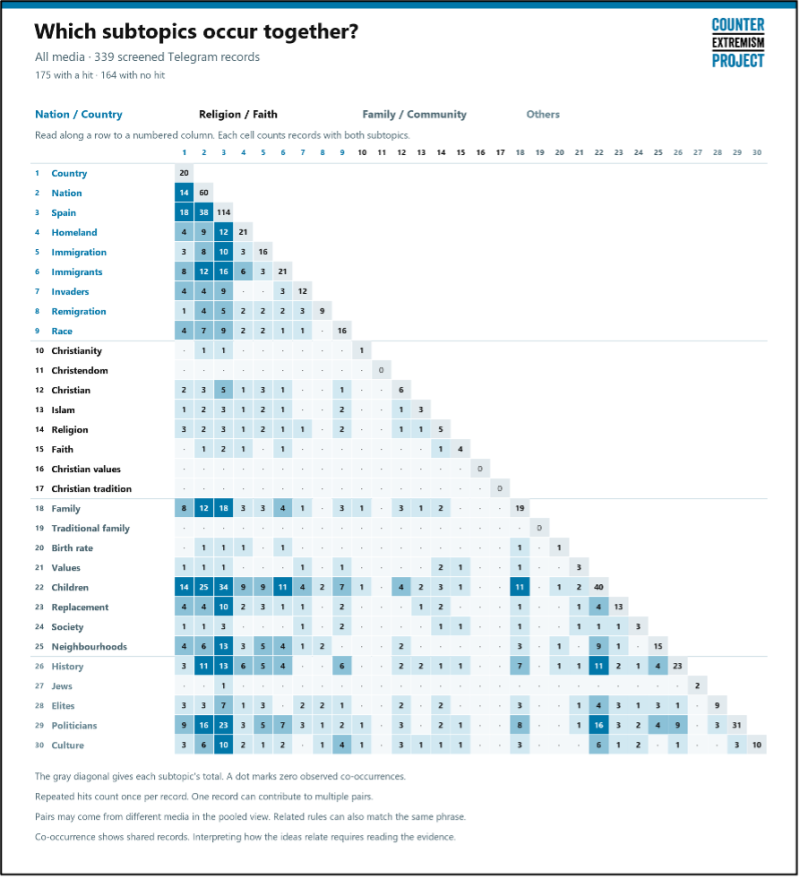
Figure 2: Co-occurrence of narrative subtopics in NN's communications. The matrix shows how frequently specific terms appear together within the same Telegram post. It highlights connections between references to Spain, national identity, children, immigration, political figures and historical grievances. These combinations help identify recurring elements of NN's messaging, although their meaning depends on the context in which they appear. Counts refer to posts containing both terms, not the number of times the terms are repeated.
NN's response to the Ceuta crisis illustrates how its established ideological claims could be applied to a rapidly developing political controversy. The organisation incorporated the border crossings into its broader portrayal of Spain as a threatened nation, rather than developing a fundamentally new argument. Similar connections appear in its communications about immigration-related disputes and perceived institutional failures. The emphasis of these messages varies over time, but the available evidence does not establish that specific events caused changes in NN's overall communications.
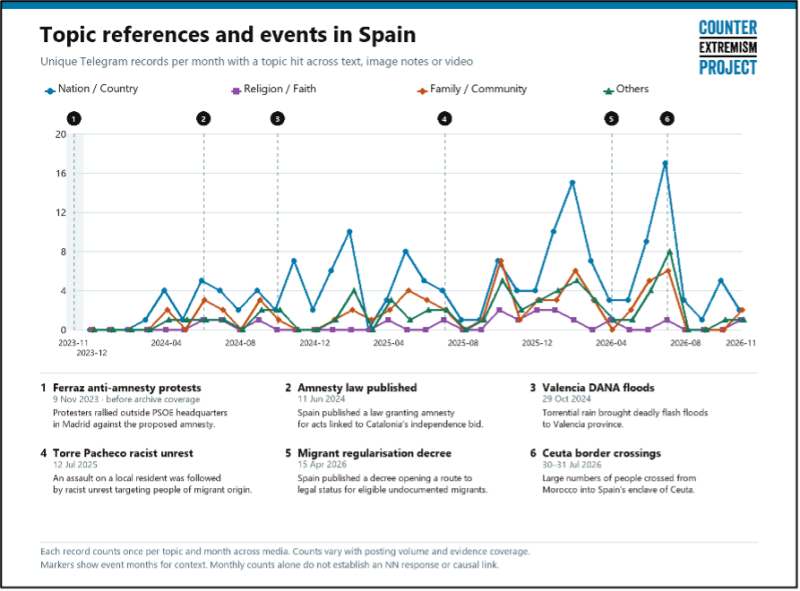
Figure 3: Evolution of NN's narrative themes alongside political developments in Spain. This timeline shows how references to national identity, religion, family and community, and other political or historical themes varied between December 2023 and November 2026. Selected events provide political context for these fluctuations, including the amnesty law, the Valencia floods, the Torre Pacheco unrest and the Ceuta border crisis. The timing of changes does not, by itself, establish that these events caused them; posting activity and the availability of screenable material also affect the figures.
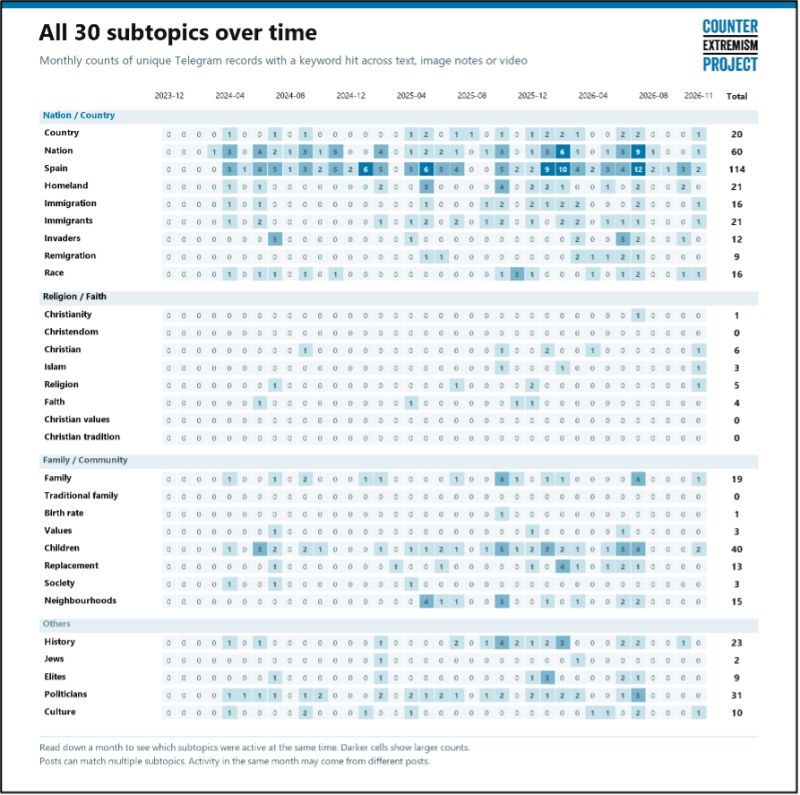
Figure 4: Evolution of individual narrative subtopics over time. This figure provides a more detailed view of how specific terms appeared in NN's communications across the period examined. It allows readers to distinguish between themes that recur throughout the archive and those that become more visible at particular moments. The figures reflect the occurrence of selected keywords, rather than the full range of ways NN may have expressed the underlying ideas.
NN communicates these ideas through written statements, promotional images and videos, with audiovisual material offering particularly revealing examples of how the organisation brings different ideological claims together. Its July 2024 recruitment video connects the alleged destruction of Spain's identity, values and race to the future of children and grandchildren, before encouraging viewers to join NN. The message presents membership not simply as an ideological commitment, but as a responsibility towards future generations.
A separate video portraying parts of Spanish cities as being in decline brings together references to nation, culture and race, positioning NN as a defender of all three. Although the two videos emphasise different concerns, both connect a perceived threat to the national community with a role for the organisation itself. These examples illustrate how NN uses audiovisual propaganda to present its ideology through more immediate images of decline, belonging and protection. They do not, however, establish that NN deliberately reserves particular narratives for video rather than other media.
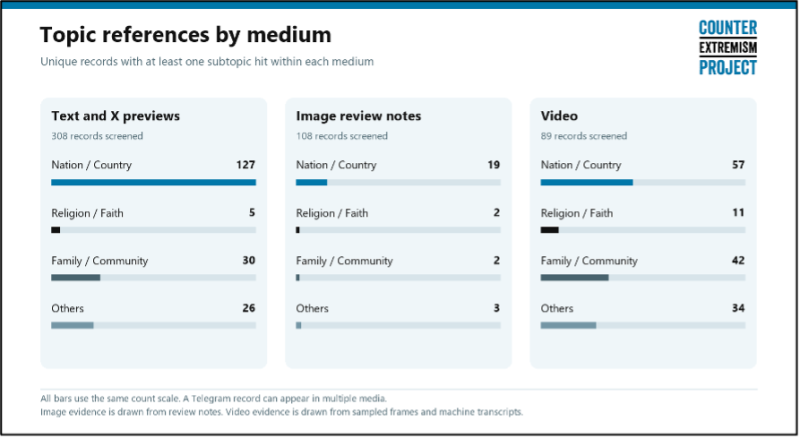
Figure 5: Narrative themes across text, images and video. This figure compares the themes identified in NN's written communications, image review notes and video material. National identity appears across all three formats, while family and community references are particularly visible in the screened videos. Because the evidence was collected differently for each medium (including sampled video frames, machine transcripts and image review notes) the comparison illustrates patterns in the available material rather than establishing a deliberate communication strategy.
The significance of NN's communications therefore lies less in the originality of its ideology than in the relationships it constructs between different issues. Immigration, institutional failure, historical memory, cultural identity and the protection of future generations are not always presented separately. They can reinforce a common interpretation of national decline, in which political and social problems become evidence of threats to the same community. This provides the ideological context for examining how NN subsequently connects its messages to recruitment, demonstrations and other forms of collective action.
From National Decline to Collective Action
Núcleo Nacional's portrayal of Spain as a nation under threat is closely connected to its appeals for collective action. In the communications examined, references to defence, unity and victory are more prominent than the selected terms associated with expulsion, reconquest or resistance. Particularly revealing is the relationship between unity and defence (Figure 6): the former constructs a collective expected to act together, while the latter provides a rationale for doing so. Their combination helps explain how NN presents national belonging not simply as a matter of identity, but as a responsibility to act. This does not mean that NN advocates these ideas more consistently than others, or that its objectives are less extreme. Rather, these expressions offer insight into how the organisation presents collective action: as a responsibility to defend a threatened national community, act together and overcome those it identifies as responsible for Spain's decline.
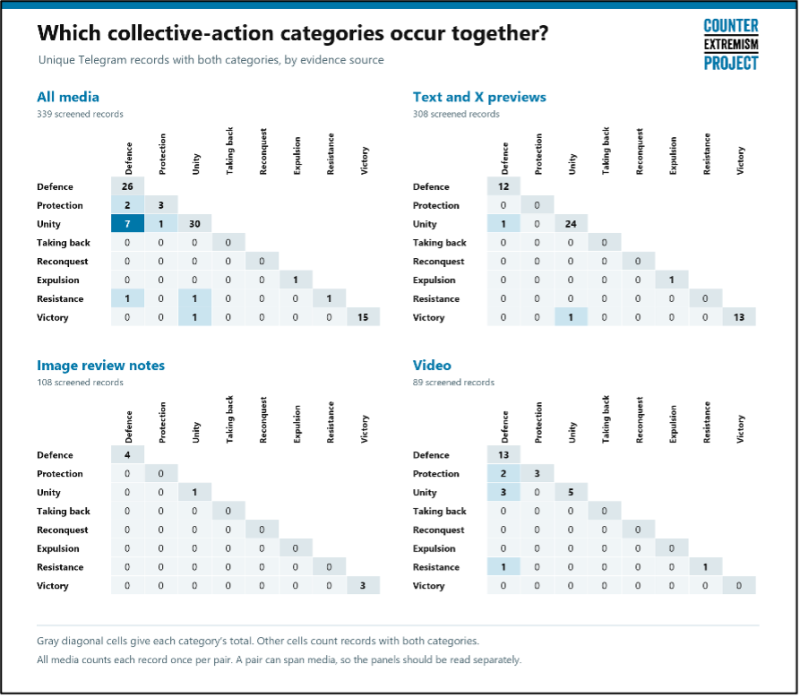
Figure 6: Co-occurrence of collective-action language in NN's communications. This matrix examines how expressions associated with collective action appear together across NN's Telegram communications. Unity and defence are among the most prominent terms, sometimes appearing in the same post. Their combination is particularly revealing: while unity invokes a collective identity, defence introduces a responsibility to protect it. Read alongside NN's broader narratives of national belonging and perceived threats, this relationship helps explain how the organisation connects ideological identification to appeals for collective action. The figure records selected expressions and does not establish the full range of actions advocated by NN.
Unity and Defence: From Collective Identity to Collective Responsibility
These expressions serve different purposes. Appeals to unity emphasise the existence of a collective with shared interests and responsibilities, reinforcing the idea that Spaniards must act together in response to common threats. Defence, by contrast, identifies what that collective is expected to protect: the nation, its cultural identity, its neighbourhoods or future generations. When the two appear together, NN presents national defence as a shared responsibility rather than an individual political preference. The organisation's July 2024 recruitment video illustrates this relationship. It accused "globalist elites" of undermining Spain's identity, values and race, connected these alleged threats to the future of children and grandchildren, and invited viewers to join NN. The appeal brought together collective identity, perceived vulnerability and organisational participation within a single message.
NN's language of collective action varies across the period examined, but it does not follow a straightforward progression from unity to defence or victory. All three expressions appear at different moments, sometimes alongside one another. Their significance lies partly in the different meanings they bring to NN's appeals: while unity and defence connect collective identity to a responsibility to act, victory introduces an additional, outcome-oriented dimension: the possibility of overcoming an adversary or achieving an objective. The language becomes more visible in early 2026, introducing a more explicitly outcome-oriented dimension to NN's appeals. Its precise meaning nevertheless depends on the context of individual messages and cannot be established from frequency alone. These variations are therefore more useful for understanding how NN presents collective action in different contexts than for identifying changes in its strategic objectives.
The relationship between language and context is particularly apparent in NN's communications concerning immigration. In March 2026, the organisation advertised a demonstration in Valencia that blamed immigration for insecurity and invoked the idea of population replacement. Its appeal connected the protection of public spaces to the recovery of Spain, presenting participation in the demonstration as a response to an alleged national threat. In Valladolid, a separate message blamed mass immigration for the deterioration of a working-class neighbourhood and equated defending that neighbourhood with defending the nation. Although the two messages addressed different local circumstances, both relied on the same connection between national identity and collective defence. The difference lay in the response proposed: one directed supporters towards a specific demonstration, while the other encouraged a broader commitment to defending the community.
The language of collective action became particularly visible again in July 2026, when references to defence and unity reached their highest monthly levels in the material examined. The Ceuta border crisis provides a concrete example of how NN applied this language to contemporary political developments. In announcing its support for the demonstration outside the Moroccan embassy, NN combined accusations of government betrayal with its portrayal of immigration as an invasion and an appeal to defend Spain. The organisation thereby presented participation in a demonstration organised by another political actor as an expression of national responsibility. Given that the border crossings occurred at the end of July, however, the crisis cannot account for the broader increase in collective-action references throughout the month. The significance of the example lies instead in how NN incorporated an emerging political controversy into its established language of national defence.
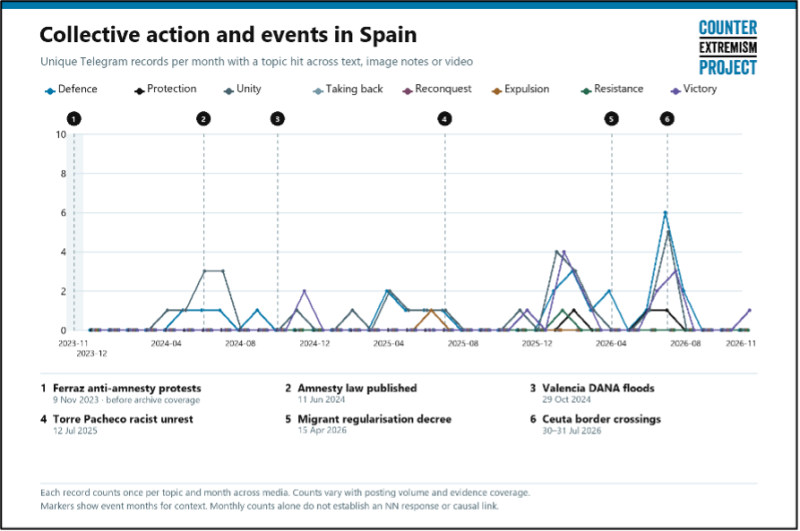
Figure 7: Evolution of collective-action language alongside political developments in Spain. This figure shows how expressions associated with collective action varied in NN's Telegram communications between December 2023 and November 2026. While unity and defence recur throughout the period examined, references to victory become more prominent at particular moments, especially in 2026. Selected political developments in Spain provide context for these fluctuations, without establishing a causal relationship between specific events and changes in NN's language. The figures reflect the occurrence of selected keywords rather than the full range of collective actions advocated by the organisation.
The relatively limited use of explicitly confrontational verbs such as expulsar, resistir or reconquistar also deserves attention. NN's communications can advocate exclusionary political positions without using these particular words. Its references to invasion, population replacement and remigration demonstrate that the absence of certain verbs does not imply the absence of the ideas associated with them. Similarly, defence is not inherently a moderate or peaceful concept: its meaning depends on what is being defended, against whom and through which actions. The prominence of defensive language is therefore relevant to understanding NN's political self-presentation, rather than determining the nature of its ultimate objectives.
Beyond these broader appeals, NN's communications also included practical instructions for participation. Recruitment messages directed prospective members towards registration channels, while demonstration announcements provided meeting points and schedules. In November 2025, NN issued instructions for its marching contingent, requiring participants to follow designated organisers, maintain formations and use approved slogans. Such messages differ from general appeals to unity or national defence because they specify what supporters are expected to do. They also illustrate how the organisation's language of collective identity could accompany efforts to coordinate its public activities.
These communications also need to be considered alongside NN's organisational development. As already documented, the group drew on established extremist networks, developed recruitment structures and established contacts with organisations abroad. Its public messaging helps explain how NN presented participation in these activities: joining the organisation, attending demonstrations and identifying with its nationalist cause were framed as ways of responding to the threats it described. The communications therefore provide a link between NN's ideological claims and the organisational activities documented elsewhere, although they cannot establish how many people were persuaded to participate or whether particular messages influenced their decisions.
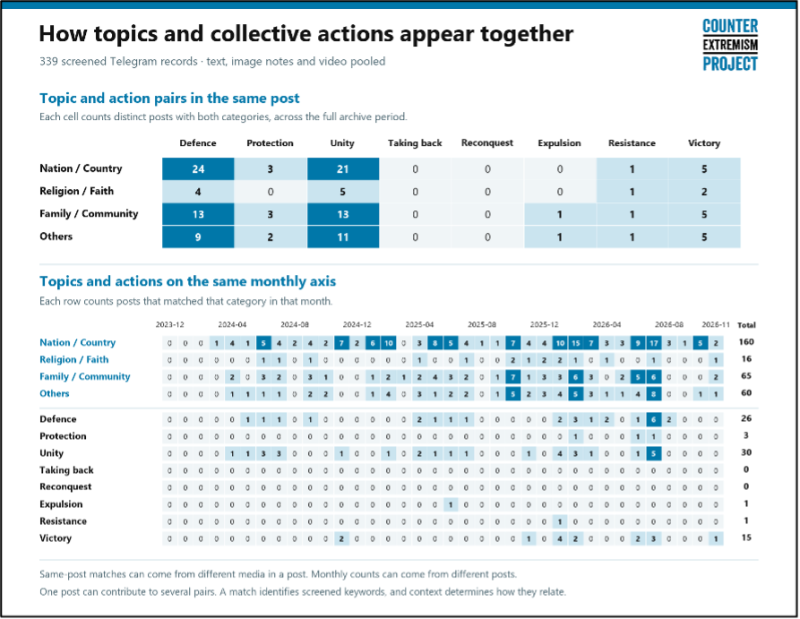
Figure 8: Connections between narrative themes and collective-action language in NN's communications. The figure shows which themes and collective-action expressions appear together within individual Telegram posts and how their prominence varies over time. References to national identity frequently coincide with appeals to defence and unity. These patterns help illustrate how NN connects ideological claims to collective responsibility, without establishing changes in organisational strategy or the effectiveness of its mobilisation efforts.
Conclusion: What NN Communications Reveal
Núcleo Nacional's communications illustrate how an established neo-Nazi ideology can be presented through contemporary political grievances without fundamentally changing its underlying ideas. Immigration, housing, neighbourhood insecurity and institutional failure become different expressions of a common argument: that the Spanish nation is under threat and that defending it requires collective action. By connecting these issues to questions of national belonging, NN seeks to make its political agenda relevant beyond the explicitly extremist circles from which it emerged.
The organisation's appeals to unity, defence and victory reinforce this message, although their prominence and meaning vary across different circumstances. Through its recruitment campaigns, participation in demonstrations and claimed assistance to communities affected by institutional failures, NN seeks to present itself not simply as an organisation opposing the existing political order, but as one acting in the interests of the population it claims to represent. Its communications therefore serve both to delegitimise existing institutions and to construct an alternative source of political legitimacy. What emerges is not evidence of a wholly new extremist strategy, but a clearer understanding of how NN presents familiar ideological claims in relation to developments in contemporary Spain.
Whether these efforts have translated into influence beyond NN's established networks remains an open question. Its references to Spanish families, workers and neighbourhoods reveal the constituency it claims to represent, not the composition of its actual audience. Likewise, participation in wider protests demonstrates an effort to associate itself with public grievances, rather than an ability to shape those movements. Establishing NN's wider influence would require evidence of recruitment, participation and audience engagement beyond its own public communications.
Stay up to date on our latest news.
Get the latest news on extremism and counter-extremism delivered to your inbox.