Counter Extremism Project’s ARCHER at House 88 to Present New Exhibition by Photographer Hannah Altman, Retracing the Physical and Emotional Journey of Holocaust Victim Lore Sternfeld
Vintage Astro-Berlin Lenses, Like Those Sternfeld Crafted, Are Used to Depict the Path from Berlin to Auschwitz
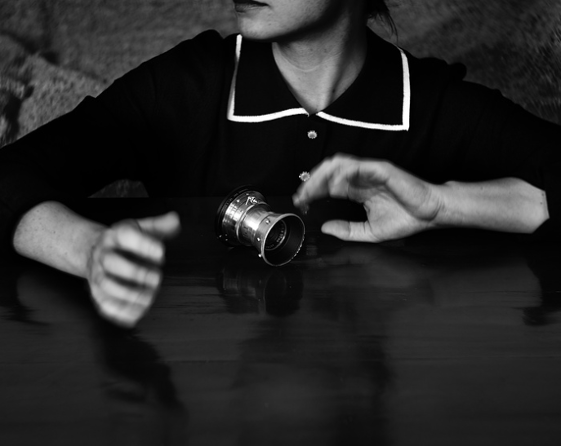
Oświęcim, Poland (April 30, 2026) – The Counter Extremism Project (CEP) is proud to organize Ground Glass: Reframing the World of Lens-Maker and Holocaust Victim Lore Sternfeld, a new exhibition by Jewish-American photographer Hannah Altman (b. 1995). The exhibition honors the life and work of Holocaust victim Lore Sternfeld (1915-1943), a precision engineer who made camera lenses for Astro-Berlin, the same company whose lenses were used by Nazi propagandists including filmmaker Leni Riefenstahl. Beginning June 21, 2026, Ground Glass will be on view at the former home of Auschwitz commandant Rudolf Höss, now the Auschwitz Research Center on Hate, Extremism and Radicalization (ARCHER) at House 88 in Oświęcim, Poland. The site functions as a center for counter-extremism research, advocacy, and art.
In early 2025 CEP acquired several Pan-Tachar lenses made by Astro Berlin during Lore’s time as an Astro Berlin lens mechanic, and in collaboration with London-based cinematic company Focus Canning, has restored, refurbished, and fit them on a modern camera. Altman used these lenses to imagine Lore Sternfeld’s inner world during the final winter of her life and to retrace her path from Berlin to Auschwitz on the 83rd anniversary of her deportation.
The first images of Ground Glass were made in a sparsely furnished Berlin apartment, using only two small rooms as the primary setting. Through the vintage lenses, Altman transformed the rooms into psychological and narrative settings, often using household found items such as eggshells, a cutting board, and Judaica, outfitted in a wardrobe that approximated Sternfeld’s documented attire.
On the anniversary of Sternfeld’s deportation, Altman boarded a train toward Auschwitz, documenting each stage of Sternfeld’s final journey along the way. In addition, Altman made photographs in the former home of Rudolf Höss, which directly overlooks the Auschwitz barracks.
“This project was, by necessity, deeply personal,” said Hannah Altman. “Merging historical record with artistic intuition, these photographs pay witness to Lore while acknowledging that her story has unfillable gaps. As I moved through this project, I felt as if Lore’s vision merged with my own. Using a collection of these reclaimed lenses to build a speculative study of Lore’s final months, I felt a powerful connection to her specific story as well as a heightened sense of the experiences we do share: those of being a young Ashkenazi woman, confined and uneasy within a limited space. In this sense, the project acknowledges the impossibility of filling the gaps, instead focusing on the opportunity to build upon her unknown inner world with empathy and expansiveness.”
According to Altman, the Astro-Berlin lenses had their own personalities, introducing distortions, flares, and a softened light shaping the images. Retrofitted onto the body of a Leica digital camera, Altman sought to collaborate with the lenses, allowing their character to guide the work. Their distinct distortions and visual unpredictability echoed the atmosphere of Berlin during the WWII era, adding a profound sense of self-realization to the project.
“The lenses themselves have the almost ghostly quality of a bygone era, and there were moments when we felt Lore was in the workshop with us,” said Ben Mitchell, Managing Director of Focus Canning, who worked with his team to restore the lenses. “It was sobering but particularly meaningful to think of Lore as a fellow colleague of the craft, separated by almost a century. The work was one of raw emotion and struggle, but also profound satisfaction that we were playing our small part in reminding the world of her name.”
On the significance of this project to CEP’s work, CEP CEO Ambassador Mark D Wallace said:
“These lenses, or lenses like them, passed through Lore’s hands. As a lens mechanic, she peered through them with her own eyes, shaping them for use by an ideology of extremism and hate. She was later murdered by the Nazis at Auschwitz. Today, as propaganda runs rampant online, inspiring the continued murder of Jews and other innocents, we will ask our visitors to take Lore’s lenses into their own hands, look through them as if through Lore’s own eyes, and turn them back upon her murderers. Hannah Altman has brilliantly captured Lore Sternfeld’s legacy and her final journey with extraordinary empathy. We hope visitors will respond to that empathy with their own act of resilience and defiance — through the lenses of Lore Sternfeld.”
The exhibition features 18 photographs. Roughly two-thirds of the images are black and white. When color appears, it is restrained within a narrow tonal range of warm oranges or brief moments of sunlight. Although some images lean toward the surreal, the group as a whole remains grounded in a specific environment and emotional landscape.
The vintage lenses that Altman used will be displayed alongside the exhibition, and visitors will be given opportunities to use them to create photographs of their own. Also on view will be the few existing documentational fragments of Sternfeld’s life.
About Hannah Altman
Hannah Altman is a photographer based in Boston, MA, whose work considers storytelling and the porosity between memory and myth. She holds an MFA from Virginia Commonwealth University. Her photobooks Kavana (Kris Graves Projects, 2020) and We Will Return to You (Saint Lucy Books, 2025) are held in libraries including the Museum of Modern Art, the Metropolitan Museum of Art, the Getty, Harvard University, and Stanford University.
Altman’s photographs have been published in The New York Times, Artforum, Vanity Fair, Harper’s Magazine, LensCulture, and British Journal of Photography. Her work has been exhibited at institutions such as the Virginia Museum of Contemporary Art, MK&G Hamburg, Houston Center for Photography, Koffler Arts, Athens Photo Festival, Ogden Museum of Southern Art, and Silver Eye Center for Photography.
She was the inaugural Blanksteen Artist in Residence at the Slifka Center for Jewish Life at Yale in 2022. Recent recognition includes: 2022 Hopper Prize finalist, 2022 Portraits Hellerau Photography Award First Prize winner, 2023 Innovate Grant recipient, 2023 Aperture Portfolio Prize finalist, 2025 Arnold Newman Prize honorable mention, and Cultured Magazine’s 2025 Young Photographers List nomination.
About the Counter Extremism Project and ARCHER at House 88
The Counter Extremism Project (CEP) is a not-for-profit, non-partisan, international policy organization formed to combat the growing threat from extremist ideologies. The Auschwitz Research Center on Hate, Extremism, and Radicalization (ARCHER) at House 88 is a unique new initiative of the Counter Extremism Project (CEP). Situated directly outside the wall of the Auschwitz-Birkenau concentration and death camps, House 88 was once the home of camp commandant Rudolf Höss, who built an idyllic life for his family while organizing one of history’s most atrocious mass murders next door. CEP has acquired the house and transformed it into a center for combating antisemitism and extremism through research, education, advocacy, and art. As part of this mission, we are dedicated to a form of Holocaust education that not only memorializes victims but also allows their stories to provide a strong response to the crisis facing Jews today.
Media Contacts
Keith Burnet
[email protected]
+44 7714 200920
Alison Buchbinder / Yaël Cohen Silver
[email protected] / [email protected]
+ 1 646 688 7826 / +1 646 619 3149