Afghanistan Content Report: May 10 – 16, 2025
Afghanistan Content Report
May 10 – 16, 2025
Please note that all items in this issue concern ISIS-K
Table of contents
1. ISIS Al-Naba Newsletter Edition 495, Published May 15, 2025
2. Pro-ISIS Online Chatter
3. ISIS Amaq/Nashir Statements
4. ISIS-K-Linked Al-Azaim Book “Guidance on the Beauty of Jihad and the Harms of Corrupt Nationalist Groups,” Released on May 11, 2025
Main points (Pro-ISIS Online Chatter)
Afghanistan
- Two Taliban soldiers were allegedly killed in Badakhshan in a fight over the burning of poppy fields.
- Unidentified gunmen murdered an Afghan man from Panjshir.
- The Taliban has sentenced the social media commentator known as “General Mubeen” to a year and a half in prison for condemning Taliban policies.
- The Taliban have killed Salafis in Kandahar, claiming that they were affiliated with ISIS. Based on the post, it is not clear when this occurred.
- A post accused the Taliban of not imposing religiously mandated punishments after the group instituted sentences of flogging and lengthy prison sentences for seven individuals charged with “adultery and sodomy.”
- A post claimed that Bagram Air Base is under the control of the U.S.
Pakistan
- Several Pakistani police officers were killed or wounded in a suicide attack in Peshawar.
- Unidentified gunmen killed a local leader in Swat.
- Unidentified gunmen killed four people in Datta Khel, North Waziristan.
- An election rally in Quetta was attacked with grenades, leading to the deaths and injuries of 12 people.
1. ISIS Al-Naba Newsletter Edition 495, Published May 15, 2025
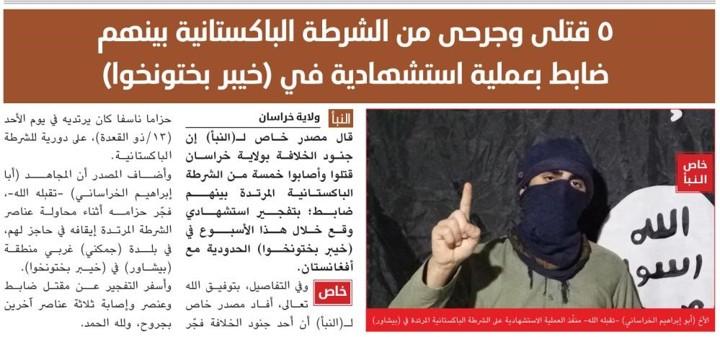
- “Five Pakistani police killed and wounded, among them officers, in a martyrdom operation in Khyber Pakhtunkhwa”
“Khorasan Province. A special source told Al-Naba that the soldiers of the Caliphate in Khorasan Province killed and wounded five apostate Pakistani policemen, including an officer, in a suicide bombing that occurred this week in Khyber Pakhtunkhwa, on the border with Afghanistan.
“Exclusive: In the details, by the grace of God Almighty, a special source told Al-Naba that one of the
Caliphate soldiers detonated an explosive belt he was wearing on Sunday (Dhu al-Qi’dah 13) at a Pakistani police patrol. The source added that the Mujahid Abu Ibrahim al-Khorasani (may God accept him) detonated his belt as apostate policemen attempted to stop him at a checkpoint in the town of Chamkani, west of Peshawar District in Khyber Pakhtunkhwa. The bombing resulted in the death of an officer and a soldier and the wounding of three other soldiers, praise be to God.”
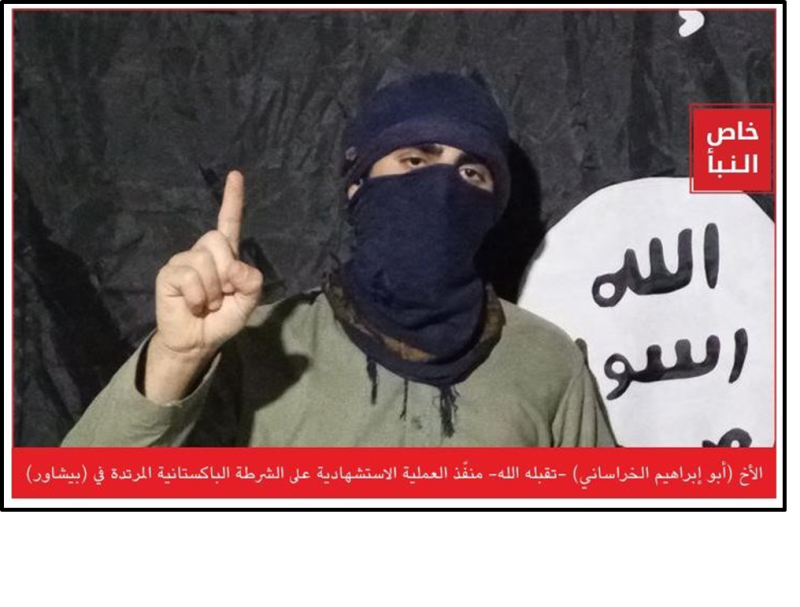
- “Brother Abu Ibrahim al-Khorasan—may God accept him—the perpetrator of the martyrdom operation against the apostate Pakistani police in Peshawar.”
2. Pro-ISIS Online Chatter
- May 10: Pro-ISIS post on Telegram stating that eight Afghan Shiites died in a mine disaster in Sughd, Tajikistan. See https://www.khaama.com/8-afghan-workers-killed-in-tajikistan-mine-explosion/. “Urgent. An explosion in the Ayni area of Sughd province, Tajikistan, kills eight Shiite Afghan workers in a Tajik mine. All of the dead are from the Shahristan district of Daykundi, a Shia Hazara-populated province in central Afghanistan. The dead have been identified as: Kazem Beji, Abdullah Ahmadi, Hassan Alizadeh, Hussein Bakhsh, Mohammad Amir, Ali Jan, Quban, and Ismail Rahimi.”
- May 10: Pro-ISIS post on Telegram claiming that unidentified gunmen murdered two people in Swat, Pakistan, and that one of them was a local leader, Fatehullah Khan, who belonged to the Awami National Party.
“Urgent. Gunmen assassinated the mukhtar [local leader] of Pakistan’s Swat district and a member of a government development council, Fatehullah Khan, along with one of his companions.”
- May 10: Pro-ISIS post on Telegram claiming that fighting has occurred in Badakhshan over the destruction of poppy fields, leading to the death of two Taliban fighters and the wounding of two others.
Text: “Badakhshan: Local sources in Badakhshan reported clashes between Taliban members in the province. On Saturday, sources in the west of the country told a newspaper that Qari Abdul Ghafour fighters and fighters from the Taliban’s intelligence and defense ministries clashed near the Arju intersection and Fayzabad, the capital of Badakhshan, over the destruction of poppy fields. According to the sources, a verbal altercation initially erupted between Qari Abdul Ghafour’s men and fighters from the intelligence and defense ministries, and later escalated into physical clashes. Sources reported that two Taliban members were killed and two others were wounded in the clash. Local Taliban officials in Badakhshan have not yet issued a statement on the matter.”
“Follow-ups. Due to disputes over poppy farms, clashes erupted between Taliban members, resulting in the deaths of two of them.”
- May 11: Pro-ISIS post on Telegram claiming that an unidentified militant killed a Pakistani police officer (with the rank of sub-inspector) and wounded another in a suicide blast in Peshawar. ISIS claimed this attack in al-Naba 495, released on May 15. See https://www.geo.tv/latest/604084-atleast-two-cops-martyred-in-peshawar-blast; https://www.app.com.pk/domestic/funeral-prayers-ofmartyr-cops-of-chamkani-suicide-attack-offered/.
“Urgent. Security sources: A gunman detonated his explosive belt in the Pakistani city of Peshawar, in Khyber Pakhtunkhwa, killing the head of security, Laiq [Zada] Khan, and another officer who was accompanying him.”
- May 11: Pro-ISIS post on Telegram noting that ISIS has not claimed responsibility for an attack in Afghanistan since February 13, 2025. The last attacks ISIS claimed in Afghanistan were the February 11 suicide bombing in Kunduz, targeting Taliban soldiers waiting in line at a bank, and the February 13 suicide attack on the Ministry of Urban Development and Housing in Kabul.
Text: “Since February 13, 2025, ISIS has not claimed responsibility for any attacks in Afghanistan, marking the longest operational pause—12 weeks—recorded under Taliban rule since August 2021. This surpasses the previous longest pause of 10 weeks in 2023.”
“Observers. An American journalist asks, and observers respond: Given that the Taliban government has not arrested anyone during this period and that none of its operations have succeeded in killing a terrorist, what makes the international community afraid of remaining silent?”
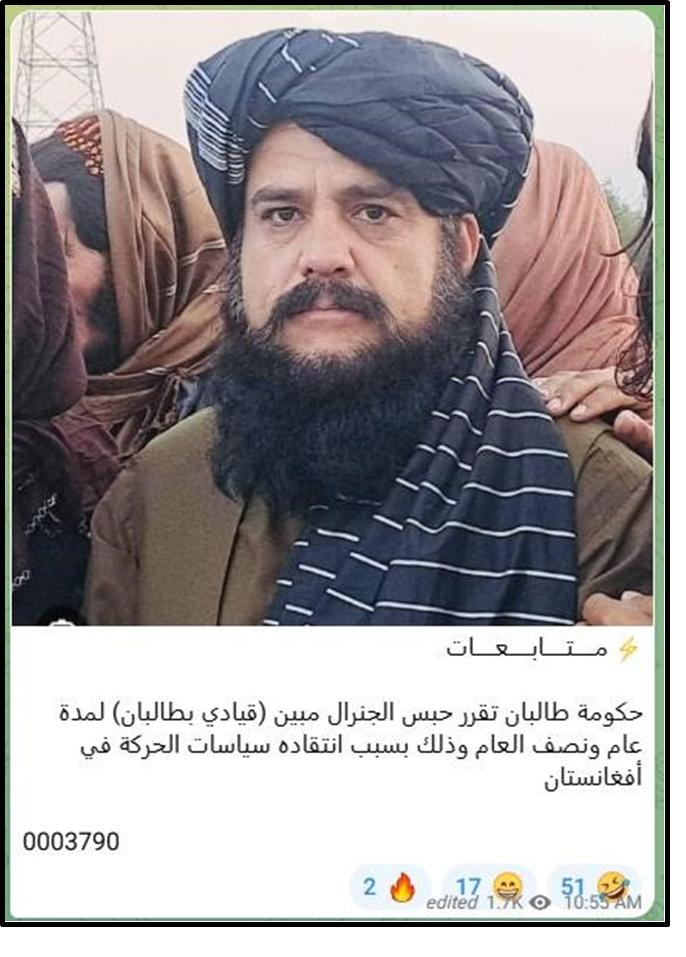
- May 12: Pro-ISIS post on Telegram stating that the Taliban has sentenced the social media commentator known as “General Mubeen” to a year and a half in prison for condemning Taliban policies. See https://x.com/TNNEnglish/status/1921956417814028302.
“Follow-ups. The Taliban government has decided to imprison General Mubeen [Mohammad Mubeen Khan], a Taliban leader, to a year and a half [in prison] for criticizing the movement’s policies in Afghanistan.”
May 12: Pro-ISIS post on Telegram stating that unidentified gunmen killed four people in Datta Khel,
North Waziristan.
“Urgent. Gunmen attack four people in the village of Datta Khel, North Waziristan, Pakistan, killing them. The motive for the attack is not yet known.”
- May 13: Pro-ISIS post on Telegram claiming that unidentified gunmen murdered an Afghan man from Panjshir who had recently come back to the country from the United Kingdom. News sources do not indicate that the man recently returned to Afghanistan. See https://x.com/paigahnews_af/status/1922202786596331986 and https://rudabe.org/archives/26672.
“Urgent. An armed attack in the Afghan city of Kabul targeted an Afghan man from Panjshir who had recently returned from Britain, killing him instantly.”
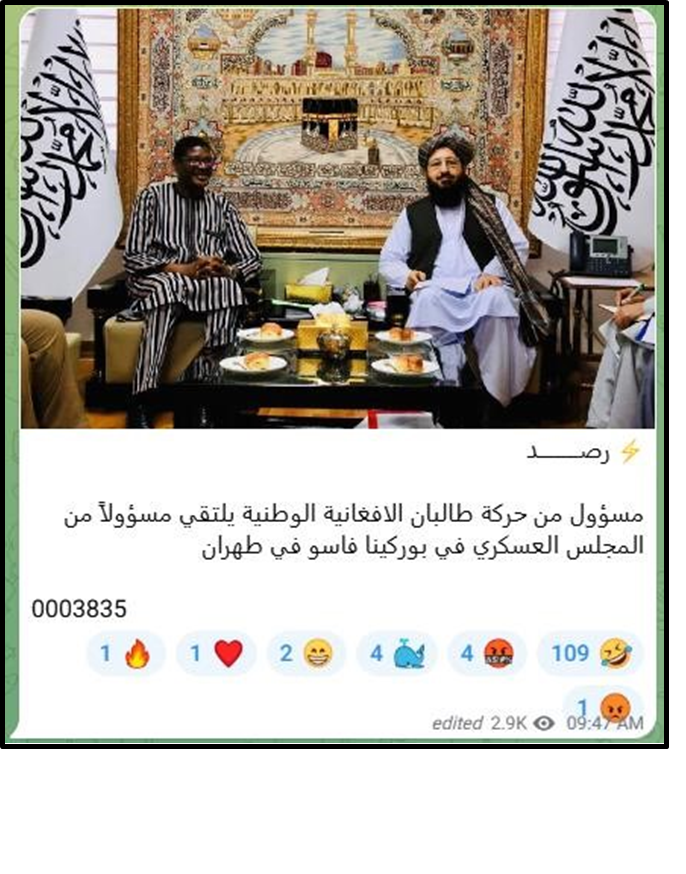
May 13: Pro-ISIS post on Telegram noting that Fazl Mohammad Haqqani, the Taliban ambassador to
Iran, met with Burkina Faso’s ambassador to Iran, Mohammad Kabore, at the former’s embassy in Tehran. See https://apnews.com/article/burkina-faso-taliban-trade9c883e1547781ebe3db766bfc385d463.
“Monitoring. An official from the Afghan National Taliban Movement meets with an official from the Burkina Faso Military Council in Tehran.”
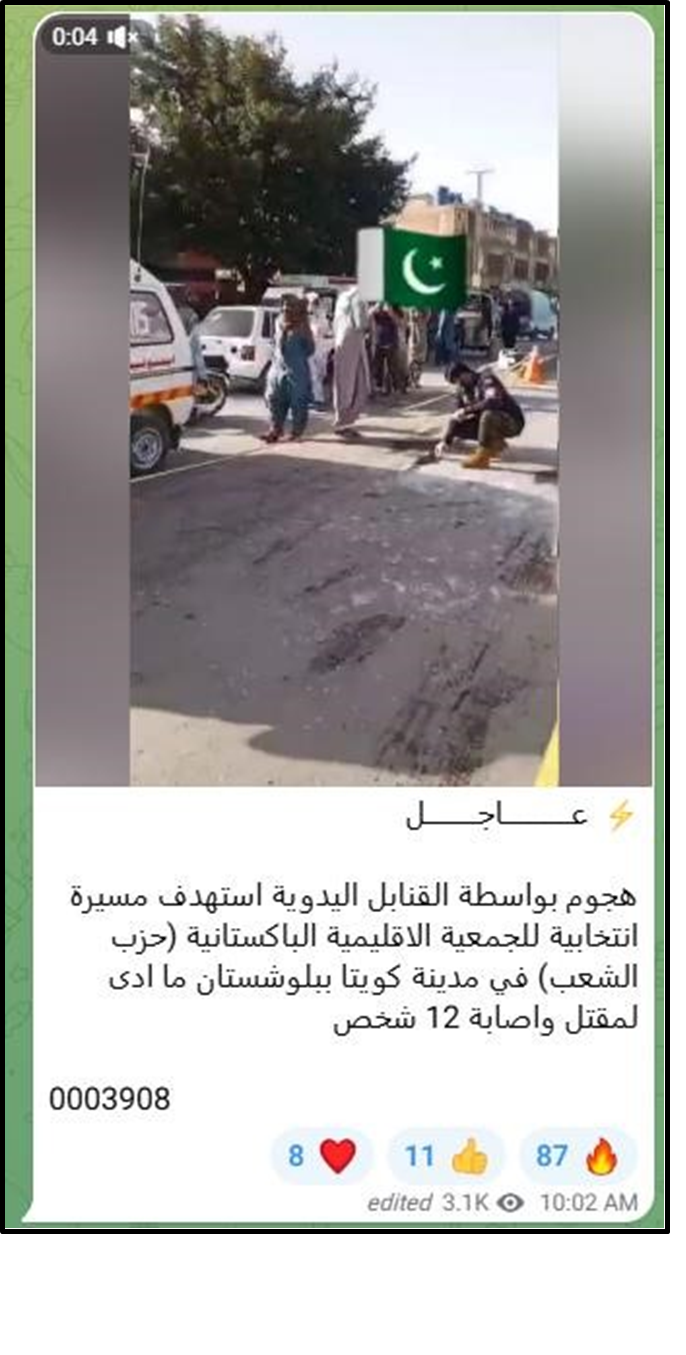
- May 14: Pro-ISIS post on Telegram stating that unidentified individuals attacked an election rally in Quetta with grenades, leading to the deaths or injuries of 12 people. See https://www.dawn.com/news/1911130.
“Urgent. A grenade attack targeted an election rally for the Pakistan Provincial Assembly (PPP) in Quetta, Balochistan, killing and wounding 12 people.”
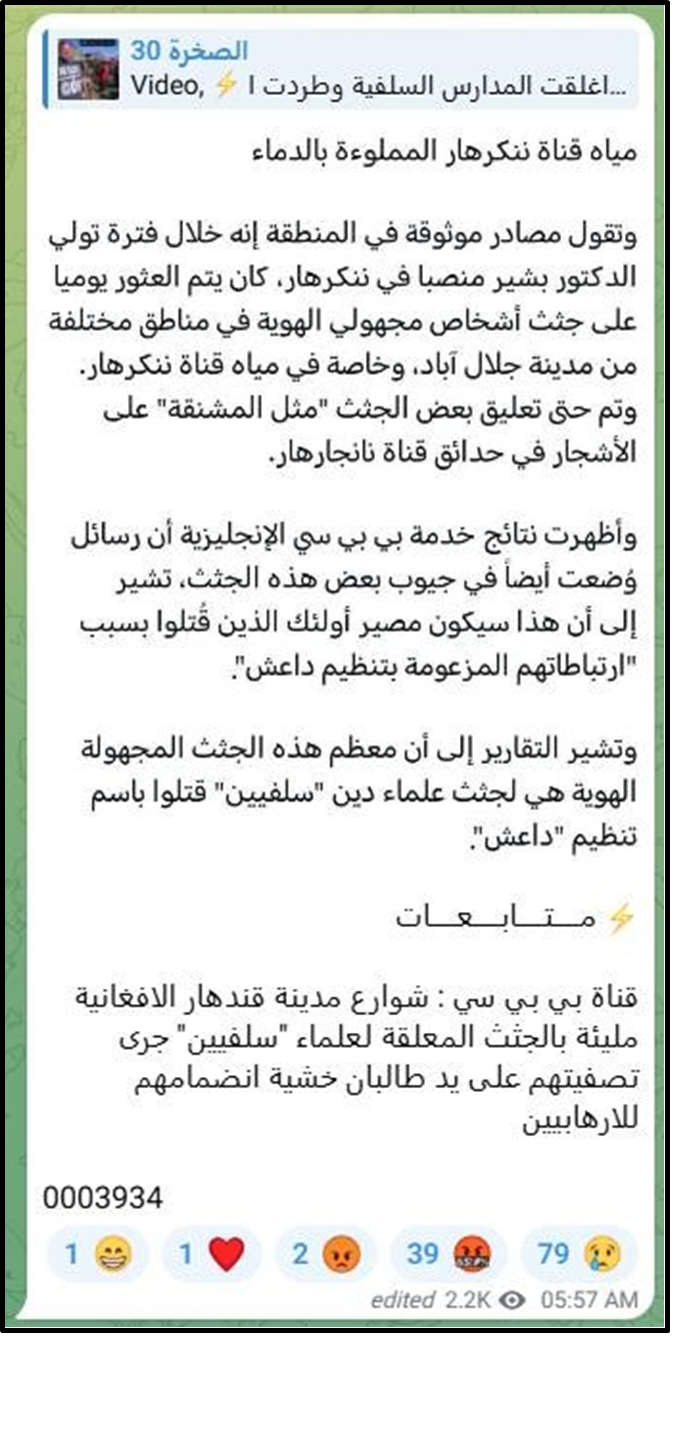
- May 15: Pro-ISIS post on Telegram claiming that the BBC is reporting that the Taliban are killing Salafis in Kandahar, claiming that they are affiliated with ISIS. Please note that it does not seem that the text below is from the BBC. The text below appears to be modified from the January 20, 2025, article “The Fate of Salafis Under Taliban: From Imam Removal to Mysterious Killings,” available at http://afintl.com/en/202501203473.
Text: “The blood-filled waters of the Nangarhar canal. Reliable sources in the region say that during Dr. Bashir’s tenure in Nangarhar, unidentified bodies were found daily in various areas of Jalalabad, particularly in the waters of the Nangarhar Canal. Some bodies were even hung ‘like nooses’ from trees in the gardens of the Nangarhar Canal. BBC English’s findings revealed that notes were also placed in the pockets of some of these bodies, indicating that this would be the fate of those killed for their ‘alleged association with ISIS.’ Reports indicate that most of these unidentified bodies were those of ‘Salafi’ religious scholars killed in the name of ISIS.”
“Follow-ups. BBC: The streets of the Afghan city of Kandahar are littered with the hanging bodies of
‘Salafi’ scholars who the Taliban executed for fear they would join the terrorists.”
- May 15: Pro-ISIS post on Telegram stating that the Taliban do not impose religiously mandated punishments after the group flogged six men and one woman in Ghazni and Parwan provinces for the offenses of “adultery and sodomy” and sentenced them to prison terms between 30 and 39 years.
Text: “In continuation of the corporal punishments imposed by the Taliban on individuals, seven people, including a woman, were publicly flogged in Ghazni and Parwan provinces for ‘adultery and sodomy.’ The Taliban-run Supreme Court announced in two separate press releases that it would sentence each of these individuals to prison terms ranging from 30 to 39 years.”
“Follow-ups. Taliban rulings that no one knows where they came from.”
- May 15: Pro-ISIS post on Telegram claiming that Bagram Air Base is under the control of the U.S.
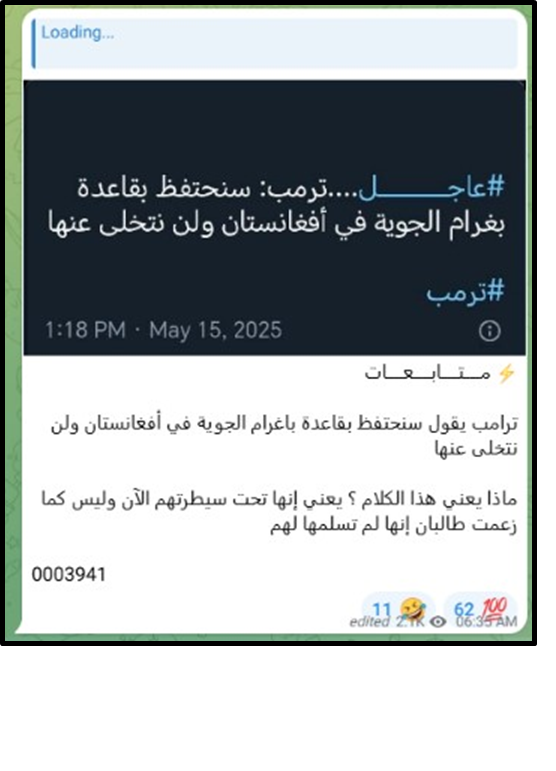
“Text: #Urgent . . . Trump: We will keep Bagram Air Base in Afghanistan and will not abandon it.”
“Follow-ups. Trump says we will keep Bagram Air Base in Afghanistan and will not abandon it.
“What does this mean? It means it is under their control now, not as the Taliban claimed, not that they had not handed it over to them.”
- May 15: Pro-ISIS post on Telegram claiming that the U.S. wants Bagram Air Base for on-the-ground coordination with the Taliban against ISIS-K as well as “surveillance, intelligence gathering, [and] targeting” and to use it as a facility from which to monitor Chinese nuclear installations.
“Observers. The U.S. wants Bagram for two reasons:
“First: To combat terrorism through surveillance, intelligence gathering, targeting, and security coordination with the Taliban on the ground, up close and personal, rather than remotely, as has been the case for years.
“Second: The base’s proximity to Chinese nuclear facilities and its use for spying on China.”
3. ISIS Amaq/Nashir Statements
• There were no Amaq/Nashir claims of responsibility for Afghanistan between May 10 and May 16. Please note that the attack claim in al-Naba was noted as coming from “a special source."
4. ISIS-K-Linked Al-Azaim Book “Guidance on the Beauty of Jihad and the Harms of Corrupt Nationalist Groups,” Released on May 11, 2025
A 218-page book in Pashto that condemns other Muslim militant or political organizations. The book is directed at explaining why the Taliban and other groups are illegitimate.
Summary:
- Some groups that claim to be fighting to institute religious law and call for fighting to implement the true religion are false.
- They distort religion to serve their own purposes, including nationalism and ethnic supremacy.
- Others deny that fighting is religiously mandated.
- Religiously mandated fighting is pure justice and a form of worship.
- Many groups fight for nationalism rather than religion.
- Fighting cannot be limited to one geographic area. Those who say it can only be mandated in one specific area, according to national borders, are not mujahid.
- We fight to institute the religion and not democracy, patriotism, ethnicity, secularism, or communism.
- All believers must unite and fight regardless of homeland, tribe, ethnicity, or language.
- Apostates, secularists, and nationalists must be killed.
- The soul is protected through religious law, which prevents moral corruption. The mind is protected by banning intoxicants. Property is protected by stopping theft and defending the oppressed. All of these protections require strength gained through fighting.
- We must hate and defeat our enemies.
- Fighting against nonbelievers is the greatest thing someone can participate in.
- Preventing the culture, customs, or traditions of nonbelievers from entering ISIS-held territory is necessary.
- This includes the above practices from Shiites, Sufis, secularists, and nationalists.
- Fighting is a form of vengeance for past wrongs committed against us.
- The opinions of those who do not endorse religiously mandated fighting do not matter.
- The requirements for appointing a caliph are outlined. This individual will lead religiously mandated fighting, following him is mandatory.
- Fighting can be conducted without this leader.
- It is forbidden to rebel against the caliph.
- Some groups fight to institute democracy. It is essential not to be deceived by these groups.
- Democracy means that power rests with the people and not the divine.
- Democracies believe in the peaceful transition of power, the separation of powers, an independent judiciary, respect for human rights, and equal application of the law.
- Democracy negates religious rule and recognizes an authority other than God.
- Practicing democracy is idolatry because it recognizes another power along with God and allows for the acceptance of blasphemous laws.
- Democracy allows for multiple political parties that endorse secularism, communism, or other religions.
- Democracy separates religion from the political system.
- Religion becomes a personal matter, and public space becomes secular.
- The Universal Declaration of Human Rights and additions contradict religious practices.
- Religiously mandated fighting is not compatible with democracy or secularism.
- There are other groups that fight for nationalism and patriotism.
- These groups believe in national and patriotic values, rather than religious values.
- Their fight is not legitimate because they view country and nationality as more important than coreligionists.
- Groups that fight for nationalism and patriotism accept apostates if they are of the same nationality.
- Piety is more important than the concept of nation.
- Nation or homeland becomes a partner of God, and therefore, groups that support this are not monotheists.
- Sufi groups are accused of being guilty of religious innovation and polytheism.
- The book accuses Sufism of endorsing apostasy and not believing in the day of judgement.
- The article condemns visiting graves.
- The book condemns Deobandism, accusing the movement of innovating.
- The book condemned the Muslim Brotherhood, stating that it supports democracy and multi-party elections.
- The Muslim Brotherhood in Syria has called for a democratic, pluralistic, and consultative state.
- The Muslim Brotherhood does not practice excommunication.
- The Muslim Brotherhood has also promoted good relations with Iran and sees its leaders as religious authorities.
- Some groups claim to support religiously mandated fighting, but then say that they do not want to interfere in the internal matters of other countries.
- This endorses the United Nations Charter, the international system, human rights, the maintenance of international security, the preservation of borders, and the concept of equality.
- The UN Charter calls for states to adopt the resolutions of the Security Council and follow the International Court of Justice.
- Other groups claim to participate in religiously mandated fighting, but associate with tyrants, through meetings or accepting aid.
- Associating with apostates is forbidden.
- Asking for help from disbelievers is also forbidden.
- The book advises the reader not to be deceived by groups that associate with polytheists.
- Consuming intoxicants is forbidden.
- Some groups allow the production of opium poppies. The production and trade of opium are forbidden.
- Groups that allow the opium trade cannot carry out religiously mandated fighting because they are tainted.
- Local groups cannot negotiate peace or other agreements. Only the Emir can ensure that the peace is just.
- Killing apostates is obligatory; they cannot be negotiated with
- The book condemns the system of ambassadors and diplomatic relations.
- One cannot fight alongside factions that endorse democracy, nationalism, ethnic supremacy, international law, etc.
Stay up to date on our latest news.
Get the latest news on extremism and counter-extremism delivered to your inbox.