Afghanistan Content Report: March 22–28, 2025
Afghanistan Content Report
March 22–28, 2025
Please note that all items in this issue concern ISIS-K
Table of contents
- ISIS Al-Naba Newsletter Edition 488, Published March 27, 2025
- Pro-ISIS Online Chatter
- ISIS Amaq/Nashir Statements
- ISIS-K Linked Al-Azaim Web Magazine Voice of Khorasan Issue 45, Released on March 27, 2025
Main points (Pro-ISIS Online Chatter)
Afghanistan
- The U.S. government removed the bounties on three senior Taliban leaders: Interior Minister Sirajuddin Haqqani, Abdul Aziz Haqqani, and Yahya Haqqani. The three are still wanted by the U.S. government and are listed as Specially Designated Global Terrorists (SDGTs).
- The Taliban are looking to make a deal with the U.S.
- Unidentified individuals killed Hassan Jabarkhil, a former member of the security forces in the Afghan Ministry of Interior in the previous Afghan government.
- High-ranking Taliban leaders met with Hibatullah Akhundzada in Kandahar. The text accompanying the post noted that the topic of the meeting was domestic security and that there was the possibility that Sirajuddin Haqqani would resign. The post claimed that the true purpose of the meeting was for Taliban leaders to pass on the “instructions and orders” coming from the U.S. government.
- Abdul Rahman Niazi, an Afghan national, was stabbed to death by another individual, allegedly from Afghanistan, in Houston, Texas. Niazi had previously worked as a translator for U.S. soldiers in Afghanistan.
Pakistan
- Qari Shahzada, the vice president of Jamiat Ulema-e-Islam, was assassinated in Karachi, Pakistan.
- Unidentified militants attacked peace committees (local militias) in Khyber Pakhtunkhwa, killing four people in two days.
- Unidentified gunmen killed a suspected member of the Jamiat Ulema-e-Islam party in South Waziristan.
- Unidentified militants killed one Pakistani soldier and injured five others in an ambush on a patrol in Dera Ismail Khan, Khyber Pakhtunkhwa.
- Unidentified gunmen assassinated a senior Counter Terrorism Department (CTD) official named Javed Lehri. Another CTD official was injured in Mastung, Balochistan.
- There was an explosion near a market in Quetta that killed at least two people and wounded 11.
- Unidentified militants killed seven Pakistani soldiers in Khyber Pakhtunkhwa.
1. ISIS Al-Naba Newsletter Edition 488, Published March 27, 2025
- There were no ISIS-K news items in this week’s al-Naba.
2. Pro-ISIS Online Chatter
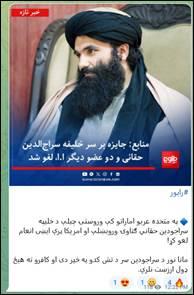
- March 22: Pro-ISIS post on Telegram stating that the U.S. has removed the bounty on Taliban Interior Minister Sirajuddin Haqqani. The U.S. government still lists Haqqani as a Specially Designated Global Terrorist.
“#Report. The recent arrests in the United Arab Emirates of Khalifa [sic] Sirajuddin Haqqani and the U.S. has canceled the bounty on him! This means that Sirajuddin’s head is now like an empty gourd and has no value to the infidels.”
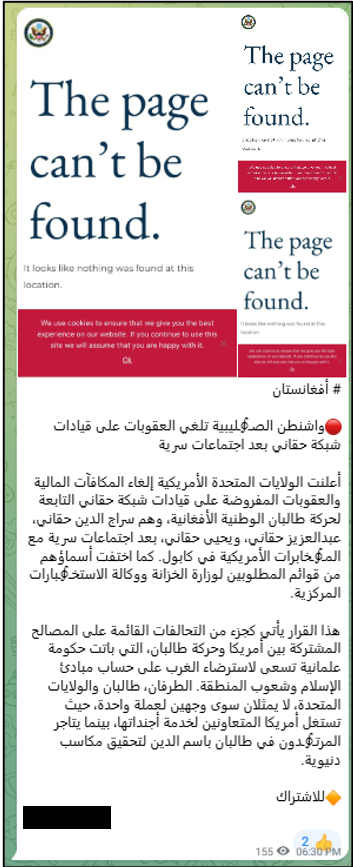
- March 22: Pro-ISIS post on Telegram stating that the U.S. removed the bounty for the leaders of the Haqqani Network, most notably Sirajuddin Haqqani, after secret negotiations in Kabul. The post claims that the U.S. took this action because the Taliban has sought to win their approval by becoming a secular government and not instituting religious law. The post below is incorrect in stating that leaders of the Haqqani network have “disappeared” from U.S. government wanted lists. See https://www.bbc.com/news/articles/c1enxv4vz7do.
“#Afghanistan. Crusader Washington lifted sanctions on Haqqani Network leaders after [holding] secret meetings.
“The United States announced the lifting of financial rewards and sanctions imposed on the leaders of the Haqqani Network, affiliated with the Afghan National Taliban movement—Sirajuddin Haqqani, Abdul Aziz Haqqani, and Yahya Haqqani—following secret meetings with U.S. intelligence in Kabul. Their names also disappeared from the Treasury Department and CIA’s wanted lists.
“This decision comes as part of the alliances based on shared interests between the U.S. and the Taliban, which has become a secular government seeking to appease the West at the expense of Islamic principles and the people of the region. The two parties, the Taliban and the U.S. represent only two sides of the same coin. The U.S. exploits collaborators to serve its agendas, while the apostates within the Taliban trade in the name of religion for worldly gain.”
- March 22: Pro-ISIS post on Telegram incorrectly stating that Taliban leaders were removed from a U.S. terrorism list after negotiations [the bounty was dropped]. The post claimed that the U.S. would resume control of Bagram Air Base.
“Following a visit by a US delegation including CIA officials to #Afghanistan, #America removes Taliban leaders from the ‘terrorism’ list. It is worth noting that the U.S. delegation that visited #Afghanistan discussed cooperation with Taliban officials in the war against the Islamic State (ISIS). Media outlets also reported the imminent handover of the Afghan Bagram Air Base to the U.S.”
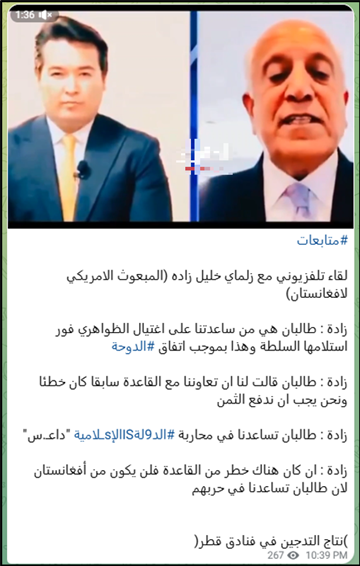
- March 22: Pro-ISIS post on Telegram stating that former U.S. Ambassador to Afghanistan Zalmay Khalilzad claimed that the Taliban assisted the U.S. in killing Ayman al-Zawahiri to make up for prior cooperation with al-Qaeda. The post also claimed that Khalilzad stated that the Taliban is fighting both ISIS-K and al-Qaeda and noted this is from “domestication in Qatari hotels,” alluding to the Doha Agreement.
“#Follow-ups. TV interview with Zalmay Khalilzad, the [former] U.S. envoy to Afghanistan.
“Zada [sic]: The Taliban helped us assassinate [Ayman] al-Zawahiri immediately after taking power, and this was following the #Doha Agreement.
“Zada: The Taliban told us that our previous cooperation with al-Qaeda was a mistake, and we must pay the price.
“Zada: The Taliban is helping us fight Islamic State.
“Zada: If there is a threat from al-Qaeda, it will not come from Afghanistan because the Taliban is helping us fight them.
“(The result of domestication in Qatari hotels.)”
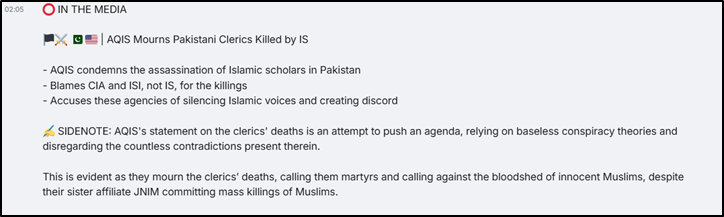
- March 23: Pro-ISIS post on Element noting the March 18 release from al-Qaeda in the Indian Subcontinent (AQIS) condemning the killing of clerics and religious scholars in Pakistan. The post said that AQIS is promoting the conspiracy theory that the U.S. and Pakistani governments control ISIS and blames the al-Qaeda affiliate Jama’at Nusrat al-Islam wal-Muslimin (JNIM) for killing Muslims in West Africa.
- March 23: Pro-ISIS post on Telegram noting that Adam Boehler, acting as an emissary for the U.S., met with Sirajuddin Haqqani in Kabul shortly after meeting with Israeli President Benjamin Netanyahu.
“Monitoring. Adam Boehler, a U.S. intelligence official and Trump’s envoy for hostage affairs [note: Boehler is not currently serving as the special presidential envoy for hostage affairs], met with [Prime Minister Benjamin] Netanyahu in Tel Aviv a few days ago and met with Sirajuddin Haqqani, a Taliban leader, in Kabul.”
- March 23: Pro-ISIS post on Telegram claiming that the Hazara politician Jafar Mahdavi, a former member of the Afghan parliament, congratulated “his brother in the homeland,” Sirajuddin Haqqani, after the latter had his bounty removed by the U.S. See https://x.com/mahdavi_jafar/status/1903849975231955338.
“Follow-ups. A representative of the Shiite community in Afghanistan (Jafar Mahdavi) congratulates his brother in the homeland, Sirajuddin Haqqani, on his removal from the U.S. sanctions list.”
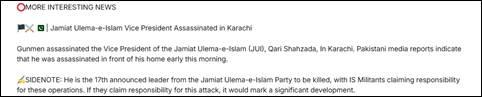
- March 24: Pro-ISIS post on Telegram noting the assassination of Qari Shahzada, the vice president of Jamiat Ulema-e-Islam, in Karachi, Pakistan. Shahzada was also a fundraiser for Lashkar-e-Taiba. The post noted that this was the 11th leader of Jamiat Ulema-e-Islam to be assassinated. The post noted that if ISIS claimed credit for this attack, “it would be a major development due to the expansion of operations in” Karachi.
“Urgent. Gunmen assassinate Qari Shahzada, the deputy leader [vice president] of the Democratic Islamic Party, Jamiat Ulema-e-Islam (JUI-F), in Karachi, in the Khairabad area of Karachi.
“Pakistani media reported that Qari was assassinated in front of his home this morning.
“This is the 11th declared leader of Jamiat Ulema-e-Islam to be assassinated, and the terrorists have claimed responsibility for these attacks.
“If the terrorists claim this action, it would be a major development due to the expansion of operations in this strategic city.”
- March 24: Pro-ISIS post on Telegram stating that unidentified individuals killed Hassan Jabarkhil, a former member of the security forces in the Afghan Ministry of Interior in the previous Afghan government. The post noted that his father had been a senior member of the Ministry of Interior and had moved to Germany.
“Urgent. Gunmen assassinated a senior officer in the Afghan Ministry of Interior of the former government, Hassan Jabarkhil, after taking him outside his home in the Shakar Dara area of the capital, Kabul. Hassan was serving as deputy security commander for the Kabul-Jalalabad highway, and his father, a senior official in the Ministry of Interior, fled to Germany several years ago.”
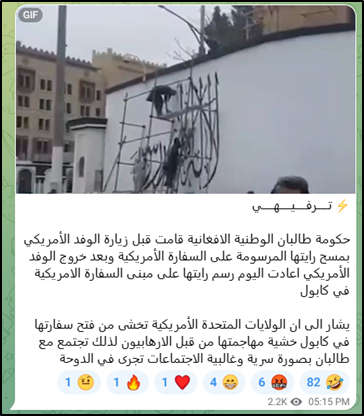
- March 24: Pro-ISIS post on Telegram claiming that the Taliban painted over their flag, which was previously painted on the wall outside the former U.S. Embassy in Kabul, for a visit by the U.S. delegation. The post noted that the flag was repainted after the U.S. delegation left. The post asserted that the U.S. is afraid of reopening its embassy in the city due to security fears, which is why U.S. officials normally meet with the Taliban in Doha.
“Entertainment. The Afghan Taliban National Government erased its flag painted on the U.S. embassy before the U.S. delegation’s visit. After the U.S. delegation’s departure, it repainted its flag on the U.S. embassy building in Kabul today. It is worth noting that the United States fears opening its embassy in Kabul for fear of being attacked by terrorists. Therefore, it meets with the Taliban secretly, with most meetings taking place in Doha.”
- March 24: Pro-ISIS post on Telegram claiming that “terrorists” beheaded a “banana seller in Kabul.”
“#Urgent. Terrorists arrested a banana seller in Kabul, then released him without a head.”
- March 25: Pro-ISIS post on Element regarding the assassination of Qari Shahzada, the Jamat Ulema-e-Islam vice president, in Karachi. The post claimed that Shahzada was the 17th leader of the political party to be killed.
- March 25: Pro-ISIS post on Telegram claiming that unidentified militants attacked peace committees (local militias) in Khyber Pakhtunkhwa, killing four committee members in two days.
“Urgent. Militants launched coordinated assassinations against members of the Inter-Services Intelligence (ISI) peace committees in Khyber Pakhtunkhwa, Pakistan.
“This morning: Militants assassinated Hidayatullah, a peace committee fighter, in the Tank area.
“This morning: Militants assassinated Samad and Hassan, two peace committee members, in the Kohat area.
“Yesterday evening: Militants assassinated a peace committee member in the Khyber Pakhtunkhwa district.”
- March 25: Pro-ISIS post on Telegram claiming that unidentified gunmen killed a suspected member of the Jamiat Ulema-e-Islam party in South Waziristan.
“Urgent. Gunmen assassinate a person in the Kalusha area of South Waziristan, Pakistan. The individual is believed to be a member of the National Ulema-e-Islam Party [Jamiat Ulema-e-Islam].
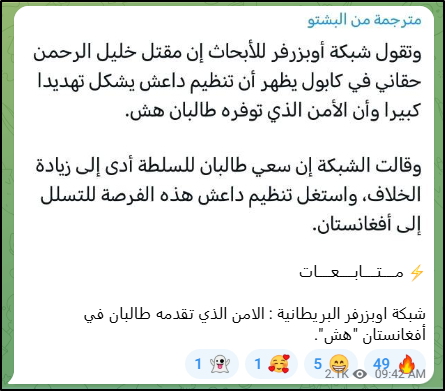
- March 25: Pro-ISIS post on Telegram citing a report from the Observer Research Foundation stating that security in Afghanistan is “fragile,” noting the assassination of Khalil-ur-Rahman Haqqani in December. The text associated with the post noted that “the Taliban’s pursuit of power has led to increased discord,” allowing ISIS to “infiltrate Afghanistan.” See https://www.orfonline.org/expert-speak/internal-rifts-and-external-threats-the-taliban-s-growing-crisis.
Text: “The Observer Research Foundation says the killing of Khalil-ur-Rahman Haqqani in Kabul demonstrates that ISIS poses a significant threat and that the security provided by the Taliban is fragile. The network said that the Taliban’s pursuit of power has led to increased discord, and ISIS has exploited this opportunity to infiltrate Afghanistan.”
“Follow-ups. British Observer Network: The security provided by the Taliban in Afghanistan is ‘fragile.’”
- March 26: Pro-ISIS post on Telegram claiming that unidentified militants killed one Pakistani soldier and injured five others in an ambush on a patrol in Dera Ismail Khan, Khyber Pakhtunkhwa.
“Urgent. An armed ambush targeted a Pakistani army patrol in the Dera Ismail Khan area of Khyber Pakhtunkhwa, which killed one soldier and wounded five others.”
- March 26: Pro-ISIS post on Telegram claiming that unidentified gunmen assassinated a senior Counter Terrorism Department (CTD) official named Javed Lehri and that another CTD official was injured in Mastung, Balochistan.
“Urgent. Gunmen assassinated a senior Counter Terrorism Department official, Javed Lehri, while another Counter Terrorism Department official, Habib, was injured on the Choto Road in Mastung, Balochistan, Pakistan.”
- March 27: Pro-ISIS post on Telegram stating that there was an explosion near a market in Quetta that killed at least two people and wounded 11.
“Urgent. An explosion near the Baresh Market in the Quetta district of Pakistan’s Balochistan province killed at least two people and injured 11. Initial sources say the dead were security personnel.”
- March 27: Pro-ISIS post on Telegram claiming that “a counterterrorism headquarters” in Surab, Balochistan, was attacked with a hand grenade.
“Urgent. A hand grenade attack targeted a counterterrorism headquarters in the Surab area of Pakistan’s Balochistan province.”
- March 27: Pro-ISIS post on Telegram stating that high-ranking Taliban leaders were meeting with Hibatullah Akhundzada in Kandahar. The text accompanying the post noted that the topic of the meeting was domestic security and that there was the possibility that Sirajuddin Haqqani would resign. The post claimed that the true purpose of the meeting was for Taliban leaders to pass on the “instructions and orders” coming from the U.S. government.
Text: “Taliban security leaders meet with the group’s leader in Kandahar. Amid speculation about internal disputes and reports of the resignation of Taliban Interior Minister Sirajuddin Haqqani, senior Taliban security officials met with Taliban leader Hibatullah Akhundzada in Kandahar.
“Taliban spokesman Zabihullah Mujahid said the meeting was attended by Defense Minister Mohammad Yaqoob, Interior Minister Sirajuddin Haqqani, Intelligence Chief Abdul Haq Wassiq, Deputy Defense Minister Abdul Qayyum Zakir, and Deputy Interior Minister Mohammad Nabi Omari.
“Mujahid said that during the meeting, Taliban security officials presented reports on the security situation in Afghanistan and made proposals for improving order, equipping [security] forces, and developing the movement’s security capabilities.
“The meeting comes amid recent reports of disagreements within the Taliban leadership and even the possible resignation of Sirajuddin Haqqani.”
“Observers. The meeting with Akhund was to inform him of the instructions and orders of the U.S. intelligence [personnel]. The media statement, however, was merely ‘incorrect,’ tired media talk.”
- March 28: Pro-ISIS post on Telegram stating that Abdul Rahman Niazi, an Afghan national, was stabbed to death by another individual, allegedly from Afghanistan, in Houston, Texas. Niazi had previously worked as a translator for U.S. soldiers in Afghanistan. See https://www.khou.com/article/news/crime/harwin-drive-office-stabbing/285-3093c7e4-12d1-4c36-b5df-a9d033ce2a6f.
“Follow-ups. A knife attack in Houston, Texas, targeted Afghan national Abdul Rahman Niazi, who had worked as a translator for U.S. forces in Afghanistan. The attack resulted in Niazi’s immediate death. An Afghan national carried out the attack. Niazi had previously been injured in an IED attack that targeted a U.S. patrol in Afghanistan.”
- March 28: Pro-ISIS post on Telegram stating that unidentified militants killed seven Pakistani soldiers in Khyber Pakhtunkhwa.
“News. Armed clashes in Khyber Pakhtunkhwa result in the deaths of seven Pakistani soldiers.”
- March 28: Pro-ISIS post on Telegram stating that unidentified gunmen attacked a police checkpoint in a market in Inayat, Bajaur.
“Urgent. Gunmen attacked a police checkpoint in the Inayat Market in Bajaur, Pakistan, causing material damage.”
3. ISIS Amaq/Nashir Statements
- There were no Amaq/Nashir claims of responsibility for Afghanistan between March 22 and March 28.
4. ISIS-K Linked Al-Azaim Web Magazine Voice of Khorasan Issue 45, Released on March 27, 2025
Please note that only summaries of relevant articles and infographics are included below.
Article 1: Stories From the Land of Living
- The text of the video “Stories From the Land of the Living: Abu Khalid al-Cambodi” released by ISIS’s al-Hayat Media on April 21, 2015.
- Abu Khalid al-Cambodi / Neil Prakash from Australia.
- Describes becoming a Muslim after converting from Buddhism.
- Abu Khalid described going to Cambodia for the first time when he was 20 and being appalled by what he viewed as the worship of idols.
- Abu Khalid described how, back in Australia, a lecture about the concept of Judgment Day profoundly impacted him. He wondered what would happen to his soul. He also started wondering about the purpose of life.
- Abu Khalid noted that he felt proud being a part of something larger than himself. He began thinking of those suffering overseas and again of his purpose in life.
- When deciding to travel to ISIS-held territory, prayer is important.
- It is important to place your faith in a higher power.
- People immigrated to ISIS-held territory to establish a state. There are schools and hospitals. This is a land of honor.
- Abu Khalid: We are portrayed in media as outcasts or troublemakers, but this is not true.
- Those in Australia should travel to ISIS-held territory.
- You must attack to avenge how they have abused women and attacked you.
- If you are unable to travel to ISIS-held territory, you should commit attacks.
Article 2: Brave Ghazi
- A story about ISIS-K fighters in the Spin Ghar mountains in Afghanistan. The year is unclear, but it is before the Taliban takeover of Afghanistan.
- Two fighters traveling together gave away their meager food supplies to children and are hungry now that time has passed.
- They see another fighter, a former university student. The narrator knew him before he became a fighter and described him as pious and trustworthy. The young fighter describes how he has no contact with his family because his brothers work for the Ministry of Interior and the U.S.
- The narrator hears that the young fighter was killed in combat three months later.
Article 4: An Impossible Mirage
- Iran is the main power fighting against ISIS in the Middle East.
- ISIS fought Iranian-backed militias in Iraq, making the latter’s goal of complete influence in the region impossible.
- Iran recruited soldiers from Pakistan, Afghanistan, and other countries to fight against ISIS.
- Iran used the Zainebiyoun [Iran-backed Pakistani Shiite militias] and Fatemiyoun [Iran-backed Afghan Shiite militias] to fight against Sunnis in Parachinar, Pakistan, and other places.
- Iran also reached out to the Taliban to build an alliance to fight ISIS-K.
- The former Taliban leader Mullah Akhtar Mansour traveled to Iran to negotiate assistance for fighting against ISIS-K. Ten years later, the Taliban and Iran are close allies.
- Iran’s foreign minister recently traveled to Kabul to meet with “senior Taliban leaders” to discuss water rights and the campaign against ISIS-K.
- While the Taliban claim that they are independent in their fight against ISIS-K, they receive assistance from other countries.
- The Taliban and Iran have had a long-standing relationship, but these ties strengthened after the Taliban took power in Afghanistan.
- The Taliban are portrayed as moving in the direction of becoming puppets of Iran.
- Taliban leaders went to the Iranian embassy shortly after they took power to assure the Iranian government that they would cooperate against ISIS-K.
- Abdul Ghani Baradar, Abdul Kabir, and Amir Khan Muttaqi have traveled to Tehran and Qom, where “they swore solemn oaths to . . . [Iranian] officials that in the fight against ‘terrorism’ (the Islamic State), they and Iran stood united as one body.”
- To win the trust of the Iranian government, the Taliban agreed to the construction of a security wall in Afghan territory. They also spied on individuals in Afghanistan on behalf of Iran. As a result of this espionage, some of these people were later imprisoned or executed.
- In allowing the construction of this wall, the Taliban betrayed Afghanistan, selling land for a cheap price.
- Iran’s previous ambassador in Kabul, Bahadur Aminian, claimed that ISIS-K was the main problem in Afghanistan and impacted all other issues. Aminian sought to improve Afghan-Iranian relations based on fighting the terrorist group.
- Iran’s next ambassador to Afghanistan, Hassan Kazemi Qomi, an Islamic Revolutionary Guard Corps (IRGC) member and founder of the Afghan Fatemiyoun, was actively involved in the fight against ISIS-K in Afghanistan.
- Kazemi Qomi would hold meetings with senior Taliban leaders, including Abdul Kabir, Amir Khan Muttaqi, and Mohammad Yaqoob, to discuss issues regarding fighting ISIS-K, including steadfastness and strengthening intelligence cooperation.
- The Taliban are now fighting Iran’s war against ISIS-K and share intelligence and work to increase bilateral cooperation.
- The Taliban claim that this fight is a regional issue.
- Muttaqi met with the now-deceased Iranian foreign minister, Hossein Amir Abdollahian, and met with now-deceased Iranian president Ebrahim Raisi to discuss the global community assisting the Taliban in fighting ISIS-K.
- Multiple Iranian officials also traveled to Kabul to speak with their Afghan counterparts about fighting ISIS-K.
- The ISIS attack in Kerman on January 3, 2024, led to a new chapter in cooperation between Iran and the Taliban. An Iranian official later claimed that a planned ISIS-K attack in Mashhad, Iran, was prevented due to intelligence information provided by the Taliban.
- The Taliban has also claimed that they have prevented ISIS-K attacks in Iran by collecting and sharing intelligence. This has led to several ISIS-K fighters being captured by the Iranians.
- The Taliban previously considered the Iranians to be disbelievers and legitimate targets, but today, they have an alliance.
- Abbas Araghchi, the Iranian foreign minister, recently met with high-ranking Taliban officials from the ministries of defense, foreign affairs, and industry, and the office of the prime minister, to work on creating a “comprehensive cooperation document.”
- The agreement covers counterterrorism, cultural and economic relations, refugees, Iranian water rights, and border security.
- The Taliban leaders have been willing to give the Iranians what they requested.
- The Taliban wants cultural cooperation with Iran. The article asks whether the Taliban will be bringing in Shiite beliefs.
- This agreement and overall relations between the two countries also show that the Taliban have embraced nationalism. The Taliban’s previous claim to create an Islamic Emirate was an attempt to fool their supporters.
- The Taliban have avoided mentioning cooperating with Iran to fight terrorism in official statements, while the Iranians have stated that the Taliban have made private commitments.
- This shows that in every situation where the Taliban have proposed bilateral cooperation, they are talking about secret assurances to fight ISIS-K.
- This behavior has continued as the Taliban seeks money from Qatar, the United Arab Emirates, the European Union, Pakistan, Iran, China, India, Russia, and others.
Article 8: Light of Darkness 6
- Some online ISIS supporters have moved to the online communications platform Gem Space, thinking that it is safer than Telegram.
- Some online supporters have falsely claimed that the ISIS central administrative department has moved propaganda activities to Gem Space.
- Before using a new platform, it is necessary to ensure that it is safe and will not harm the users.
- Gem Space is a new communications platform that claims to be secure and private.
- It is not open source, meaning that security researchers cannot verify the platform’s claims. Without verifying claims that the platform is private and secure, there could be hidden backdoors or vulnerabilities, allowing access to governments or hackers.
- Comparatively, Telegram is open source while Facebook Messenger is closed source.
- Gem Space has no information on what type of encryption it uses.
- Without transparency regarding encryption, users cannot trust the platform.
- Without knowing the type of encryption used, there is no way of knowing who could potentially have access to messages.
- Telegram has end-to-end encryption, meaning only the receiver can read messages in a private chat. Facebook Messenger does not use end-to-end encryption by default.
- Absence of end-to-end encryption confirmation.
- Gem Space does not specify if its platform uses end-to-end encryption. The platform does not allow outside security audits and cannot confirm messaging security.
- This means that law enforcement or intelligence agencies, Gem Space employees, or hackers could have access to messages on the platform. Messages could potentially be accessed from the platform’s servers.
- Gem Space ownership is hazy.
- The platform was developed by “GEM4ME HOLDINGS LTD.,” but it is unclear who owns it. The article alleged that there may be a connection to Russia and noted that Russian companies have previously been criticized for granting the government access to user data.
- Telegram partly moved from Russia to Dubai to avoid government pressure.
- Little technical documentation
- There are no transparency reports or independent research to confirm the safety or legitimacy of the Gem Space platform.
- Potentially fabricated publicity
- Gem Space claims to have had over 40 million downloads, but little information supports this. No third-party group has confirmed the platform’s security.
- Articles praising Gem Space seem like sponsored content.
- It is dangerous to assume that an app is secure.
- Gem Space has no third-party security audits.
- It is unclear whether a third party has validated Gem Space’s security claims. Third parties evaluate trusted platforms like Telegram.
- Legitimate communications platforms have hired cyber security companies to audit their encryption.
- Gem Space is not transparent regarding data retention policies.
- Gem Space does not specify how long they store data, how it is handled, or whether they share it with third parties.
- It is unclear if deleting messages on Gem Space removes messages from their servers.
- Limited user review or independent analysis.
- User reviews of Gem Space do not seem genuine. There are no detailed reviews on cybersecurity blogs, privacy forums, or tech review sites.
- Cybersecurity experts have not reviewed the platform.
- Potential for data collection and user profiling.
- It is unclear whether the app collects data for AI training purposes.
- Gem Space’s privacy policy does not specify how data is stored, whether it shares data with third parties, or what AI-powered features the platform collects.
- It is unclear if data is used for targeted ads or training AI models, or how Gem Space responds to law enforcement requests. Old conversations could be hacked or leaked.
- Potential geopolitical risks.
- It is not known whether Gem Space turns over information to governments. It is also unclear where information is geographically stored and whether it is subject to mass surveillance.
- Gem Space allows logins using Gmail, Telegram, or phone numbers, which adds additional levels of risk considering the unknowns when using the platform.
Infographic: Monero request. Please note that this is the same wallet address used in previous issues of Voice of Khorasan.

Stay up to date on our latest news.
Get the latest news on extremism and counter-extremism delivered to your inbox.