Afghanistan Content Report: January 25–January 31, 2025
Afghanistan Content Report
January 25–January 31, 2025
Please note that all items in this issue concern ISIS-K
Table of contents
- ISIS Al-Naba Newsletter Edition 480, Published January 30, 2025
- Pro-ISIS Online Chatter
- ISIS Amaq/Nashir Statements
- ISIS-K Linked Al-Azaim Web Magazine Voice of Khorasan Issue 43, Released on January 26, 2025
Main points (Pro-ISIS Online Chatter)
Afghanistan
- Unknown individuals killed 13 members of the same family in Alishiro district of Khost province.
- Unidentified armed men kidnapped Samad Sherzad, a Shiite Hazara, who is the son of the former director of national security for the Miramor district in the government of the Islamic Republic of Afghanistan.
- One person was killed and a Taliban vehicle was damaged when an explosive detonated in front of the office of the governor of Takhar province.
- Two men were killed in an attack in Khwaja Sabz Posh, Faryab. One of them had recently returned from Iran.
- A former police chief was assassinated in Lashkar Gah.
- Four Taliban soldiers were killed in an IED attack in Kunduz.
- Unidentified individuals killed two brothers in Parwan.
- The Taliban called for a high-level meeting to discuss how to retool policies for the Trump administration.
- There was an explosion in a hall in Kapisa province where Taliban religious scholars were meeting.
- Taliban leaders met with the Iranian foreign minister in Kabul to discuss fighting ISIS-K.
- Posts accused the Taliban of protecting minority groups in the country but persecuting Salafis.
- The Taliban has continued to ban books of importance to Salafis.
- The Taliban have stopped distributing the salaries of security personnel from public banks due to the fear of ISIS-K attacks on individuals standing in line.
Pakistan
- A leader in the political party Ulema-e-Islam was killed in an attack in Khyber Pakhtunkhwa.
- Unidentified militants killed a local Pakistani leader in Dera Ismail Khan.
- There was an explosion and attack on a Pakistani army camp by unidentified militants in Balochistan.
- Several Pakistani soldiers, including officers, were killed or injured when a car bomb hit their bus on a highway in Balochistan.
- Unidentified individuals killed members of the Pakistani intelligence services in Turbat, Balochistan.
1. ISIS Al-Naba Newsletter Edition 480, Published January 30, 2025
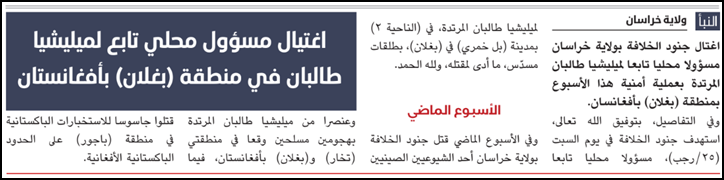
- “Assassination of a local Taliban official in the Baghlan district of Afghanistan.”
“The soldiers of the Caliphate in Khorasan Province assassinated a local official affiliated with the apostate Taliban militia in a security operation this week in the Baghlan region of Afghanistan. In the details, with the grace of Allah Almighty, the soldiers of the Caliphate targeted a local official affiliated with the apostate Taliban militia on Saturday (25 Rajab) in District Two [editor’s note: There is a discrepancy regarding which district this took place in; the Nashir claim alleged this took place in District One] of the city of Pol-e-Khomri in Baghlan with pistol bullets, which led to his death, praise be to Allah.”
- “Last week.”
“The soldiers of the Caliphate in Khorasan Province killed a Chinese communist and a member of the apostate Taliban militia in two armed attacks that took place in the Takhar and Baghlan regions of Afghanistan, while they killed a spy for Pakistani intelligence in the Bajaur region on the Pakistani-Afghan border.”
2. Pro-ISIS Online Chatter
- January 25: Pro-ISIS post on Telegram claiming that there was an “explosion inside the office” of the governor of Takhar province.
“Urgent. There was an explosion inside the office of the Taliban governor in the Afghan province of Takhar.”
- January 25: Pro-ISIS post on Telegram claiming that one person was killed and a Taliban vehicle was damaged when an explosive detonated in front of the office of the governor of Takhar province.
“Update. A person was killed and a vehicle belonging to the Taliban militia was damaged as a result of an explosive device that targeted a military vehicle in front of the governor’s office.”
- January 25: Pro-ISIS post on Telegram alleging that the Pakistani Taliban has been reckless in their social media use, allowing Pakistani security forces to locate them. The post compared this to ISIS-K, which was described as more “reserved.”
Text: “The Pakistani Taliban’s ubiquitous social media presence, which reveals almost everything, has made it easy for law enforcement to track them down, resulting in significant losses recently. In contrast, the strength of the Islamic State in Khorasan lies in avoiding detection through its extremely reserved online behavior.”
“Follow-ups. This is how a Pakistani journalist tweeted after a series of assassinations and arrests that recently targeted leaders and members of the Pakistani Taliban militia.”
- January 26: Pro-ISIS post on Telegram stating that several Pakistani soldiers, including officers, were killed or injured when a car bomb hit their bus on a highway in Balochistan. The post noted that two Pakistani military intelligence officials were either killed or wounded.
“Urgent. A car bomb explosion targeted a bus carrying Pakistani army soldiers and officers on its way to Rawalpindi from Khuzdar via the M-8 highway near Kohri in Balochistan, killing and wounding several bus passengers, including two Pakistani military intelligence officials, Naik Shiraz and Ahmad Raza.”
- January 26: Pro-ISIS post on Telegram stating that Taliban leaders met with the Iranian foreign minister in Kabul to discuss fighting ISIS-K.
“Follow-ups. A friendly brotherly meeting between the leaders of the Taliban militia and the Iranian foreign minister in the Afghan capital, Kabul, and the file of jointly combating terrorism tops the meeting’s agenda. How will you patch it, O patcher?”
- January 26: Pro-ISIS post on Telegram claiming that there was an unidentified explosion in Kabul.
“Urgent. An explosion rocks the Afghan capital, Kabul.”
- January 26: Pro-ISIS post on Telegram stating that a leader in the Democratic Ulema-e-Islam Party, Qazi Zahoor Ahmed, was killed in an attack with firearms in Khyber Pakhtunkhwa.
“Urgent. An armed attack targeted the leader of the Pakistani Democratic Ulema-e-Islam Party, Qazi Zuhur Ahmed, in Ahmed Khel in Peshawar, Khyber Pakhtunkhwa, which led to his immediate death.”
- January 26: Pro-ISIS post on Telegram containing a photo of Qazi Zahoor Ahmed.
“Update. Leader’s photo.”
- January 27: Pro-ISIS post on Telegram stating that a Pakistani government leader was killed by unidentified militants in Dera Ismail Khan.
“Urgent. Militants assassinate a local Pakistani government leader, Khair Mohammad [Wazir Torikhel], near Baloch Hotel on the border of Gomal University, North Waziristan [sic].”
- January 27: Pro-ISIS post on Telegram claiming that there was an explosion and attack on a Pakistani army camp by unidentified militants in Balochistan.
“Urgent. A car bomb explosion targeted a Pakistani army camp in Balochistan, followed by gunmen storming the camp.”
- January 27: Pro-ISIS post on Telegram stating that two men were killed in an attack in Khwaja Sabz Posh, Faryab. The post noted that one of the deceased “had recently returned from Iran to attend his son’s wedding.”
“Urgent. An armed attack targeted a motorcycle carrying two residents of the Khwaja Sabz Posh area in the Afghan province of Faryab, leading to their immediate death. It is worth noting that one of the dead had recently returned from Iran to attend his son’s wedding.”
- January 27: Pro-ISIS post on Telegram stating that Mullah Yaqoob, Taliban minister of defense, requested that Iran “provide him with intelligence and other comprehensive cooperation” in the fight against ISIS-K.
“#Report. The acting minister of national defense of the armed forces has asked the Iranian minister of foreign affairs to provide him with intelligence and other comprehensive cooperation in the fight against terrorism.”
- January 27: Pro-ISIS post on Telegram complaining that the Taliban protects religious minorities and allows them to worship but discriminates against Salafis.
“In Afghanistan, the Taliban allow you to freely practice your religion, whether you are a Buddhist, a Sikh, a Shiite, or a Sufi. But beware of following the Book [Quran] and the Sunnah. For by doing so, they will be cooperating with America against you.”
- January 28: Pro-ISIS post on Telegram claiming that the Taliban “renewed the imprisonment” of several residents of the province of Badakhshan for their affiliation with Salafism.
“Follow-ups. The Taliban militia renewed the imprisonment of several Badakhshan residents because of their affiliation with ‘Salafis’ according to its claim. They committed the following actions, and their sentence is as follows:
“1- Three months for those who raised their hands in prayer.
“2- Three months for those who said Amen out loud.
“3- Three months for those who put their hands on their chest.
“4- Three months for those who read behind the imam.
“5- Three months for those who stuck their feet together.
“This is after a previous report was submitted about them that they performed the Tarawih prayer last Ramadan with eight rakahs [prayer cycles].”
- January 28: Pro-ISIS post on Telegram claiming that the Taliban have stopped distributing the salaries of security personnel from public banks due to the fear of ISIS-K attacks on individuals standing in line. ISIS-K attacked Taliban members collecting their salaries at a bank in Kandahar on March 21, 2024.
“Monitoring. The Afghan Taliban militia, which always claims that it has cut off the terrorists as its masters, has decided to prevent the distribution of salaries of its security and military personnel in public banks for fear of terrorist attacks targeting militia gatherings.”
- January 28: Pro-ISIS post on Telegram stating that unidentified individuals killed members of the Pakistani intelligence services in Turbat, Balochistan.
“Urgent. For the second day in a row, assassinations continued to target members of the death squad of Pakistani intelligence. This attack targeted an element in the Bahman area of Turbat city in Balochistan.”
- January 28: Pro-ISIS post on Telegram stating that unknown individuals killed ten members of the same family in Alishiro district of Khost province. The motive for the murders is unknown.
“Urgent. Armed men stormed a house in the village of Bukhane, in the Alishiro district of the Afghan province of Khost, leading to the death of all ten family members. The motives for the attack are unknown.”
- January 28: Pro-ISIS post on Telegram stating that unidentified armed men in Lashkar Gah assassinated a former police chief who served in the Islamic Republic of Afghanistan.
“Urgent. Armed men on a motorcycle attacked the Helmand police chief in the previous regime, Faizullah Miraj, in Lashkar Gah city, killing him instantly.”
- January 29: Pro-ISIS post on Telegram claiming that there was an explosion in a hall in Kapisa province where Taliban religious scholars were meeting.
“Urgent. An explosion inside a hall where the so-called ‘scholars’ of the Taliban militia are meeting in the Afghan province of Kapisa.”
- January 29: Pro-ISIS post on Telegram stating that 13 people were killed in the attack on a house in the Alishiro district of Khost province the previous day. The post noted that the motive for the murders is still unknown and that there has been “media and public uproar.”
“Update. 13 people killed, media and public uproar in Afghanistan because of the attack, the motives of which are not yet known.”
- January 29: Pro-ISIS post on Telegram stating that four Taliban soldiers were killed in Kunduz province by an IED that targeted their vehicle.
“Urgent. Four Taliban militia members were killed in an IED explosion that targeted their vehicle in the Afghan province of Kunduz.”
- January 29: Pro-ISIS post on Telegram stating that unidentified individuals killed two brothers in Parwan.
“Urgent. An armed attack targeted two brothers in the Afghan province of Parwan, leading to their immediate death.”
- January 29: Pro-ISIS post on Telegram claiming that armed men entered six homes in Kabul and stole valuables, including “money, gold, jewelry, phones, and computers.” The post claimed that there is a lack of security due to the Taliban not instituting religious law.
“Follow-ups. Armed men seize money, gold, jewelry, phones, and computers after entering six houses in Security Zone 18 in the capital, Kabul, at the same time. Residents complain of a lack of security due to the Taliban’s non-deterrent sanctions.”
- January 30: Pro-ISIS post on Telegram claiming that the Taliban will hold a high-level meeting in Kandahar to create new policies that address the “requirements” of the Trump administration.
“Follow-ups. An expanded meeting led by a Taliban militia official will be held in the coming days in Kandahar to develop a new policy in Afghanistan that suits [President] Trump’s requirements.”
- January 30: Pro-ISIS post on Telegram claiming that the Taliban called for the meeting after Trump suspended funds to the Taliban. The post noted that counterterrorism funds were suspended due to the Taliban’s “failure to eliminate terrorism.”
“Update. The meeting came after Trump announced the suspension of financial aid to the Taliban militia, which was allocated to fight terrorism, due to the militia’s failure to eliminate terrorism.”
- January 31: Pro-ISIS post on Telegram stating that unidentified armed men kidnapped Samad Sherzad, a Shiite Hazara, who is the son of the former director of national security for the Miramor district in the government of the Islamic Republic of Afghanistan. The post claimed that Sherzad was kidnapped while attending a Taliban conference in Bamiyan.
“Urgent. Armed men kidnapped Samad Sherzad, a Shiite Hazara, and the son of the director of national security in the Miramor district in the previous government, while he was attending a security conference for the Taliban militia in the Afghan city of Bamiyan.”
3. ISIS Amaq/Nashir Statements
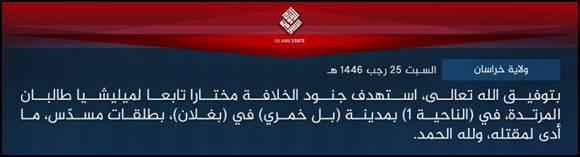
- January 25: ISIS claims to have killed a Taliban-affiliated village leader in Pol-e-Khomri, Baghlan.
“Khorasan Province. With the grace of God Almighty, the soldiers of the Caliphate targeted a mukhtar [village elder] affiliated with the apostate Taliban militia in District One of the city of Pol-e-Khomri in Baghlan, with pistol bullets, which led to his death, praise be to God.”
4. ISIS-K Linked Al-Azaim Web Magazine Voice of Khorasan Issue 43, Released on January 26, 2025
Please note that only relevant articles and infographics are included below.
Article 1: Who is the Shariah Ruler to Whom Obedience is Obligatory for the Ummah?
- The article calls for following the “rightful” caliph, the leader of the Caliphate.
- National leaders falsely claim to be legitimate rulers.
- Illegitimate leaders must be fought against.
- Rebellion against a ruler is mandatory if they do not rule according to the Quran, do not mandate prayer, do not uphold the religion, or become disbelievers.
- Obedience to rulers is only required when the ruler is just.
- The article lists the governments of Pakistan, Iran, and Afghanistan as being illegitimate and states that fighting against them is obligatory.
- The three governments “enforce democracy and man-made laws,” have altered religious law to suit their purposes, have created laws that are not religiously mandated, and have allied with Jews and Christians.
Infographic

Article 4: They Will See Soon
- The Los Angeles area wildfires are described as being divine punishment for Israel’s attacks on Gaza.
- This is presented as a modern example of Pharaoh’s army drowning in the Red Sea.
The article states that those who support the oppression of others or stay silent about it will be punished.
Article 7: Light of Darkness 5
- The article asks whether Telegram is safe to use despite recent policy changes and information sharing with law enforcement. The article concludes that Telegram is worth using with caution because of its privacy measures and capabilities, but added that features such as VPNs (Virtual Private Networks) should be used.
- The article warns that Telegram has provided IP addresses and telephone numbers in response to valid requests from governments since 2018.
- Other platforms, such as Signal, Threema, and WhatsApp, also turn over user data to governments in terrorism cases.
- Messaging apps commonly share data with governments. Even encrypted apps balance privacy with legal requirements.
- Signal, which is end-to-end encrypted, provides limited metadata to authorities but does not have access to actual conversations.
- Threema will provide data to Swiss authorities when presented with a valid request. The decentralized nature of the app means that the company can only turn over basic information and does not have access to metadata, contact lists, or the contents of conversations.
- WhatsApp is end-to-end encrypted and will turn over metadata, including IP addresses, contacts, and message time stamps. WhatsApp shares more information than Signal or Threema.
- RocketChat, as a decentralized platform, gives administrators the ability to set privacy levels.
- Facebook Messenger is not encrypted, and Meta will turn over metadata and the contents of conversations to the authorities.
- Telegram prioritizes transparency and minimizes data collection.
- User data is not used for advertising.
- Telegram stores minimal user data, including phone numbers, profile names, and profile photos.
- Messages and content, such as photos, are encrypted in the cloud.
- Secret chats, which are end-to-end encrypted, are not stored on Telegram’s servers.
- Data storage
- For European Economic Area users, Telegram stores information in data centers in the Netherlands. These data centers adhere to Europe’s General Data Protection Regulation (GDPR).
- Data outside of Europe is stored and encrypted in multiple countries. The article states that Telegram prioritizes privacy and security.
- Encryption
- User data is protected when it is transmitted and stored.
- Secret chats use end-to-end encryption, which means that only the intended users have the decryption keys. This provides the highest level of privacy on Telegram.
- Internal data sharing:
- Telegram may share data with its affiliated companies, Telegram Group Inc., Telegraph Inc., and Telegram FZ-LLC. Those firms are based in the British Virgin Islands and Dubai, United Arab Emirates, which have strict data protection laws.
- User control and settings.
- Users can select the amount of privacy they want through the settings feature.
- Users can delete their accounts and associated data.
- How safe is user data on Telegram?
- Data in the Telegram cloud is encrypted and shared in multiple data centers for extra security.
- Secret chats use end-to-end encryption, which means that only the intended recipients can decode the encrypted messages. This includes photos and videos. Telegram does not have the capability to decrypt messages in secret chats.
- Telegram restricts access to data centers.
- Telegram bans accounts that:
- Violate community guidelines, such as sharing ISIS propaganda. To avoid this, share content via file-sharing sites such as idocu.xyz, Mediafire, Files.Fm, PasteThis.To, etc.
- Have been reported by other users. To avoid this, do not participate in potentially spamming behavior.
- Have suspicion login attempts, such as logins from multiple locations or using third-party apps. To avoid this, only log in using the Telegram app and use two-factor authentication.
- Overuse features, such as excessive channel creation or sending bulk messages. To avoid this, be aware of use and observe a cool-down period.
- Telegram also bans accounts that:
- Have not logged in for six months.
- Spam other users.
- Belong to chats or channels that have been banned.
- Promote illegal activities.
- Use banned stickers.
- Use bots inappropriately.
- If your account has been banned, you can appeal to the Telegram abuse e-mail address, wait for temporary restrictions to end, or create a new account with a new phone number.
- Is Telegram still a good choice?
- Telegram is transparent about its policy changes and how it cooperates with law enforcement.
- Telegram allows customizable privacy features.
- Limited data retention.
- Telegram offers the best capacity for group chats and file sharing and provides the best channel options.
- The lack of an ad model means that Telegram collects less data on users than other platforms.
- Online security can be increased by using a VPN and not sharing phone numbers or locations with other users.
Request for Monero.
Final page commemorating attacks by ISIS supporters and encouraging additional attacks.
Stay up to date on our latest news.
Get the latest news on extremism and counter-extremism delivered to your inbox.